Natural Gas, Crude Oil
August 20, 2026
INDIA CEO SERIES: Oil India steps up domestic offshore drive, targets selective overseas assets

Editor:
HIGHLIGHTS
Focus on Krishna-Godavari, Cauvery, Mahanadi, Andaman basins
Government’s offshore funding support to help cut exploration risks
Numaligarh Refinery expansion nearing completion
The India CEO Series by S&P Global Energy is a compilation of exclusive interviews by Asia Energy Editor Sambit Mohanty with some of the leaders of the biggest energy companies in India.
Oil India Ltd. will pursue domestic offshore exploration in high-risk basins while selectively expanding overseas upstream assets to secure reliable equity hydrocarbons, as the state-owned company seeks to balance energy security with portfolio diversification amid shifting global energy dynamics, its Chairman and Managing Director Ranjit Rath said.
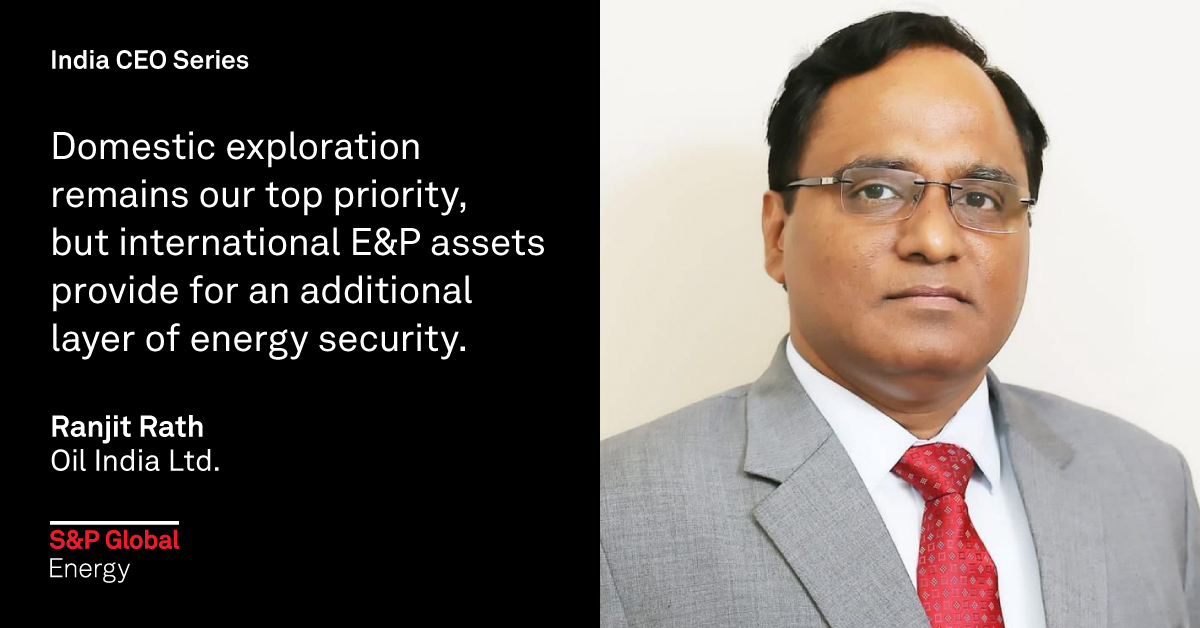
"Domestic exploration remains our first priority, but international E&P assets provide portfolio diversification, access to larger resource bases, technology exposure, and an additional layer of energy security. We view these two pillars as complementary objectives," Rath told Platts, part of S&P Global Energy, in an exclusive interview for the India CEO Series.
The shifting geopolitical landscape is redefining global energy dynamics, with energy security now focused on securing long-term, reliable equity hydrocarbons rather than solely market access, he said.
At home, Oil India is deepening exploration in frontier offshore areas, including the Krishna-Godavari, Cauvery, Mahanadi, and Andaman basins, where much of India's future hydrocarbon potential lies, Rath said. The government's National Offshore Exploration Scheme, called Samudra Manthan, offers financial support of up to 50% of deepwater exploration drilling costs, helping to cut risks associated with wells that can cost $125-$150 million each, he added.
The Indian cabinet in late July approved investments of up to 840 billion Indian rupees ($8.8 billion) over five years to advance offshore oil and gas exploration under the scheme. The initiative is expected to catalyze reserve accretion of over 600 million mt of oil equivalent by fiscal 2030-31, the petroleum ministry said July 31.
"Recognizing the high-risk, high-cost nature of such exploration, the government is adopting a risk-sharing approach to encourage sustained investment, accelerate exploration, and unlock India's offshore hydrocarbon resources," Rath said.
He said higher oil and gas prices give the company a cash flow cushion to allocate more capital to exploration.
"However, our risk appetite is not being driven by price alone. We are consciously moving from a conservative, mature-basin-led model to a portfolio-led exploration strategy -- one that combines near-field monetization, deeper plays in producing basins, and high-impact offshore opportunities in frontier and emerging basins," he added.
Strategic push
In 2025-26 (April-March), Oil India drilled 74 exploration and development wells and maintained a domestic reserve replacement ratio of more than one. It also achieved its highest-ever daily oil production of 84,817 barrels/day on Aug. 2, 2026, Rath said.
The company is pursuing larger, better-evaluated exploration acreages where risk can be reduced through superior data, technology and partnerships. It is engaging global technology leaders and international oil companies for seismic design, processing and interpretation, and high-impact prospect evaluation.
"Our collaboration with TotalEnergies for offshore exploration and technical support is a case in point. This allows Oil India to retain its strategic operatorship and national energy-security focus, while bringing in world-class capability where geological risk and capital intensity are highest. The macro environment has made our approach disciplined: pursue bigger opportunities, use better data, partner selectively, and convert today's favorable cycle into long-term domestic resource security," Rath said.
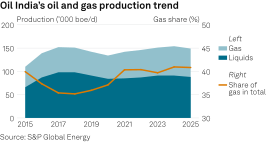
He said that while natural decline is an inherent characteristic of aging reservoirs, a substantial volume of hydrocarbons remained unrecovered.
Oil India is deploying advanced reservoir characterization, integrated subsurface modeling, sophisticated seismic interpretation, targeted infill drilling, intensified workover operations, and enhanced reservoir management, alongside recovery techniques including low saline water injection, polymer injection, and cyclic steam stimulation, to identify and extract bypassed and stranded hydrocarbons, he said.
Rath said Oil India is expanding into frontier areas with significant resource potential, highlighting the offshore exploration program in the Andaman & Nicobar Basin, where natural gas has been found in two of three exploratory wells drilled to date, confirming an active petroleum system and validating the basin's prospectivity.
"We are recognizing that future discoveries will increasingly come from technically complex environments," he said.
Rath said Oil India's overseas ambition was to build a balanced and resilient international portfolio focused on high-potential hydrocarbon provinces.
"We are actively evaluating opportunities that offer scale, resource longevity, and strategic alignment with India's long-term energy requirements. At the same time, we remain disciplined in capital allocation and are selective in pursuing opportunities where geological potential, fiscal terms, and risk-reward economics are attractive," Rath said.
Downstream expansion
The expansion of Oil India's Numaligarh Refinery Ltd., or NRL, is strategically important because it provides the group a more integrated position across the hydrocarbon value chain, Rath said.
"While the company's upstream business remains focused on growing reserves and production, NRL provides a natural hedge against commodity cycles by balancing exposure across both crude production and refining. This strengthens earnings resilience and reduces dependence on any single segment of the energy value chain," Rath said.
He said the commissioning process of NRL's expanded 9 million mt capacity is ongoing. The crude distillation unit and vacuum distillation unit are scheduled for commissioning during August-September 2026, and the crude oil pipeline by October-November 2026, while the overall refinery is scheduled for commissioning by March-April 2027.
"NRL will follow a diversified sourcing strategy focused on securing reliable and economically competitive feedstocks. The objective is to maintain flexibility in crude selection, optimize refinery margins, and adapt to evolving product demand patterns. For the upgraded refinery, a 1,635 km pipeline is being laid to procure imported crude from the Paradip port," Rath said.
