Refined Products, Crude Oil
August 19, 2026
Iraq approves oil exports via local and international traders as of Sept. 1
Editor:
HIGHLIGHTS
More transport routes also approved
Iraq is OPEC's No. 2 crude producer
Iraq's council of ministers has approved the export of Iraqi oil through various global and domestic companies, effective Sept. 1, the official state-run Iraqi News Agency reported Aug. 19, citing a statement from the prime minister's media office.
Currently, all of Iraq's oil exports are carried out by the state marketing organization, SOMO. Iraq is OPEC's second-largest crude producer, with output of 2.6 million b/d in July, according to the latest Platts OPEC+ survey by S&P Global Energy.
As part of the government's measures to increase export and import capacities, the ministers approved the purchase of crude oil at a 30% discount to either the price set by SOMO or the price stipulated in the federal budget, whichever is lower and determined on an annual basis, effective Sept. 1, according to the statement.
SOMO wasn't immediately available to comment on the matter.
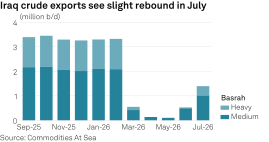
Iraq's crude sector has faced declining output with the Iran war and the subsequent near-closure of the Strait of Hormuz. Iraq pumped 3.22 million b/d in February, prior to the Iran conflict.
Iraq nationalized its oil industry in 1972 and, in 1998, SOMO was designated to focus on marketing Iraqi oil and surplus refined oil products, according to the company's website. In 2003, authority was extended to include imports of oil products.
Iraq's Basrah Medium grade crude was assessed by Platts at $63.48/b on Aug. 18, down from a recent high of $110.65/b on April 7.
Iraq has been on a drive to attract investment since the election of Prime Minister Ali al-Zaidi in May.
During an Oval Office meeting in July with Al-Zaidi, US President Donald Trump said that US "oil companies are going in there at levels that have never been seen before," adding that Iraq has "tremendous potential, because of oil."
In addition to new US upstream investment, the country has been seeking to diversify its crude export routes, including a pipeline to Syria's Banias port and another from Basrah to Ceyhan via Kirkuk, according to Iraq's oil ministry.
More outlets
According to the statement from the prime minister's office, Iraq's council of ministers has also authorized the oil minister to establish additional transportation routes for oil exports and imports, without being more specific.
The oil minister was also authorized to approve the import of petroleum products.
In addition, state-owned Oil Pipelines Co. has been given permission to expand loading platforms, according to the statement.
Approval was also given to start work on the rehabilitation of the IT2A station and an auxiliary unloading station for the IT1 station with a capacity of 300,000 b/d, the statement said. The pumping stations are part of the Iraq-Turkey pipeline, which transports crude oil from the fields of northern Iraq to the Turkish Mediterranean port of Ceyhan.
The work is intended to encourage "rapid supply of imported raw materials without compromising the principles of competition and transparency," it said.