Electric Power, Refined Products, Energy Transition, Agriculture, LNG, Natural Gas, Diesel-Gasoil, Fuel Oil, Hydrogen, Biofuels
August 18, 2026
INDIA CEO SERIES: Shell targets diverse fuel mix for energy security, transition amid shifting flows

Editor:
HIGHLIGHTS
Strait of Hormuz risks highlight need for supply resilience
Global portfolio flexibility helps manage India supply volatility
Deploying AI to optimize retail operations, asset maintenance
The India CEO Series by S&P Global Energy is a compilation of exclusive interviews by Asia Energy Editor Sambit Mohanty with some of the leaders of the biggest energy companies in India.
Shell is accelerating its diversified energy strategy in India as geopolitical risks highlight the need for supply chain resilience to balance energy security with the transition to lower-carbon fuels, according to Mansi Madan Tripathy, chairperson, Shell Group of Companies India, and senior vice president for Shell Lubricants in Asia-Pacific.
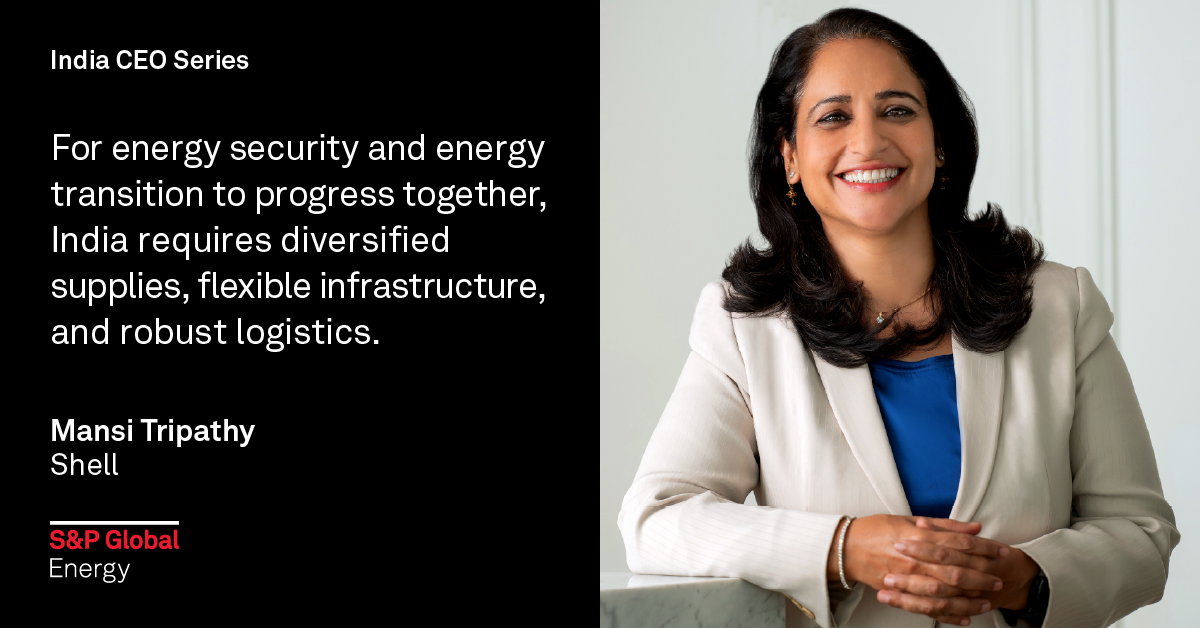
"The broader lesson is that energy security and the energy transition must progress together. For India, this will require diversified sources of supply, flexible infrastructure, robust logistics and market mechanisms that can adapt to rapidly changing global conditions," she told Platts, part of S&P Global Energy, in an exclusive interview for the India CEO Series.
Shell's global portfolio, robust trading capabilities and access to multiple supply sources provide flexibility in managing market volatility, a strength particularly important for India's fast-growing energy market, she said.
Shell's expanded global LNG supply and regasification infrastructure have bolstered market resilience and mitigated the effects of shipping disruptions through the Strait of Hormuz, underscoring the critical role of diversified supply sources, flexible infrastructure, and robust global networks, Tripathy said.
"During recent supply disruptions in the Middle East, Shell drew on the flexibility of its global LNG portfolio to bring additional gas into India. We significantly increased the number of LNG cargoes delivered to the country, supporting efforts to stabilize the energy system and maintain feedstock availability for fertilizer production, which is critical to India's food security," she said.
India's energy demand has grown nearly 40% over the past decade due to rapid economic and population growth. The country's role in global energy will expand, with energy demand surpassing the US in the 2040s and China in the 2060s, she added.
Shell operates the 6 million metric tons/year Hazira LNG regasification terminal and is aligning with government goals by supplying gas across various sectors. Its investments, such as the Hazira terminal, along with expertise in small-scale LNG, including truck-loading units, are improving access for off-grid industrial clusters and supporting decarbonization across various sectors, she said.
"LNG can play an important role in providing flexibility, reliability and security of supply as energy demand grows. Gas can also support the growth of renewable energy by providing flexibility to the broader energy system and can help reduce emissions when it replaces coal in industry and power generation, or diesel and fuel oil in heavy-duty transport and shipping," Tripathy added.
India's ambition to increase the share of natural gas in its energy mix will require greater market access and strong collaboration across industry and government, she said.
Diversified footprint
Shell's India footprint spans across LNG, lubricants, mobility and technology. The company operates more than 325 retail fuel outlets and offers electric vehicle recharge facilities. Its recent acquisition of Raj Petro Specialties Pvt. Ltd, a Mumbai-based specialty oil and lubricant manufacturer, strengthened its lubricants portfolio, Tripathy said.
She added that Shell remained committed to supporting the energy transition and to investing where it had strong capabilities, clear customer demand, and a pathway to sustainable value creation.
On July 13, Shell announced it will divest its Indian solar and wind power unit, with Shell Overseas Investment B.V. agreeing to sell 100% of Solenergi Power Private Ltd. -- including the Sprng Energy group -- to Aditya Birla Renewables Ltd. for $1.8 billion.
The decision to divest Sprng Energy reflects Shell's continued focus on high-grading its power portfolio and recycling capital in support of the asset-backed trading strategy, Tripathy said.
Exploring new opportunities
India's ambitious green hydrogen plans position the fuel as a critical enabler of the energy transition, with potential to decarbonize hard-to-abate sectors including chemicals, oil refining, steel, commercial road transport, aviation and marine.
"Globally, Shell sees opportunities across the hydrogen supply chain, including production, storage, shipping and end-customer solutions. In India, we will continue to evaluate opportunities where hydrogen can become a credible and scalable solution, particularly where there is strong customer demand, supportive policy, and the right infrastructure," Tripathy said.
Biofuels and other lower-carbon fuels are crucial for sectors requiring high energy density, reliability and affordability, with India's biofuel policies and ethanol-blending program providing clearer market signals and fostering the growth of lower-carbon fuel alternatives, she added.
Tripathy said artificial intelligence has been fundamentally altering the energy sector, and Shell has been deploying AI to optimize its downstream retail business, asset maintenance and supply chain logistics. In downstream retail, Shell has been using data-led insights to improve customer engagement and support more informed decision-making.
AI-driven asset maintenance by Shell's India teams leverages machine-learning models to analyze sensor and operational data from compressors, pumps and turbines, enabling early issue detection, reduced unplanned downtime, optimized maintenance planning and lower operating costs, she said.
"At Hazira, the Smart Torque System enhances flange management by ensuring the correct torque is applied and tightening sequences are followed precisely, helping prevent leaks and mitigate related safety and operational risks. The system also captures historical torquing data, enabling effective investigation and traceability should a leak occur," Tripathy added.
