Refined Products, Crude Oil, Chemicals, Energy Transition, Natural Gas, LNG, Agriculture, Renewables, Hydrogen, LPG, Biofuels
August 17, 2026
INDIA CEO SERIES: IOC charts growth path with refining expansion, petrochemicals, clean fuels

Editor:
HIGHLIGHTS
IOC's refining capacity to rise 19% by next year
Company exploring crude trading unit, to boost LPG storage
SAF, biogas, solar part of 2040 diversification strategy
The India CEO Series by S&P Global Energy is a compilation of exclusive interviews by Asia Energy Editor Sambit Mohanty with some of the leaders of the biggest energy companies in India.
Indian Oil Corp. plans to increase its group refining capacity by 19% and expand into petrochemicals and renewable fuels as it seeks to grow its share of the country's energy market to 12% from 9% by 2040, said its Chairman Arvinder Singh Sahney.
"Our group's refining capacity, which includes Chennai Petroleum Corp., will be close to 100 million mt by next financial year, rising from about 84 million mt. Beyond that, we will have to assess if we need more refining capacity, depending on how demand as well as the energy landscape evolve," Sahney told Platts, part of S&P Global Energy, in an exclusive interview for the India CEO Series.
The diversification strategy comes as the state-owned refiner balances robust demand for traditional fuels with the need to adapt to a changing energy landscape, as India is poised for exponential growth in consumption of both traditional and alternative fuels over the next two decades, he added.
According to S&P Global Energy CERA, India's refining capacity will reach 5.85 million barrels/day at the end of 2027, up 0.6 million b/d from 2025. IOCL's capacity addition in Panipat, Koyali, and Barauni will be the major contributors to this, adding 346,000 b/d to the nation's capacity.
"With our ongoing refining expansions and the recent commissioning of HRRL, we will already be having a surplus of oil products in the country," Sahney said.
HPCL Rajasthan Refinery Ltd. -- an integrated refinery and petrochemical complex with a capacity of 9 million metric tons/year and 2.4 million mt of petrochemicals capacity -- began operations July 4.
India's oil and gas demand is projected to stay strong through this decade and into the next, as continued use of two-, three-, and four-wheelers over the next 15-20 years will sustain high fuel consumption despite rising electric vehicle adoption and alternative energy sources, Sahney said.
"The growth rate in fuel demand may eventually plateau, but even with that, I will still be selling the same amount of oil products twenty years from now that I am selling today," he added.
Sahney said that the petrochemicals expansion was a strategic priority as the sector is expected to account for over 10% of global oil demand growth, and India is emerging as a key consumption hub.
Oil will remain vital to India's energy security, but refinery decarbonization is now a strategic priority, with measures such as boosting energy efficiency, shifting from liquid fuels to natural gas, expanding renewable power use, integrating compressed biogas, electrifying processes, and gradually adopting green hydrogen, Sahney said.
Oil trading, LPG storage
IOC is also aiming to establish a crude and refined products trading unit to diversify its business and capitalize on global arbitrage opportunities, following the model of international oil majors with dedicated trading units, Sahney said.
"It is a natural progression for any oil and gas company. We are looking at that option. We have not finalized the partner yet," Sahney said.
Expanding LPG storage infrastructure has become a strategic priority following the recent Middle East conflict and the disruption of the Strait of Hormuz, the maritime corridor through which the bulk of India's LPG imports flow, Sahney said.
"LPG gave us some stress during the conflict. We are working on plans to expand LPG storage. That should help us to avoid any stress in the future," he added.
India's underground storage capacity is limited to two caverns with a combined capacity of about 140,000 mt. Combined with above-ground storage, these facilities provide roughly 22 days of supply cover.
India could add about 410,000 mt of overall LPG storage capacity over the next two to three years to bolster strategic reserves and safeguard against market disruptions, according to CERA.
In the April-June quarter, IOC substantially increased its reliance on spot crude purchases 84%, compared with 51% in the corresponding period last year, a senior company official said during the company's post-results investors' call July 31.
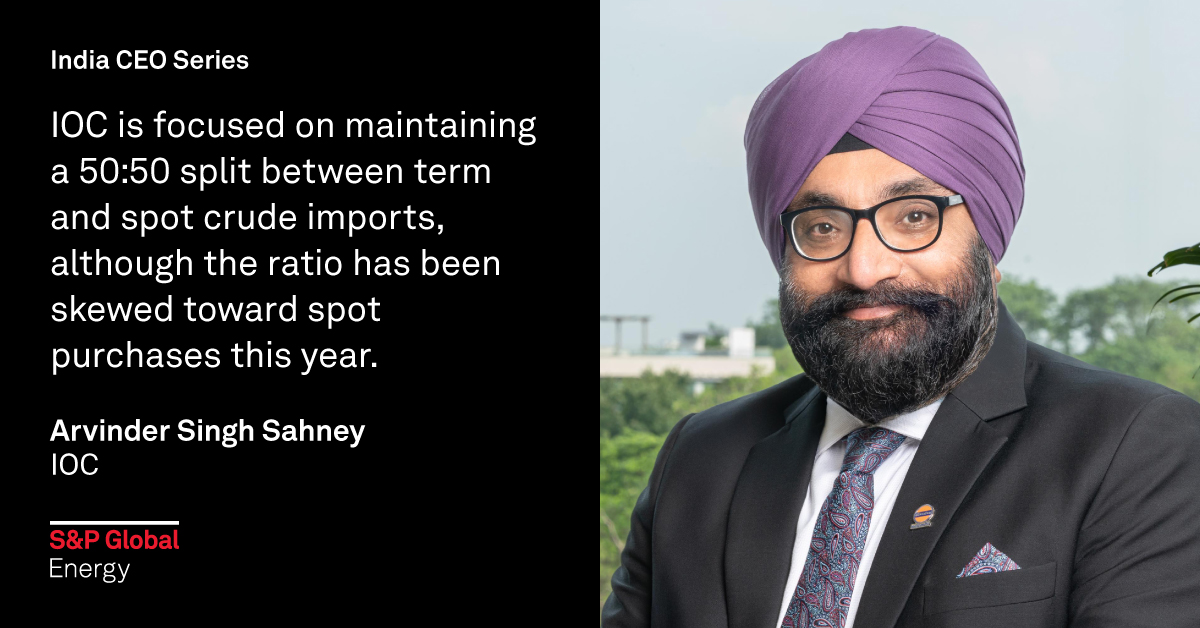
"IOC is focused on largely maintaining a balanced 50:50 split between term and spot crude imports, although the ratio has been skewed toward spot purchases this year due to geopolitical tensions in the Middle East. The company's flexible sourcing strategy -- opting to procure crude from wherever it is commercially viable -- helped to keep its refineries running at optimum capacity despite supply challenges," Sahney said.
IOC, whose term contracts are primarily with Middle Eastern and West African suppliers, is actively seeking to expand purchases from Brazil and South America—including Venezuela—to diversify sourcing and enhance operational resilience and market competitiveness, he added.
Biorefinery, hydrogen
Sahney said that IOC was working on plans to set up a biorefinery and was looking for partners. "It is on the drawing board now, but our next refinery will be a biorefinery."
Hydrogen stands out as a particularly promising area for IOC's future growth, Sahney said. "The key challenge lies in reducing the cost of production, whether hydrogen is generated through electrolyzers or bio-sourcing methods."
With India's energy consumption projected to rise substantially, IOC will need to expand its portfolio to retain market share, and reaching the 12% target will demand further investment and a wider array of energy products, Sahney said.
"This diversification will not be limited to conventional energy sources, which have historically contributed around 95% of Indian Oil's revenue. The company is actively expanding into areas such as compressed biogas, LNG, sustainable aviation fuel, and renewable energy sources, like solar," Sahney said. "By 2040, these new energy offerings are expected to contribute approximately 30%-35% of the company's revenues."
