Maritime & Shipping, Crude Oil, Wet Freight
August 12, 2026
Russia threatens to seize EU ships in sanctions retaliation, plans further Arctic shipping
By Max Lin and Alexandra Vladimirova
Editor:
HIGHLIGHTS
New EU rules allow sales of oil seized from sanctioned ships
China, India interested in developing NSR: Russia
Russia could seize EU-linked ships in retaliation for the bloc's sanctions enforcement against the country's oil trades, while continuing to develop Arctic shipping, President Vladimir Putin said Aug. 12.
On July 23, EU member states agreed to their 21st package of sanctions against Russia that grants each of them the legal right to confiscate Russian oil on sanctioned ships and sell the cargo.
"This amounts to nothing less than piracy and banditry," Putin said during the Russian Pacific Fleet's drills.
"Should this be put into practice, we will be compelled to respond in kind — and not necessarily in the specific waters where raids on our ships and vessels are planned, but wherever we deem it necessary and appropriate, including within the area of responsibility of the Pacific Fleet."
Some individual EU countries have occasionally boarded or detained ships suspected of transporting sanctioned Russian oil since Russia's full-scale invasion of Ukraine in 2022, mostly in the Baltic and North Sea, often on environmental grounds.
This year, EU navy forces have started to board and inspect sanctioned tankers servicing Russian oil trades for their flag status in the Mediterranean and planned to take similar actions in the Western Indian Ocean and in the Red Sea.
"We see that the authorities of certain countries, in violation of international maritime law, are attempting to restrict the movement of vessels belonging to our economic operators," Putin said.
Between April 24 and Aug. 6, some 379 of the 1,001 vessels passing through Russia's Exclusive Economic Zone were flying the flags of "unfriendly states", Russian Pacific Fleet Commander Viktor Liina said.
"At the same time, Western nations are actively utilizing vessels flying the flags of third countries to transport cargo in their own interests. In essence, this constitutes their 'shadow fleet,'" Liina added.
"We possess the capabilities to inspect and detain vessels belonging to unfriendly states and their shadow fleets."
Arctic routes
Separately, Russia hopes to expand the use of Arctic sea trade lanes with China, India and other countries for its logistics capacity, Putin said.
"They are discussing these issues with us, and we would certainly welcome joint efforts," Putin added.
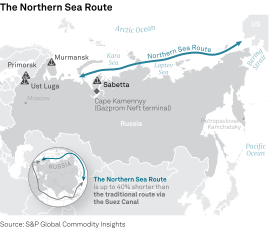
Tanker transit time from Russia's western oil hubs to East Asia via the Suez Canal usually amounts to six weeks or more, while the Northern Sea Route, which usually opens between July and October/November when sea ice conditions allow, can theoretically reduce the voyage time by up to 40%.
Crude and condensate loadings from Russian Arctic ports amounted to 26.9 million barrels in June and July, up from 20.4 million barrels in the same period of 2025, according to S&P Global Commodities at Sea. China and India are among the top destinations.
Alternative supply routes such as the NSR should be developed in response to ongoing logistical risks in the Middle East, Rosneft CEO Igor Sechin said during the company's annual shareholder meeting June 19.
Shipping consultancy Windward on Aug. 9 said an "unprecedented convoy" of eight Russia-linked sanctioned tankers was sailing through the sea route, comprising one Suezmax, four Aframaxes, and three MR tankers.
"The convoy reflects a deliberate Russian strategic shift to route oil shipments through Arctic waters to avoid European naval enforcement and flag verification boardings in the English Channel and Mediterranean," Windward said in a note.