Maritime & Shipping, Crude Oil, Wet Freight
August 10, 2026
CPC crude loadings recover as high tanker rates entice shipowners
HIGHLIGHTS
Exports recover to 1.41 million b/d in past week
High freight rates lure tankers despite risks
Ukraine pledges to spare non-Russian vessels: report
Crude loadings from the Caspian Pipeline Consortium terminal have recovered since late July, according to cargo-tracking data, as high freight premiums entice more shipowners to trade in the region despite heightened risks.
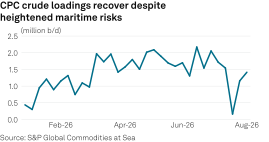
In the week from Aug. 3, S&P Global Commodities at Sea data shows 1.41 million barrels/day of crude were lifted from the CPC terminal at the Russian Black Sea port of Novorossiysk.
Comparatively, 1.16 million b/d was lifted during July 28-Aug. 2 and 163,000 b/d was lifted during July 21-27, a year-to-date low, as CPC reported multiple loading suspensions in July following tanker attacks.
Worse security conditions added risk premiums to freight rates in the Black Sea tanker markets, which in turn lured some risk-tolerant shipowners even as others stayed away, Gibson Shipbrokers said in a recent research note.
"The number of vessels working the region has risen, with the growing freight premium drawing more owners into the trade," Gibson added.
Platts, part of S&P Global Energy, assessed the time-charter-equivalent earnings of a non-eco, non-scrubber Suezmax transporting non-Russian crude from Novorossiysk to Trieste at $469,130.02/day on Aug. 10, the highest since the assessment was launched in December 2024.
Platts' Global Suezmax Index — a weighted average of Suezmax earnings in main trades across the globe — stood at $160,070/d on Aug. 7.
Risk environments
CPC, whose shareholders are Transneft, KazMunayGas and Chevron, among others, serves as the main export network for Kazakhstan's oil production.
Crude exports from the CPC terminal have averaged 1.43 million b/d so far this year, of which 94% were Kazakh-origin and the remainder were Russian-origin, according to CAS.
Gibson said that recent disruptions at the terminal only lasted for days, but that a prolonged strike campaign targeting tankers could be negative for shipowners by leading to a long-term decline in export volumes.
CPC and Chevron together reported seven tankers — some operated by Greek companies — that were trading at the terminal were attacked in July. The Security Service of Ukraine then separately said another three ships were hit as part of its campaign against Russian energy assets. Nearly all of the ships were Suezmaxes.
The incidents were part of "a major escalation in the Russia-Ukraine maritime conflict" as "both sides increasingly targeted merchant vessels and maritime infrastructure," security consultancy Vanguard TECH said in a monthly report.
Ukraine has pledged to the US not to attack non-Russian tankers and Black Sea energy infrastructure serving Kazakhstan's energy exports, Bloomberg reported Aug. 8, citing an unnamed US official.
A source familiar with the issue confirmed the report.
In a recent interview with state-run Anadolu Ajansi, Turkish Foreign Minister Hakan Fidan said Russia and Ukraine had both targeted civilian logistics facilities, including Turkish ships.
"We have called on both sides to recognize a moratorium on attacks on civilian shipping," Fidan said.
An official from Turkey's Directorate General of Coastal Safety, who spoke on condition of anonymity, told Platts that Ankara did not impose any traffic restrictions on maritime traffic through the Turkish straits in response to regional tensions.
