Maritime & Shipping, Crude Oil, LNG, Wet Freight
August 07, 2026
G7 tankers’ share in Russia hits one-year high in July on higher Greek shipments

By Max Lin
Editor:
HIGHLIGHTS
Greek operators boost shipments to three-year high
Urals fell below EU, US price cap in early July
Shadow fleet faces tighter sanctions, scrutiny
Share of Russian crude exports on G7-linked tankers rose to the highest level in a year in July, with Greek operators increasing their shipments amid an earlier oil price retreat.
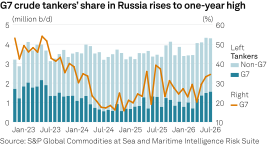
Tankers flagged, owned or operated by companies based in G7 countries and their allies, or insured by Western protection and indemnity clubs, lifted 36.2% of Russia's crude exports of 4.3 million barrels/day in July, according to S&P Global Commodities at Sea and Maritime Intelligence Risk Suite data.
The proportion, which has grown for four consecutive months, was the highest level since July 2025 and up from 34.4% in June.
Driving the increase were Greek tanker operators, whose liftings rose from 24.9 million barrels in June to 26.4 million barrels in July, the highest monthly volume in nearly three years and maintaining their pole position in the Russian market.
Platts, part of S&P Global Energy, assessed the monthly average free-on-board Primorsk price for Urals -- Russia's flagship crude -- at $52.927/barrel in July, a five-month low and down from $60.297/b in June.
Urals crude prices fell to as low as $39.72/b on July 2 amid receding supply fears during an earlier US-Iran truce, but have since recovered to $61.475/b on Aug. 7 after the peace agreement fell apart.
Price weakness would provide more opportunities for compliant trades, as the US has allowed tanker operators to ship Russian crude when the price is below $60/b and the EU, UK and Canada set the threshold at $47.6/b.
In recent months, Greece -- the top EU shipowning nation -- has become increasingly vocal in its doubt over the bloc's sanction rules during diplomatic negotiations.
The Greek government reportedly managed to carve out a one-year allowances for LNG shipping under the EU's 21st package of sanctions last month in exchange of agreeing to free the Russian crude price cap, supposed to increase by more than $10/b based on prevailing market rates amid the Hormuz shipping crisis.
Union of Greek Shipowners, the industry associating representing the country's shipping companies, has argued sanctions laws would create unfair competition while pledging Greek companies would not transport oil outside of the price cap.
Transporting Russian oil is often more lucrative due to premiums associated with higher legal and operational risks.
Platts assessed the time-charter-equivalent earnings for an Aframax shipping from Ust-Luga to Sikka at $88,069.74/d on Aug. 6, compared with the Global Aframax Index for non-eco, non-scrubber ships at $73,671.55/d.
Shadow operations
Non-G7 ships were mainly from of the shadow fleet, whose size, based on S&P Global Energy CERA's estimates, reached 2,083 oil tankers confirmed or suspected to have violated sanctions as of the end of June.
"The majority of these vessels continue to be linked to the Russian oil trade, with a significant concentration in the Aframax/LR2 and Suezmax segments," according to a research note from CAS.
The CASR and MIRS data showed non-G7 ships were often operated by companies based in Mainland China, Hong Kong, Russia and the UAE, whose total liftings amounted to 73.5 million barrels in July.
But shadow fleet operations have faced more constraints in recent months, with tightening sanctions and flagship clampdowns.
In June, the International Maritime Organization published the Guidelines on the Registration of Ships as an initial step to improve transparency and due diligence in flag registration, which recommended measures including sanction cross-checks.
The UN agency's member states have expressed concerns over fraudulent registration in recent years. This year alone, seven countries -- including Cameroon and the Cook Islands -- have told the IMO that 115 ships with a total carrying capacity of 9.78 million deadweight tons were removed from their flag registries or wrongly claimed to be flagged with them.
A Platts review of their circular letters shows 105 of the ships were oil, gas or chemical tankers, while 108 were designated by Western authorities, underlining the overlap between false-flag concerns and sanctioned oil shipping.
