Refined Products, Crude Oil, Gasoline, Diesel-Gasoil, Naphtha, Fuel Oil
August 05, 2026
Russian oil product exports hit decade low in July amid Ukraine strikes
By Thomas Washington and Max Lin
Editor:
HIGHLIGHTS
Ukraine strikes cut refining by over a third
Russia imports fuel from Kazakhstan, Belarus
Crude exports to India fall 58% MOM
Russian seaborne exports of petroleum refined products fell to the lowest in at least 10 years in July, while crude exports remained high, despite falling from a June peak, according to cargo-tracking data, as Ukraine continued strikes on Russian refining infrastructure.
In July, Russia's product exports fell to 1.18 million barrels/day from 1.51 million b/d in June and the lowest since the record began in 2016, preliminary data from S&P Global Commodities at Sea showed Aug. 4. The data may be revised later.
Ukrainian drone strikes have taken a significant toll on Russian refining operations, knocking out over a third of the country's capacity and causing crude runs to fall below 4 million b/d, the lowest in more than two decades, analysts at CAS said.
The resulting domestic fuel shortages have prompted the Russian government to implement an export ban on diesel over July 8-31, which has been extended until January 2027. However, an exception will start in September, when refiners will be able to export gasoil again.
"In a notable reversal of its traditional role as a major exporter, Russia has begun importing refined products from neighboring Kazakhstan and Belarus, including seaborne procurement of gasoline from India, to address its domestic shortfall," CAS analysts said.
Russia's gasoil/diesel loadings for international fell 157,000 b/d in July from 471,000 b/d in June, according to CAS. Naphtha exports reached 290,000 b/d, down 9% from June.
Platts, part of S&P Global Energy, launched several new assessments for shadow fleet freight routes on Aug. 3. Platts estimates that tankers associated with shadow fleet activity now represent about 22% of the global fleet, with most linked to crude and refined product flows originating in Russia.
Platts assessed the time-charter-equivalent earnings to carry refined products on a Medium Range tanker, burning very low sulfur fuel oil, from the Baltic port of Primorsk to Mersin at $16,261/day on Aug. 4. Platts assessed the TCE to carry clean products on a non-scrubber-fitted, non-eco MR burning VLSFO from Ust-Luga to Santos at $18,931/day.
Crude shipments
Russia's crude exports remained high in July despite falling from the June peak as reduced domestic refinery runs increased availability for overseas buyers.
Seaborne exports of Russian crude were 4.321 million b/d in July, down 7% from June, but up 26% year over year and the second highest monthly reading in 2026, preliminary CAS data showed.
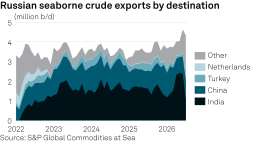
Preliminary data showed Russia exported 994,000 b/d to India in July, down 58% month over month and 39% year over year. In contrast, Russia exported 1.017 million b/d to China, up 18% month over month and 12% year over year.
Exports to Singapore surged 112% month over month to 456,000 b/d in July. The figures included ship-to-ship transfers in Southeast Asian waters, which have increased amid renewed pressure from Western sanctions.
The European Commission formally adopted its latest sanctions package against Russia June 23, which includes measures to clamp down on offshore tanker transfers of Russian oil and a ban on Russian crude flows via the northern branch of the Druzhba pipeline. The US waiver for oil on water, extended several times by the US Treasury Department since the start of the Middle East war, expired June 17.
Platts assessed the TCE to carry crude from Russia's Baltic Sea port of Ust-Luga to Sikka on a non-scrubber-fitted, non-eco Aframax burning VLSFO at $86,489/day on Aug. 4. Platts assessed the TCE to carry crude on a non-scrubber-fitted, non-eco Suezmax burning VLSFO from Novorossiysk to Vadinar at $245,804/day.
