Energy Transition, Electric Power, Crude Oil, Natural Gas, Emissions, Renewables
August 04, 2026
More than 100 countries have adopted energy policies to adapt to Hormuz closure: IEA

By Kate Winston
Editor:
HIGHLIGHTS
Energy conservation, price supports adopted
Global oil demand drops 5 million b/d on year
EV sales surge up to 150% in some regions
More than 115 countries have adopted policy measures like energy conservation, price supports and structural changes to adapt to the energy impact of the Iran war and the closure of the Strait of Hormuz, an official form the International Energy Agency said Aug. 4.
"Demand-side measures are not enough to replace the sheer size of energy that's transiting through that strait, but it can dampen and moderate the impact," Jérôme Bilodeau, head of analysis for IEA's Office Energy Efficiency and Inclusive Transitions, said during a webinar hosted by the Center for Strategic and International Studies.
Since the war began, 58 governments have taken energy conservation measures, Bilodeau said. These measures have mainly focused on limiting oil use, including reducing private transportation fuel use, encouraging working or studying from home, reducing government travel and adjusting cooling temperature set points, he said.
In addition, 94 governments have introduced price supports such as price caps, fuel subsidies and tax measures, Bilodeau said. For instance, Japan and South Korea introduced price caps and fuel subsidies, in part because they have the means to do so, he said.
And 30 governments announced structural policies to reduce fuel use in the longer term, including energy efficiency programs, electrification plans and renewable incentives, Bilodeau said. For example, Vietnam lowered its taxes on EVs and India is pushing electric stoves, he said.
In the first quarter of 2026, sales of heat pumps were up compared to the first quarter of 2025 by 22% in France, 34% in Germany and 20% in Poland, according to a presentation discussed during the webinar. In the first quarter of 2026, sales of electric cars were up compared to the first quarter of 2025 by 65% in India, 150% in South Korea and 80% in Southeast Asia, the presentation said.
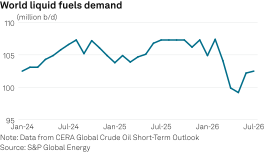
World liquids demand dropped to 99.2 million b/d in May 2026, down from 105.1 million b/d in May 2025, according to S&P Global Energy CERA's August Short-Term Outlook. Demand in July 2026 was 102.5 million b/d, down from 107.3 million b/d in July 2025, the data shows.
Countries in Asia were the first to implement policy changes, starting in March, to address the energy impacts of the war, Bilodeau said. "It was a bit like a wave or a tsunami, where it started in India and Southeast Asia, especially, and then we started to see this go to other parts of the world," he said.
While many of the policies tracked by the IEA are linked to oil use, a few measures target natural gas, according to a list of policies on IEA's website. For instance, Japan has subsidies for electricity and natural gas, and India capped industrial gas usage, according to the website.
