Refined Products, Crude Oil, Naphtha
July 30, 2026
South Korea secures Australian condensate to offset Middle East supply concerns
By Gawoon Vahn, Leon Wong, and Charles Lee
Editor:
HIGHLIGHTS
SK Incheon Petroleum to produce naphtha from condensate
First 300,000-barrel cargo due at Incheon in early August
South Korea diversifies away from Qatar, Iranian grades
South Korea is set to receive up to 1 million barrels per year of condensate from Australia's Barossa project as SK Innovation E&S plans regular equity cargo lifts, addressing concerns over irregular Middle Eastern ultra-light crude supplies and strengthening the country's energy security amid geopolitical uncertainties, according to its parent company SK Innovation and industry sources.
South Korean LNG importer and power utility SK Innovation E&S is entitled to 1.1 million barrels/year of condensate out of the 3 million barrels/year expected to be produced from the Barossa field based on its stake in the project, SK Innovation said in a statement July 27.
The condensate, or ultra-light crude oil, will be handled by SK Innovation's refining arm, SK Incheon Petroleum, which operates a 100,000 b/d condensate splitter to produce naphtha for use in the production of high-value-added products, such as paraxylene, as well as gasoline and jet fuel, the country's top refining firm said.
Regular condensate shipments from Australia allays concerns over instability in Middle Eastern ultra-light crude procurement as South Korea failed to secure any Qatari Deodorized Field Condensate, or DFC, in June, while South Korean refiners and petrochemical firms completely avoided Iranian South Pars condensate since second quarter 2019, feedstock managers at two major refiners based in Incheon and Seosan, as well as analysts at Korea Chemical Industry Association based in Seoul told Platts over market discussion sessions over July 28 and July 30.
South Korea, Asia's third-biggest crude importer, has been increasingly relying on Australian ultra-light crude grades such as Ichthys and North West Shelf amid disruptions in Middle Eastern condensate shipments, the feedstock managers and Korea Chemical Industry Association analysts said.
The Barossa project's very first 300,000-barrel condensate cargo is scheduled to arrive at the Incheon terminal on South Korea's west coast in early August, SK Innovation said in the statement.
South Korea imported 14.07 million barrels of crude and condensate from Australia in the first half of 2026, up 9.1% from the same period a year earlier, the latest data from state-run Korea National Oil Corp. issued July 28 showed.
SK Innovation E&S will receive 1.1 million barrels/year of Barossa condensate and 1.3 million mt/year of LNG for the next 20 years, securing a total of 22 million barrels of condensate and 26 million mt of LNG from the project, it said.
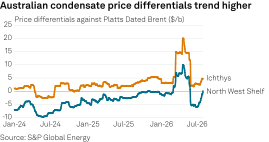
Platts, part of S&P Global Energy, assessed Australia's flagship Ichthys condensate at an average premium of $8.8/b to Dated Brent to date this year, compared to the 2025 average premium of $3.01/b.
Australian project investment
SK Innovation E&S started investing in the Australian Barossa project 14 years ago and the South Korean power utility acquired a 37.5% stake in 2012, SK Innovation said.
Australian energy producer Santos holds a 50% stake, while Japan's largest power generator JERA owns the remaining 12.5%.
SK Innovation E&S launched "full-scale" production in January this year at the Barossa gas field, off Australia's northwestern coast. In February, the company brought the initial LNG cargo to South Korea from the gas field.
"The projected condensate and LNG volumes from the Barossa project will help South Korea better cope with uncertainties in the global energy market, which remains vulnerable to geopolitical risks, including international disputes," the company said in the statement.
