Refined Products, Crude Oil, Diesel-Gasoil
July 30, 2026
Russian export ban strains African gasoil markets
By Kelly Norways and Matthew Tracey-Cook
Editor:
HIGHLIGHTS
Russia-Africa exports were 330,000 b/d in June
West African gasoil prices surge over 50%
Tunisia, Gambia among most exposed
Russia's diesel export ban is mounting pressure on African importers, who are facing a sudden fuel shortfall, driving prices higher in some of the world's most price-sensitive economies.
Effective July 9, Moscow's diesel export ban reflects the severity of its domestic fuel situation, hitting its main oil product trade—a key revenue source for its war economy.
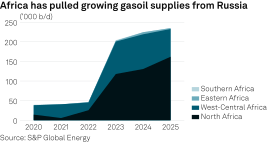
Among the regions in the crosshairs are North and West Africa, both prominent outlets for Russian gasoil, which now face at least another month without supplies.
According to S&P Global Commodities at Sea data, about 110,000 barrels/day of Russian gasoil has landed in African ports to date in July, down from around 330,000 b/d in June. In July, only 54,000 b/d of Russian gasoil was dispatched to Africa, according to preliminary CAS data.
The sudden downturn follows existing export pressure in June, when Ukraine ramped up its drone attacks on Russian refineries. Total gasoil exports were already down by 37% month over month, touching all-time lows.
In response, prices have surged. In West Africa, the cost of high sulfur gasoil in the Lome transshipment hub has jumped by more than 50% since late June, according to assessments by Platts, part of S&P Global Energy. Small clips of 50 parts per million sulfur product were heard fetching more than $85/b premiums to ICE LSGO August futures, more than double levels at the beginning of the month.
'Worse than April'
One local trader described the export ban as a "double whammy" for a market already reeling from the impact of Middle Eastern supply disruptions, which have sent diesel prices soaring.
"It's worse than April," a West African trade source, who was not authorized to comment publicly, said. "There is little product to go around."
Since the Russia-Ukraine war triggered a slew of international oil sanctions against Moscow, several African countries have become particularly dependent on rerouted oil.
In the gasoil market, Tunisia and The Gambia have recently relied on Russia for almost 70% of their gasoil supplies, compared with a 61% share for Senegal and 52% for Ghana, according to analysts at S&P Global Energy CERA.
It is not clear whether any African countries will benefit from Russian exemptions for intergovernmental contracts, which could apply to countries like Mali where has close economic ties. Neither the Russian nor the Malian energy ministries were available for comment.
For Senegal, one trader said the US could offer a potential alternative to lost Russian product; however, trade flows indicate the country has struggled to compete for alternative barrels elsewhere. The country has already implemented some emergency measures, including foreign travel bans for ministers to economize on fuel, but has dismissed reports of fuel shortages.
In practice, US gasoil shipments to Africa have trended lower in July, according to CAS data, with Brazil, another Russian importer, appearing to have more success in attracting barrels.
India shipped an extra 34,000 b/d of diesel/gasoil to West Africa in July, up from zero in June, CAS data showed, while North Africa pulled an extra 16,000 b/d from India's Nayara Energy terminal, home to the Rosneft-backed Vadinar refinery. Nonetheless, the extra volumes have been insufficient to offset lost Russian flows.
Dangote refinery support
In West Africa, Nigeria's Dangote refinery has helped to service large volumes of local demand, preventing the domestic market and nearby Ghana from any acute fuel shortages.
The Nigerian downstream regulator has tightly controlled import licenses through 2026, but Dangote has blamed low-quality fuel for continuing to enter the country and suppress local demand.
"As the imports dry up, the demand for the local production will move up," Devakumar Edwin, Dangote's vice president for oil and gas, said July 30.
According to Nigeria's downstream regulator, the refinery produced the equivalent of around 110,000 b/d of diesel/ gasoil and exported 48,000 b/d of it in June, with output down 27% month over month. CAS data indicates that all the exports went to the STS Lome market in July, contrasting with June when direct shipments went to Angola, Côte d'Ivoire, Senegal and Benin.
The refinery recently expanded its capacity to 700,000 b/d and has operated at near full capacity in recent months. After a series of maintenance programs in 2025, the company has said it has no new major turnarounds planned until 2030
Bidding war
Increasingly, keeping foreign product flowing into African hubs could rely on bidding wars with Europe, despite fierce competition and rising freight rates.
Offers for CIF Med diesel during the Platts Market on Close assessment process have been thin in recent days, with no activity over July 27-29 compared with more than 30 bids.
The depth of the disruption will depend on how long the Russian ban lasts, with the Russian government committing to an end date for refinery exports from Sept. 1.
A July 8 note from Dumdisi Awanen, an African refining analyst at CERA, warned that new affordability concerns could encourage more African governments to strike exclusive import agreements with traders, a trend recently most apparent on the east and south of the continent.
Such deals have typically involved paying a premium for supply to ease acute fuel supply concerns, he said, particularly among governments committed to capping prices with state support.
"Because many governments are already financially strained after months of supporting prices amid the Strait of Hormuz blockage, it is unclear how much further they will be able to stretch themselves," he said.
