Crude Oil, NGLs
July 28, 2026
US Senate to vote on sweeping Russia sanctions bill

Editor:
HIGHLIGHTS
Bipartisan agreement moves legislation forward
Tariffs target top five Russian oil importers
Bill imposes 500% duties on Russian goods
A bipartisan group of US senators said they have agreed to advance comprehensive sanctions legislation targeting major purchasers of Russian oil and gas, including tariffs on countries that continue to trade with Moscow during Russia's war in Ukraine.
The Lindsey O. Graham Sanctioning Russia and Iran Act of 2026 -- which a Senate Foreign Relations Committee release said would advance to a procedural vote July 28 -- would allow the US president to impose targeted tariffs on imported goods from countries that buy the vast majority of Russian oil or gas and enable sanctions evasion. The legislation limits these tariffs to the five largest importers of Russian crude oil or natural gas during the most recent 12-month period preceding the date of the enactment of the act and the top five countries aiding Russia's energy sanctions evasion.
India, China and Turkey have remained the three leading buyers of Russian crude throughout 2026, with India and China taking an average of 2.9 million of Russia's 5.7 million b/d in exports, according to S&P Global Commodities at Sea.
The bill, previously known as the Sanctioning Russia Act of 2025, was first introduced by US Senator Lindsay Graham in April of 2025. US President Donald Trump and many US representatives were scheduled to attend Graham's funeral July 28.
"There is no greater way to honor Senator Graham's legacy than to move forward with this bipartisan agreement, and we look forward to today's vote," Senators Jeanne Shaheen (Democrat-New Hampshire), Richard Blumenthal (Democrat-Connecticut), Darline Graham (Republican-South Carolina), Katie Britt (Republican-Alabama), Roger Wicker (Republican-Mississippi) and Jim Risch (Republican-Idaho) said in a statement.
Energy trade restrictions
The bill would impose duties of up to 100% ad valorem on all goods imported from countries identified as the five largest importers of Russian crude oil or natural gas by total volume during the most recent 12-month period, according to the bill text. Countries determined to be facilitating Russian oil sanctions evasion would face similar tariffs.
An exception would apply for countries whose natural gas imports from Russia represented less than 15% of total Russian natural gas exports and have taken significant steps to reduce such imports, the bill said. The US Trade Representative would be required to review and update the list of targeted countries every 180 days.
The legislation would also prohibit new US investment in Russia's energy sector and ban exports of American energy products to Russia within 30 days of enactment. Duties of up to 500% would apply to all goods imported directly from Russia, including oil, natural gas, liquefied natural gas, petroleum products and coal.
Foreign persons providing goods, services or technology that facilitate maintenance or expansion of Russian energy production would face sanctions under the bill. The president would be required to impose blocking measures on leaders and executives of Russian energy projects, including Yamal LNG and Arctic LNG.
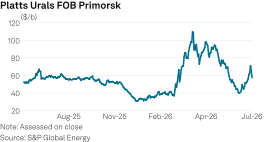
The vote on the measure comes during a period of rising pressure on Russia's energy sector, which in recent weeks has faced increasing attacks on refineries and export facilities by Ukrainian forces. At a July 22 Atlantic Council event, former Russian Federation officials said increased oil sanctions could tip Russia's economy into crisis.
"Mr. Putin will face a big problem by the end of this year," former Russian Federation prime minister Mikhail Kasyanov said. "This is a good period of creating, I would say, coordinated pressure on Putin on all sides: Ukraine, the West, and of course, growing problems in Russia."
Russia's flagship Urals crude has traded at a discount to Platts Dated Brent since the G7 price cap took effect in December 2022. The proposed duties and expanded vessel measures could intensify pressure on the discount at which Moscow can clear its barrels, which Platts assessed at $33.34/b below Dated Brent July 27.
Financial sector measures
The legislation would impose blocking sanctions on the Central Bank of Russia, Sberbank, VTB Bank and Gazprombank within 30 days of enactment, according to the bill text. Foreign financial institutions engaging in significant transactions with these Russian banks would also face sanctions, with exceptions available if the Treasury secretary determines such measures are inconsistent with US economic or foreign policy interests.
US persons would be prohibited from engaging in transactions with the sanctioned Russian financial institutions. The bill would also restrict correspondent and payable-through accounts in the US for these entities and prohibit international financial messaging systems from providing services to them.
The legislation targets Russian government officials ranging from President Vladimir Putin to ministers overseeing defense, foreign affairs and finance, as well as military commanders and intelligence directors. Sanctions would apply to oligarchs who have not demonstrated opposition to Russia's war on Ukraine or continue to benefit from association with the Russian government.
Vessel sanctions
Foreign vessels used to transport Russian-origin crude oil, uranium, natural gas, LNG, petroleum products or coal would be identified as blocked property if they lack adequate maritime insurance or evade compliance with price caps established by the Price Cap Coalition or the US, the bill said. Sanctions would also apply to vessel owners, operators, insurers and crew leadership.
Foreign ports allowing vessels subject to US sanctions to dock or receive services would face measures under the legislation. The president would be required to review and impose sanctions every 180 days on persons and vessels supporting Russia's military operations.
The bill also includes provisions to extend the Iran Sanctions Act of 1996 through 2031, restricting funding for Iran's energy and weapons sectors. The legislation would sunset five years after enactment, except for the Iran sanctions extension.
The president could waive sanctions provisions after certifying to Congress that doing so serves US national interests. Sanctions could be terminated if Russia signs a peace agreement accepted by Ukraine's government and ceases military hostilities, subject to a 30-day congressional review period.
Even if the scheduled Senate vote advances the bill, final passage would be delayed by the US House's summer recess, which ends Aug. 31.
