Refined Products, Crude Oil
July 28, 2026
Indian oil importers face 'dual choke point' challenge in securing future supplies
HIGHLIGHTS
Refiners have secured crude through September
Higher freight, feedstock costs to pressure refiners' margins
Russia remains India's top crude supplier in H1 2026
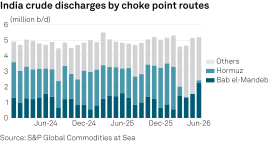
Indian oil importers have secured crude supplies through September and are now racing to finalize procurement strategies for the final quarter, as disruptions in the Strait of Hormuz and Bab al-Mandab Strait have heightened concerns about future supplies through the two critical maritime choke points, refining sources and analysts said July 27.
Indian refiners have so far shown resilience by diversifying their crude sources, but replacing large volumes from Russia or the Middle East could become more costly and operationally challenging. This could constrain refinery throughput and limit operational flexibility if flows through the key routes do not return to normal in the near term, they added.
"India's crude supply outlook has become more vulnerable than it was earlier in the year. Ongoing uncertainty over Middle Eastern exports through both the Strait of Hormuz and the Bab al-Mandab Strait has heightened the risk of a dual choke point crisis and could also affect the supply of Russian imports through the Bab al-Mandab Strait," said Premasish Das, executive director for oil analytics at S&P Global Energy CERA.
"While we do not expect any significant tightness in the domestic fuel supply, prices could rise. However, a reduction in refinery throughput will lower the volume of refined product exports, further tightening global refined product balances, particularly for middle distillates," he added.
US President Donald Trump decided to pause US military strikes against Iran to allow diplomacy another chance, Axios reported July 27.
Traffic through the Strait of Hormuz was unchanged at 16 ships on July 26 and July 25, while the Bab al-Mandab Strait saw a rise to 32 ships on July 26 from 26 on July 25, according to a July 27 report from S&P Global Commodities at Sea.
Procurement by state refiners
India's state-owned refiners, including Bharat Petroleum Corp. Ltd. and Hindustan Petroleum Corp. Ltd., have secured crude supplies through September, company officials said, underscoring comfortable inventory levels. The country's diversified crude procurement strategy has helped cushion refiners from price volatility triggered by geopolitical developments.
"We are comfortably covered until September for crude," a BPCL official said, adding that the company is now evaluating crude purchase opportunities beyond September based on market competitiveness.
Another BPCL official said the company is not purchasing Venezuelan crude on a regular basis because price movements have remained inconsistent.
Regarding Russian supplies, the official said BPCL had already secured purchases of Urals crude through August but was seeing little commercial incentive to take on additional volumes. "We have already procured Urals grade until August, but beyond that, nobody is offering any discount on Russian crude," the official said.
Platts, part of S&P Global Energy, assessed Urals DAP India at a discount of $8.85/b to forward Dated Brent on July 27, compared with a discount of $12.50/b on Feb. 27.
A HPCL official also said the refiner was well supplied for the near term. "We have no problem with crude inventories."
A petroleum ministry official said India is currently importing crude from more than 40 countries, enabling refiners to respond flexibly to changing market conditions and geopolitical disruptions.
"While the current situation does cause concerns, diversifying supply sources and various actions taken both on the supply and the consumption side should help India manage oil and gas supplies to meet its requirements. Higher crude oil prices will continue to be a cause of concern," said Mukesh Kumar Surana, former chairman and managing director of HPCL.
"Prolonged conflict situation with blockade at the Strait of Hormuz, escalating tension on Red Sea routes, damage to oil infrastructures in the Gulf region and depleting global oil inventories with no visibility on resolution in the immediate future would be a cause of concern for the whole world," he added.
Price concerns add to worries
Rajat Kapoor, managing director for oil and gas at Synergy Consulting, said India has managed the supply side commendably by ramping up imports from Russia and, increasingly, Venezuela.
Indian government officials said June 4 that New Delhi will explore the possibility of term oil contracts with Venezuela and upstream investment opportunities in the South American country, where production has been rising gradually, opening avenues to expand future energy ties.
"For India, the bigger issue is price rather than supply. Refiners have kept throughput normal but face a sharp reduction in margins with higher landed costs of prices, freight, war-risk insurance and longer voyages," Kapoor said.
India's crude oil import profile for January-June reflects both resilience and evolving challenges in securing energy supplies. Russia was the top supplier, shipping 1.82 million barrels/day to India in the first half of the year, up slightly from the same period last year, while purchases from the UAE and Brazil rose significantly.
However, imports from Iraq and the US dropped sharply. Overall, total crude imports in H1 2026 declined marginally to 5.02 million b/d from 5.04 million b/d in H1 2025, CAS data showed, underscoring the impact of geopolitical tensions and logistical uncertainties.
"The renewed tensions in the Middle East could result in significantly higher supply concerns for India as well as many other Asian oil-importing economies. Saudi Red Sea exports coming under pressure could mean a sharply higher outlook for crude prices," said Tushar Bansal, senior director at consulting agency Alvarez & Marsal.
