Maritime & Shipping, Crude Oil, Wet Freight
July 28, 2026 · Updated July 29, 2026
Houthi threat triggers tanker crunch as Saudi oil reroutes
By Thomas Washington and Kelly Norways
Editor:
HIGHLIGHTS
Just 74 VLCCs available on ballast West of Suez
Vessel shortage, bunker needs hike freight rates
European, East African oil product flows at risk
The Houthi naval blockade on Saudi Arabia has forced a mass rerouting of its crude, tightening global tanker supply and driving up freight rates, traders and analysts have said, adding stress to a global oil market already under strain.
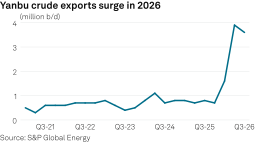
Saudi Arabia has increasingly depended on its East-West pipeline as an outlet for its crude, allowing Asian buyers to lift cargo from Yanbu on the Red Sea without relying on the Strait of Hormuz.
Some 3.9 million b/d of crude loaded from Yanbu in the second quarter of 2026, more than double last year's level, of which roughly 80% went East of Suez, according to location signals detected by S&P Global Commodities at Sea.
However, since Yemen's Houthi militia announced its blockade, most shipping operators have treated southbound Saudi oil transits through the Bab al-Mandab Strait as completely off-limits, opting instead to leave the Red Sea via the Suez Canal and sail around the entire African continent in order to reach Asia.
"If you're thinking about Yanbu crude going to China, instead of going via Bab al-Mandab, you now must go via the Cape, adding more than 30 days of sailing," Andrea Olivi, head of shipping at Trafigura, told Platts, part of S&P Global Energy, on July 28.
The rerouting has raised questions over how much Saudi crude manages to make the long journey to Asia, rather than being snapped up by European refiners. It has also exposed a critical shortage of available vessels, particularly very large crude carriers, in the Atlantic and Mediterranean basins, now tasked with further journey routes and surging fuel costs.
VLCCs cannot transit the Suez Canal at full capacity, but can reduce their loads to make the voyage. Some laden ships could potentially take on extra crude on the other side of the canal by loading at Sidi Kerir in Egypt, an exit point for Egypt's SUMED pipeline, said Kevin Zhao, a shipping analyst at S&P Global Horizons. However, West-of-Suez ballaster availability stands at just 74 VLCC units, representing roughly 10% of the mainstream fleet, according to a July 24 note from Gibson shipbrokers.
As a result, rates have shot up. Platts assessed the cost to carry a 270,000 metric ton cargo of crude from Yanbu to the Far East at $66.87/metric ton on July 28, up from $32/mt when it launched in early May.
Shipper caution
The shipping industry has taken the Houthi threat seriously. Traffic through the Bab al-Mandab has dropped to roughly three-quarters of its early July levels, CAS data showed, with most ships traveling southbound from non-Saudi ports.
The number of vessels willing to make the voyage has been affected by recent threats to physical infrastructure, with the Houthis claiming recent drone and missile attacks on "sensitive Aramco-affiliated facilities" in both Jazan and Yanbu, as well as a new tanker attack on July 28. Neither Aramco nor the Saudi energy ministry has commented on the statements.
"Even without imposing a complete blockade, the Houthis have repeatedly demonstrated that they need only create sufficient uncertainty for commercial operators, insurers and charterers to reconsider their routing decisions," Greek shipbroker Xclusiv said July 27.
Freight costs for the Yanbu-to-Asia route are expected to surge from the recent mid-to-high $5/b assessment to mid-to-high $9/b via Suez and the Cape of Good Hope, assuming freight rates remain roughly steady, Gibson said.
Rates could find further support from rising fuel costs, said leading bunker supplier Peninsula, which says diversions around the Cape could require an additional 1,500 mt of fuel and more than double tanker operating costs.
"The industry could be dealing with a sudden, significant increase in fuel consumption. This is more complex than simply plotting a longer course – it will require a fundamental recalibration of voyage economics," said Kenny MacLean, the company's Chief Operations Officer.
Nevertheless, Asian buyers could be left with little choice but to absorb the higher costs of drawing Saudi crude, Gibson said. Key buyers like China and South Korea have recently relied on crude from Russia, Brazil and the UAE, CAS data showed. However, ongoing disruptions in the Strait of Hormuz have limited alternatives to Saudi medium and heavy sour grades, while new Black Sea attacks create further upside price risk.
Clean products
On the refined products side, Saudi Arabia exported roughly 1.1 million b/d from its Red Sea ports in Q2, much of it destined for Europe and East Africa, CAS data showed.
Traditional swing suppliers such as India's west coast and Oman's Duqm refinery would typically backfill shortfalls, but weak east-west arbitrage economics have kept barrels directed toward Asia, Gibson said. BRS, another shipbroker, noted signs of some product tankers making the voyage around the Cape, with two LRs recently fixed to take Saudi naphtha to Asia via Suez.
Before the Houthi blockade, almost 100 Aframaxes and LR2s had already joined the "dirty" fleet since late 2025, CAS data showed, tightening availability in the clean segment. Higher rates will only mount pressure on oil products markets already commanding historic premiums to crude oil, with growing concern over the Gulf supply deficit and falling inventories.
Platts assessed the rate to carry a 55,000 mt cargo of refined products from the Red Sea to Japan at $87.78/mt July 28, above a five-year average of $56.94/mt. The equivalent rate for a 90,000 mt cargo traveling from the Red Sea to the UK/Continent was $40.83/mt.
