Refined Products, Crude Oil, Gasoline, Fuel Oil, Diesel-Gasoil
July 28, 2026
EU oil stocks reform unlikely to revise 90-day storage target: sources

Editor:
HIGHLIGHTS
EU reviews oil stocks directive to address 'failures'
Netherlands rejects support for higher mandate
Focus on energy transition, stock composition for new policy
An EU review of its oil stockpiling policy is unlikely to increase the quantity of emergency reserves its members are obliged to maintain, but may change their composition, according to a consultation note and sources privy to the discussions.
In a July discussion seen by Platts, part of S&P Global Energy, the European Commission said that the Middle East conflict had exposed "concrete operational failures" in its oil security framework and hinted at the need to increase its buffer as part of an urgent policy review.
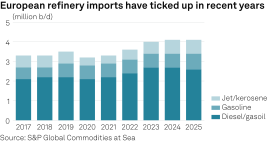
"The crisis has shown that the EU must be prepared for longer-duration oil supply disruptions," the note said. "It has also shown the dependence of the EU on jet fuel imports."
For almost two decades, the EU has required its member countries to hold oil stocks equivalent to 90 days of net imports, or 61 days of consumption, whichever is higher. Of those reserves, one-third must be oil products, while the remainder can be crude oil. The commission consulted experts on its stockpiling policy on July 2 and July 23 and is expected to propose amendments later this year.
However, political and fiscal challenges are likely to water down the scope of legislative reform, market sources said, warning that the minimum 90-day net import requirement is likely to remain unchanged.
Policy review
Ravi Bhatiani, executive director for the Federation of European Tank Storage Associations, said the consultation could "easily have an underwhelming outcome."
"Our worry as an organization is that the moment the pressure is off because you seem to be exiting the crisis, that's the same moment that politicians basically lose all ambition," he said, noting that reforms could pose a "fiscal headache" for governments.
The European Commission did not respond to requests for comment.
FETSA, whose members operate almost 800 European terminals, has advocated increasing stock mandates to address geopolitical risks, Europe's higher import dependency and new security threats.
Nevertheless, government officials have proven reluctant to revisit the threshold.
"We do not see any clear reason to lift the 90-day net imports baseline," said a spokesperson for the Ministry of Economic Affairs and Climate Policy in the Netherlands, one of the larger stockpilers.
Maurits Kreijkes, Group Market Intelligence manager at Evos, a Dutch storage operator, said, "At this stage, the Commission appears to be gathering information rather than steering towards an increase in the current 90-day stockholding requirement."
Instead, reforms may focus on expanding the scope of the directive to cover products like biofuels and future energy carriers, Bhatiani said. The European Commission consultation emphasized the need to consider the energy transition as part of its review while acknowledging that oil still contributes 38% of Europe's energy mix.
Additionally, it singled out military fuel needs as a specific area to be protected. NATO and EU member states have previously called for specific stock requirements for diesel, jet fuel and gasoline and have advised that military stocks be distinguished from civil reserves.
Bhatiani expressed confidence that the commission would expand the scope of its directive to include newer fuels, such as biofuels and future energy carriers. It should also shift its stock composition to favor refined products over crude, he urged.
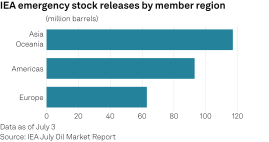
According to the International Energy Agency, Europe had released 63 million barrels of oil from emergency reserves by July, while hubs like the Netherlands have since announced their first draws.
Energy security drive
A potential reluctance to increase reserves in absolute terms contrasts with other parts of the globe, including India, South Africa and Pakistan, which have all outlined plans to boost their stockpiles.
Traders expect a scramble to rebuild depleted stocks—and possibly increase them—could prop up global oil demand for at least a year after the conflict subsides, with ripple effects for prices.
In the three weeks after the US-Iran memorandum of understanding in June helped cool crude markets, global stock injections averaged 3.9 million barrels/day, according to Goldman Sachs. China has also been known to ramp up stockpiling when market structure would normally incentivize draws, notably in the aftermath of the 12-day Israel-Iran war in 2025.
"Some major producer countries are also looking to rebuild their stocks in locations outside of the Strait of Hormuz, closer to their major consumer markets," said Saad Rahim, chief economist at global commodities trader Trafigura.
Storage economics
Whether Europe is willing to stomach the costs of a new storage model remains to be seen, and member states are typically given years to transpose new mandates into national law.
In a special 2018 report, the IEA argued that oil stocks can offer up to $1 trillion in savings for net-importing countries during oil shocks, helping offset GDP losses and higher import costs. Still, building a new 500,000 cubic meter oil terminal was estimated to cost €50 million, and an extra €200 million to fill it with 70% crude and 30% products.
Weighting storage makeup more toward products would increase inventory costs, while products like Jet A-1 require higher-spec infrastructure. Proponents have suggested that collective ownership models may offer one solution, as may allocating defense budgets to new strategic reserves.
In July, NATO members committed to invest €27 billion ($31 billion) in fuel storage and distribution infrastructure, but details remain scarce. FETSA's Bhatiani also called for private-sector operators to be given"risk preparedness" obligations, advocating a model similar to the EU's Critical Raw Materials Act to modernize stocks.
"At the moment, they're designed for things like refinery interruptions, temporary closures of something like the Suez Canal for a few days," he said. "They are not designed for dealing with the geopolitical transition that we are going through."
