Refined Products, Crude Oil
July 25, 2025
Heavy crude supplies tight as US considers allowing Chevron to operate in Venezuela
HIGHLIGHTS
US waterborne imports of heavy crudes fall in July
Maduro claims Chevron allowed to operate JV with PDVSA
Latin American heavy crude prices climb
Heavy crude supplies have tightened in the US as the Trump administration is said to be considering allowing Chevron to continue operations in Venezuela, a producer of heavy crude grades.
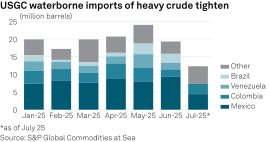
S&P Global Commodities at Sea data shows the US importing 17.6 million barrels of waterborne heavy crude so far in July, down from 25.5 million barrels in June and 32 million barrels in May.
The decline was led by a drop in imports from Venezuela and Mexico. Zero Venezuelan barrels have been delivered to the US so far in July, down from 3.9 million barrels in May, CAS data shows.
In March, the US amended a license that had allowed Chevron to operate in Venezuela, stipulating that the company wind down operations by May 27. Additionally, since April, any country importing Venezuelan oil may be subject to a 25% tariff on its exports to the US.
Chevron, the only American company remaining in Venezuela, partners with state-owned oil company PDVSA in four joint ventures in the country. Those joint ventures, and others, have helped push Venezuela's crude production to above 1 million b/d.
However, it appears that the US has allowed Chevron to continue operations, which could allow exports of heavy crude to the US to resume.
"Chevron was informed of the granting of licenses to continue operating in Venezuela," Venezuelan President Nicolas Maduro said in a televised interview late July 24. "While it was in limbo, the wells it managed increased in production. Welcome back to work."
"Chevron has been in Venezuela for 102 years, and I want it to stay for another 100 years," Maduro said.
Maduro said "no comment" when asked if the granting of Chevron's license was related to Venezuela's recent release of American prisoners in exchange for the release of Venezuelan prisoners from El Salvador.
Chevron would not confirm that its license has been granted.
"Chevron conducts its business globally in compliance with laws and regulations applicable to its business, as well as the sanctions frameworks provided for by the US government, including in Venezuela," said Chevron's head of media relations, Bill Turenne.
Chevron's authorization to resume operations in Venezuela is reportedly through a company-specific license, a type of license that is not publicly released by the US Treasury Department.
The US Treasury Department could not be reached for comment.
"While we cannot speak to any specific licenses, the U.S. Government will not allow the Maduro regime to profit from the sale of oil," a State Department spokesperson said July 24.
Welcome news to USGC refiners
"Amid ongoing heavy oil tightness, sanctions relief might prove welcome news to high-complexity refiners, including U.S. players in the Gulf Coast," said ClearView Energy Partners analysts in a July 25 report. "Given the prominence of affordable gasoline to White House economic messaging, President Trump might also be pleased if additional Venezuelan barrels help to keep a lid on crude costs and pump prices. Likewise, additional heavy-sour volumes could add room to the market for a tighter U.S. sanctions pinch on Iranian and/or Russian exports."
The tight heavy supplies were acknowledged by Valero in its second-quarter earnings call. The company owns and operates several refineries on the US Gulf Coast.
Valero's chief operating officer Gary Simmons noted Mexican crude production volatility, the unavailability of 200,000 b/d of Venezuelan crude, [Gulf of Mexico] crude quality issues, which have impacted some medium sour crudes like Mars, and Canada's June wildfires, which took 5 million barrels of crude off the market.
He expects heavy oil supply to increase as Canadian production recovers and grows, and OPEC+ unwinds its 1.9 million b/d cuts by August.
"It will probably be the fourth quarter before you really see that," he said, noting that much of the OPEC production has not reached the market, instead being used at home for crude oil burn for seasonal summer power demand.
CAS data shows the US importing 4.9 million barrels of heavy Mexican crude so far in July, down from 9.3 million barrels in June. While additional shipments could boost July deliveries, CAS vessel tracking data does not show any scheduled deliveries of Mexican crude to US ports until Aug. 1.
Mexican crude production has fallen to below 1.4 million b/d since December 2024, reducing exports. Also, fewer barrels could be available for export as the state oil company Pemex ramps up its new Olmeca refinery, said one spot crude trader, who pointed to higher Latin American heavy crude prices.
"This rebound is mainly due to the partial startup of the Olmeca refinery in Dos Bocas and operational improvements in the rest of the refining system," he said.
Platts assessed Ecuador's Oriente crude at a $4.40/b discount to WTI on July 24, tightening from a $5.65/b discount on July 7. Colombia's Vasconia crude was assessed at a $1.305/b premium to WTI July 24, up from a 78 cents/b premium on July 7.
Platts is a unit of S&P Global Energy.
USGC refiners also regularly import heavy crudes from Canada via pipeline, although the bulk of Canadian crude heads to Midwest refiners. Imports from Canada on the four-week moving average have risen to 3.8 million b/d in the week ended July 18 from 3.6 million b/d the prior week, US Energy Information Administration data shows.

Editor: