Refined Products, Crude Oil, Maritime & Shipping, Fuel Oil, Bunker Fuel
July 24, 2026
EU sanctions Georgian, Belarusian refineries for Russian oil links
Editor:
HIGHLIGHTS
EU sanctions Mozyr, Kulevi oil refineries
Georgian refiner given 6 months to ditch Russian crude
Russian crude price cap fixed until July 15, 2027
The EU sanctioned a string of new refineries under its 21st package of sanctions against Russia, including Belarus's Mozyr, Georgia's Kulevi and three Russian facilities, it said in a statement late July 23.
The new sanctions package steps up existing restrictions against the 240,000 barrels/day Mozyr refinery, one of two in Belarus, by formally designating it as a sanctioned entity. Also listed was European Trading Company, a state-owned entity used to export the country's oil.
Belarus is one of the last remaining European consumers of Russian pipeline crude, which it relies on to feed its Mozyr and Naftan refineries. The country has a rolling contract to purchase 24 million mt/year (480,000 b/d) of Russian crude, enough to fully cover the needs of its two plants.
In Georgia, Kulevi port was previously proposed for inclusion in the EU's 20th sanctions package, but avoided being listed after commitments from the Georgian authorities, according to a letter from the EU's sanctions envoy, David O'Sullivan, seen by Platts, part of S&P Global Energy.
Black Sea Petroleum, which owns the 24,000 b/d Georgian refinery, said in July it would suspend its Russian crude refining from August to September. In a press briefing from Brussels July 24, European Commission spokesperson Siobhan McGarry said that the six-month delay was agreed to give the company time to honor its commitment, and said the transaction ban would not be enforced in the case of demonstrable compliance.
Black Sea Petroleum did not respond to a request for comment. A statement from the Georgian Ministry of Foreign Affairs said it was ready to cooperate with the EU.
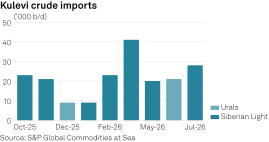
According to research from the Centre for Research on Energy and Clean Air, a policy think-tank, Kulevi has relied exclusively on Russian crudes like Siberian Light since it opened in 2025, and has supported large volumes of Georgian fuel shipments to European countries, particularly the UK.
The refinery aims to expand its capacity almost fourfold to process about 90,000 b/d of crude and boost its yields of high-value products.
In Russia, refinery targets were the owners of the Yaya oil refinery in Kemerovo Oblast, southwestern Siberia, Kuybishev and Novokuybishev in the Samara region, all identified as significant revenue generators for the Kremlin.
Additionally, the bloc extended transaction bans to five new oil traders for violating restrictions on the purchase of Russian crude and fuel, and created the framework to prohibit transactions between listed Russian refineries and their third-country partners.
Refinery focus
The new refinery sanctions follow a suite of new measures from the EU aimed at Russia's largest oil consumers.
After banning direct seaborne imports of Russia's crude and fuel in 2022-23, in January, the bloc introduced a new ban on products made from Russian oil in third countries, and has also listed specific refiners in India and China.
The EU paused plans to replace its Russian oil price cap with a full maritime services plan in April, and said July 23 that it would fix its crude threshold at $44.10/b until July 15, 2027.
The price cap freeze, intended to keep the threshold "necessary and proportionate," paused a mechanism that would have automatically raised the limit in July due to rising global oil prices. The EC estimates the lower threshold will cost Russia roughly $3.5 billion in lost energy revenues.
At the same time, Brussels has continued to focus on enforcing the price cap by targeting tankers associated with transporting higher-value oil. The 21st sanctions package listed a total of 41 vessels, most of which are oil tankers in Russia's "shadow fleet," on top of the 632 ships already sanctioned.
The ships also include five non-EU bunker barges for the first time, as EU officials vowed to expand the scope of their sanctions. Brussels previously banned EU companies from providing marine fuels to sanctioned tankers.
In addition to tankers circumventing the price cap, new targets included vessels providing services transporting Russian military equipment or stolen Ukrainian grain, the Council said. Shipping companies operating on behalf of Russia's oil majors were also targeted, along with a crewing agency found to be supporting the shadow fleet.
A statement from Kaja Kallas, vice-president of the European Commission, called the new raft of measures the EU's largest number of listings in four years and committed to keeping pressure on Russia's war economy.
"With each round of sanctions, we squeeze Russia's economy and its capacity to prolong its illegal war," she said.
