Maritime & Shipping, Crude Oil, Wet Freight
July 20, 2026
Tanker attacks at CPC disrupt oil loading for Kazakhstan main export route
Editor:
HIGHLIGHTS
Four tankers hit in recent days
Crude loading halted after attacks
Ukraine confirms strikes on Black Sea ships
Caspian Pipeline Consortium oil loading was disrupted again July 20, after a fourth tanker loading at the network was attacked in as many days, CPC said in a statement.
Ukrainian attacks on CPC have intensified, threatening around 1.5 million barrels/d of oil exports from Kazakhstan and Russia, shipped via the Russian Black Sea port of Novorossiisk.
CPC said that although oil loading resumed after a temporary disruption late July 19, it was suspended again July 20 after another tanker attack.
The Nelsa tanker was attacked by drones during loading operations, CPC said. It was carrying Rosneft Urals crude, according to S&P Global Commodities at Sea. At the end of May the tanker carried Urals for Lukoil to India's Paradip terminal. Rosneft and Lukoil did not respond to a request for comment from Platts, part of S&P Global Energy.
The UK and the EU sanctioned the Nelsa, previously named Fast Kathy, for alleged illicit Russian trades in 2024 and 2025, respectively. The tanker was mainly used to transport Russian oil in the past two years, but CAS data showed there was at least one loading of Kazakh oil in 2024.
"A hit to the aft section of the starboard side -- in the area between the superstructure and the engine and boiler room -- sparked a fire on the tanker's deck and in its compartments. The fire was extinguished within a few hours by the tanker's loading crews and CPC emergency response teams operating from marine vessels," the consortium said.
CPC did not respond to a request for comment on the current state of operations at the network. Deliveries via CPC have averaged 1.48 million b/d so far in 2026, according to CAS, but monthly volumes have fluctuated significantly due to disruptions.
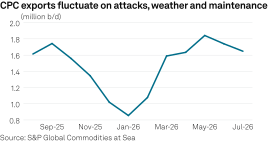
CPC and the Kazakh Energy Ministry said July 19 that two tankers loading at CPC were attacked, leading to suspension of crude loadings.
The Liberian-flagged Asia was carrying oil from the Chevron-led Tengizchevroil.
Chevron said July 19 that the incident has had no impact on TCO operations or exports.
The second tanker was the Marshall Islands-flagged Nissos Ios, loading Kashagan crude. Kashagan operator NCOC did not comment on current production at the project.
CPC said earlier that the Nordic Zenith was struck July 17.
Media reports identified Nordic Zenith as chartered by ExxonMobil, but the company said it does not discuss operational details related to marine transportation.
"ExxonMobil does not own or operate marine vessels, and transport activities are managed by independent vessel owners and operators," ExxonMobil told Platts.
The Ukrainian military confirmed July 19 that it struck two tankers in the Black Sea.
"The tankers are used to transport Russian oil, oil products and fuel in the interests of the armed forces of the Russian Federation," it said in a statement posted on Telegram.
The Asia was last used for Russian-origin crude deliveries in 2023, while Nissos Ios loaded Russian oil in the summer of 2025, according to CAS. CAS data shows that the Nordic Zenith was last used for Russian crude transshipments in 2019 before the start of Russia's full-scale invasion of Ukraine.
S&P Global CERA analysts expect the incidents to be neutral for Mediterranean light sweet differentials, Black Sea freight rates and the Brent/WTI spread if loading is restored within a day. If restoration is delayed, prices may begin to rise, analysts said July 20.
CPC shareholders are Transneft, KazMunayGas, Kazakhstan Pipeline Ventures, Chevron, Lukoil, Mobil Caspian Pipeline Co., Rosneft-Shell Caspian Ventures, BG Overseas Holding Limited, Eni and Oryx Caspian Pipeline.
CPC is not subject to Western sanctions and said that foreign shippers accounted for over 75% of the 70.5 million mt of oil shipped via the network in 2025.
Platts, part of S&P Global Energy, assessed CPC Blend crude at a $2.65/b discount to Dated Brent July 17.
Analysts at S&P Global Energy CERA said that historical precedent, including an attack on the second single point mooring unit in November 2025, suggested that even brief disruptions lasting for weeks could lift the CPC differential by $1-$2/b and raise Black Sea freight rates and the Brent/WTI spread.
"However, the high volumes of competing supply converging on the Mediterranean in August from West Africa and Latin America will provide a meaningful cap to the upside unless renewed Strait of Hormuz attacks persist for longer," they said in a note released July 19.
One Med crude trader expected the impact to be limited given that the terminals sustained no damages but added that the port remained closed due to drones.
'The impact should be limited, but ... not sure vessels want to berth in current conditions," the crude trader said.
A second Med crude trader said this was "a very different case" from usual, "as the terminal has halted all loadings."
The Russian Foreign Ministry condemned the attacks and said it viewed the strikes as an attempt by Ukraine to further destabilize global oil markets.
