Maritime & Shipping, Crude Oil, Refined Products
July 18, 2025
EU bans products refined from Russian crude, drops price cap to $47.60/b
HIGHLIGHTS
EU agrees 18th sanctions package after Slovakia drops opposition
Refined product imports banned from countries processing Russian crude
UK joins EU in price cap drop from $60/b to $47.60/b
The EU has banned imports of refined products made from Russian crude oil, overhauled its oil price cap mechanism and blacklisted over 100 shadow fleet tankers, it said July 18, in one of its largest crackdowns on the Kremlin's energy industry to date.
The agreement on the sanctions package came after Slovakia finally agreed to drop its opposition to the measures late July 17.
A statement from the European Council announced a ban on refined products made from Russian crude in third countries, pledging to prevent Russia's crude oil from reaching the EU market "through the back door."
The ban could hit exports from India, China and Turkey, all of which have emerged as major consumers of Russian oil since the war. Exemptions were provided for the US, the UK, Canada, Norway and Switzerland.
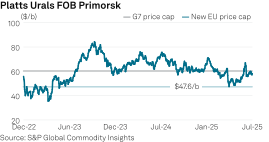
The council confirmed a downward adjustment to its crude oil price cap from $60/b to $47.60/b, the first to be enacted under a new "automatic and dynamic" pricing mechanism. Effective from Sept. 3, the next cap will be at 15% below the average market price for Urals, subject to review every six months.
The UK, which has generally worked side-by-side with Brussels in sanctioning Russian oil, also announced it was making the same reduction in the price cap. However, it noted there was no change to the parallel price cap on oil products such as diesel, gasoline and fuel oil, an area not addressed in the EU's latest sanctions announcement.
Platts assessments show Russia's flagship crude export grade, Urals, has been mostly traded below $60/b since late-February and was last assessed at $58.11/b July 17.
The reduction is the first to be made since the price cap was first introduced in December 2022, despite plans to keep it 5% below the average market price and review it every two months.
Other G7 countries, including the US, have so far avoided proposals to reduce the cap, despite persistent lobbying from the EU.
Wider scope
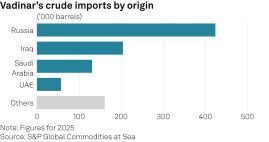
Additionally, the EU issued fully-fledged sanctions on a refinery in India majority-owned by Rosneft, a presumed reference to Nayara Energy's 400,000 b/d Vadinar refinery.
S&P Global Commodities at Sea data shows that Vadinar has received 976,600 b/d of crude so far this year, of which 43% from Russia.
It also listed a Russian LNG entity and issued full transaction plans on the Nord Stream and Nord Stream 2 gas pipelines that will bar their future use.
In an attempt to boost enforcement of its rebooted price cap, the new sanctions package clamped down on the 'shadow fleet' -- a network of old, often uninsured tankers used to ship oil above the threshold.
The statement announced that 105 vessels were added to the blacklist, taking its total to 444. For the first time under EU sanctions, the captain of a shadow tanker was specifically targeted, as well as an international flag registry.
New measures will also expand transaction bans to 22 more Russian banks, along with foreign financial institutions and crypto service providers found to be supporting the regime.
In a statement on X, Kaja Kallas, vice president of the European Commission and EU high representative, called the EU's latest intervention "one of its strongest sanctions packages against Russia to date."
"The pressure is on. It will stay on until Putin ends the war," EC President Ursula von der Leyen said.
ICE low sulfur gasoil futures -- the European distillates benchmark -- jumped on the announcement July 18, taking the August/September time spread from $17.25/mt to $27.75/mt, and raised the outright price by roughly $42.50/mt by 1200 GMT.
By the same time, Brent crude futures had climbed by just $1/b from the previous close, reaching $70.52/b.
Tougher stance
The new sanctions come after days of fraught negotiations in Brussels and have fanned concerns over a shortage of distillates in Europe.
Since banning its own member countries from importing seaborne Russian crude and refined products in December 2022 and February 2023, the EU had deliberately left the door open for flows to be redirected toward foreign buyers, such as India and China.
As a result, India has since emerged as Russia's largest crude consumer and a major fuel supplier for Europe, which turned to refiners like Nayara to replace large volumes of diesel and jet fuel once sourced from the Baltic and Black Sea.
US President Donald Trump has also suggested targeting Russian trade partners, threatening them with 100% secondary sanctions if Russia fails to reach a peace agreement with Ukraine by September.
In an interview with Platts, part of S&P Global Energy, ahead of the decision, Indian Oil Minister Hardeep Singh Puri warned that oil price inflation remains a major risk in the event of new clampdowns, and said that global price benchmarks could have shot up to $130/b in 2022 without the country's purchases of Russian crude.
"If the India refinery is out, then there are fewer refineries for Singapore and the Far East to pull from," a European distillates trader said, while others warned that low inventories left the continent exposed.
"Europe's diesel market was already just getting by on low stocks," a second trader said, fearing shortages in the lead-up to the winter heating season.
"There are always questions about compliance when it comes to sanctions, but banning product made from Russian crude is a significant escalation," Rebeka Foley, an oil analyst at Energy, said.
"Looking at prices, European (and US) diesel cracks are very robust -- above last year and above gasoline prices at a time when gasoline usually leads the pack. We have low stocks in both ARA [Amsterdam-Rotterdam-Antwerp] and the US and near average in Singapore, so the market is lacking bandwidth to absorb shocks," she said.

Slovakia position
The agreement on the 18th package comes after Slovakia dropped its long-standing opposition to the new sanctions, which it had linked to the EU's separate plan to ban Russian gas and oil imports by the end of 2027.
"At this moment it would be counterproductive to continue the blockage of the 18th sanctions package," Slovakian Prime Minister Robert Fico said late July 17.
"All the negotiating possibilities are exhausted -- we would just be damaging our interests if we continue the blockage," Fico said.
The EC made a series of commitments to Slovakia in a letter delivered by von der Leyen to Fico July 15, and is discussing the possibility of providing additional support, Fico added.
He said Slovakia had negotiated with the EC over the possibility of using European funds to compensate for high gas prices and the full participation of the EC in any arbitration for non-fulfillment of legal obligations concerning Slovakia's import contract with Gazprom that runs to 2034.
Nonetheless, Fico still described the EC move to end Russian energy imports and gas deliveries from the end of 2027 as "imbecile" and "ideological."
"We have approved a clear plan for realizing our national interests," Fico said, adding that Bratislava had created an action team responsible for implementing the EC's guarantees and putting in place strict control measures.
"And if all this fails, I would remind you that Brussels officials are already diligently working on another sanctions package, the 19th, against Russia, which will not change anything fundamental concerning its position."
