Agriculture, Energy Transition, Refined Products, Biofuels, Renewables, Jet Fuel
July 17, 2026
Thailand seeks SAF supply over mandates with technology, investment catalysts

By Mia Pei
Editor:
HIGHLIGHTS
Civil Aviation Authority keeps 1% SAF target voluntary
Thailand's agricultural base offers opportunity
Thailand is prioritizing supply-chain development and institutional reforms for sustainable aviation fuel blending while seeking foreign investment and technology for domestic feedstock production, rather than introducing mandates, Dr. Pongpat Thiensiri, deputy director general of the Civil Aviation Authority of Thailand, told Platts, part of S&P Global Energy, in an interview during the SAF APAC Summit 2026 in Melbourne, Australia.
Thiensiri said CAAT will establish its first sustainability department later in 2026 to coordinate the country's aviation decarbonization strategy, with Thailand's immediate priority as building a commercially viable SAF ecosystem rather than imposing mandates on its strategically important airline sector before production capacity catches up.
"It will be necessary in the years to come, but at the moment we don't want to enforce strict regulations on the airlines," Thiensiri said. "We don't want to rush. We need to make the infrastructure ready, the demand and supply balanced."
CAAT intends to keep the current 0.5%-1% SAF uptake target voluntary, review it in 2028-2030 and enforce mandatory SAF utilization in 2031 or later.
Thailand's current SAF production capacity of 6 million liters annually is slated to scale up to 24 million liters if the country can tap into its massive agricultural residues, he said at a keynote speech during the summit.
Aviation remains critical to Thailand's economy, where tourism is a major source of national income, making airline competitiveness a key policy consideration, he said.
Thiensiri said geopolitical events, such as the US-Iran conflict, had highlighted how vulnerable airlines are, prompting carriers to seek government support as fuel costs rose before recovering through operational efficiency improvements.
Challenges and opportunities
"The biggest challenges (to scale up the SAF market in Thailand) are supply availability, cost, feedstock readiness, certifications and market confidence," Thiensiri said.
He said Thailand's biggest opportunity lies in its agricultural base. While its abundant crops could become SAF feedstocks, the country lacks sufficient technology to efficiently convert many of them into aviation fuel.
Technology transfer and overseas investment would allow the country to extract greater value from its domestic agricultural base, thereby creating opportunities for overseas companies, said Thiensiri.
He said investors need clear policy direction, stable regulation and visibility of future demand before committing capital.
Despite Thailand having had three prime ministers over the past three years, continuity in the SAF policy helped build confidence among lenders and project developers, Thiensiri said.
Thiensiri cited UOB Thailand's financing of Bangchak's SAF project as evidence that policy certainty can unlock investment: Bangchak secured a Baht 6.5 billion transition finance package from UOB in late 2024 to build Thailand's first commercial SAF plant, which entered commercial production in May.
Beyond policy certainty, Thailand must convince investors that SAF demand will be sufficiently large to justify new production capacity, he said. "We need to provide greater confidence to producers and investors that SAF is no longer an alternative; it's a must now ... We need to create a larger and more scalable market."
According to Thiensiri, regional cooperation on feedstocks, technology and supply chains would help achieve that scale rather than countries pursuing isolated national markets. Thailand seeks to build a regional value chain rather than competing with neighboring countries, he said.
He envisages Australia contributing feedstocks and research, ASEAN countries sharing technologies with Singapore and Malaysia complementing regional refining and logistics, and cross-border investment to create a larger SAF market.
Thailand's success should not be judged by domestic production volumes, but by whether it can create a self-sustaining aviation decarbonization ecosystem that balances environmental goals with airline competitiveness, he said.
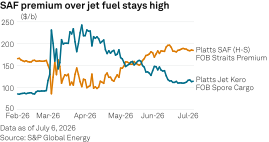
Platts assessed SAF (HEFA-SPK) FOB Straits at $2,475/metric tons on July 16, unchanged day over day.
