Crude Oil
May 14, 2026
INTERVIEW: Energy security drives focus on existing wells over new drilling

By Binish Azhar
Editor:
HIGHLIGHTS
Oil firms maximize output from existing wells
Venezuela workovers could boost production 40%
US rig count stays flat at 589 amid caution
Global energy security concerns are driving a shift toward maximizing production from existing oil and gas assets rather than relying on distant supply sources, creating opportunities for well intervention services in markets from the North Sea to Venezuela, Guillaume Borrel, CEO of oilfield technology company GOWell, said in an interview.
The change in strategy comes as countries reassess their dependence on production "on the other side of the planet," Borrel told Platts, part of S&P Global Energy, on May 12. The UK's North Sea basin exemplifies the trend, he said, noting 2024 marked the first year without a single new well drilled there as policy focused entirely on plugging and abandonment work. Now the government is considering incentives to boost output from existing assets, he said.
"A barrel that you produce without having to drill a new well will always be a more effective barrel," Borrel said, adding that workover projects and idle well reactivation represent faster paths to additional supply than new drilling campaigns.
Venezuela opportunity
GOWell, whose customer base includes major oilfield service providers such as SLB, Halliburton and Baker Hughes alongside regional operators, is positioned to support an expected uptick in Venezuelan activity through its existing clients, Borrel said. The intervention and workover specialist sees the market developing gradually due to surface infrastructure challenges, but views it as an imminent opportunity.
"That's definitely the first thing that will happen before we see massive drilling campaigns taking place," Borrel said of workover activity in Venezuela. Industry estimates suggest workovers and well reactivation could deliver 30% to 40% additional production compared with current output levels, he said.
The company's service offering is evolving to capture both production enhancement and decommissioning demand, with the latter driven by regulatory requirements in certain basins, Borrel said. While decommissioning activity has long been anticipated, it is finally materializing in some markets, he said.
Market outlook
Borrel said he does not expect oil prices remaining above $100/b to trigger dramatic changes in operator budgets or long-term planning, noting the market had an oversupply before recent disruptions. Even if shipping constraints through key straits resolve quickly, reopening shut-in production would require several months, he said.
"More than a number, it's really the conviction that wherever we're at it's going to stabilize," Borrel said. "If there's still huge volatility in the market, if we think it's another blip it will not materialize into significant changes in budgets."
In the US, operators are similarly focused on workover activity to improve output efficiencies, according to recent earnings from multiple oilfield service operators. Rig deployments remain a possibility further down the timeline as producers monitor the longevity of higher oil prices.
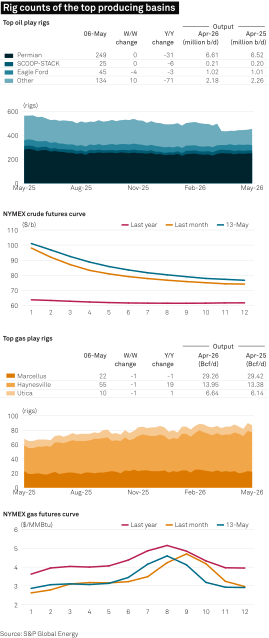
That cautious stance is reflected in US drilling activity, which has remained largely flat despite the recent price surge. The US rig count gained only one unit to 589 rigs in the week to May 6, according to S&P Global Energy CERA data published May 14. Total rigs are down 28 year over year, suggesting operators are maintaining capital discipline rather than rushing to add new drilling capacity.
Oil rigs added one to reach 463, while gas rigs held steady at 126. The muted activity aligns with Borrel's view that price volatility, rather than absolute levels, is keeping operators from committing to major budget increases.
The Permian Basin, the largest US oil-producing region, was unchanged at 249 rigs. The Eagle Ford lost four rigs to 45, while gas-focused basins also saw modest declines. The Haynesville, Marcellus and Utica basins each lost one rig, leaving them at 55, 22 and 10 rigs, respectively.