Crude Oil
May 14, 2026
Hormuz closure drives record tanker rates, boosts Teekay earnings

Editor:
HIGHLIGHTS
Teekay Q1 net income doubles to $153.6M
100+ tankers trapped, tightening fleet supply
Trade flows shift due to geopolitical disruptions
The effective closure of the Strait of Hormuz and the loosening of Venezuelan crude flows propelled midsize tanker rates to among the highest levels on record, Teekay Tankers executives told investors May 14, crediting the geopolitical environment for a surge in first-quarter earnings.
Teekay Tankers reported first-quarter 2026 net income of $153.6 million, or $4.42 per share, roughly double the $76 million it earned a year earlier. Adjusted net income was $128.3 million, or $3.69 per share, compared with $41.8 million a year earlier.
The owner of 33 oil and product tankers said Suezmax and Aframax/LR2 spot rates averaged $61,000/day in Q1, with Suezmaxes earning $62,124/day and Aframax/LR2s $59,934/day. Quarter-to-date Q2 rates have climbed further, with Suezmaxes booked at $121,800/day on 60% of available days, Aframax/LR2s at $98,000/day on 53%, and the company's lone VLCC at $141,800/day on 71%.
CEO Kenneth Hvid attributed the results to ongoing geopolitical disruption.
"Spot rates were close to the highest on record for a first quarter, primarily due to geopolitical events in both Venezuela and Iran," Hvid said. "The US blockade and the effective closure of the Strait of Hormuz, an unprecedented event which has not directly impacted the operations of our vessels, continues to disrupt the oil and tanker markets and has propelled our second quarter of 2026 to-date tanker rates to new record levels."
Changing trade flows
Following the start of US and Israeli strikes against Iran on Feb. 28, and a subsequent blockade of the strait by Iran and then the US, Middle East crude exports have fallen by about 10 million b/d versus prewar levels, even after Saudi Arabia and the UAE diverted some volumes to Yanbu on the Red Sea and Fujairah on the Gulf of Oman, the company said.
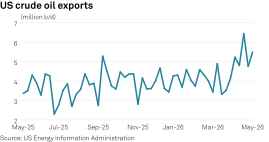
The Atlantic basin and the West Coast of the Americas have increased exports by about 4-4.5 million b/d since the conflict began, with US Gulf crude exports hitting a record 5-5.5 million b/d in April after Strategic Petroleum Reserve releases by the US Department of Energy.
Teekay said the resulting trade dislocations have tightened effective fleet supply. About 100 Aframax-sized or larger tankers are trapped west of Hormuz, including 59 VLCCs representing about 8% of the non-sanctioned VLCC fleet, with another 86 vessels idling outside the strait or off India's west coast, Hvid told investors.
Aframax voyage distances out of the US Gulf have lengthened 30% year over year, and 69 Suezmaxes loaded US Gulf cargoes in April, including five that transited the Panama Canal en route to Asia -- an unusual routing that the company said reflected Asian refiners' scramble for replacement barrels.
"It highlights the lengths to which refiners in Asia are willing to go in order to make up for the shortfall in Middle East oil," Hvid said.
Prior to the Iran conflict, rates had already firmed on tightening sanctions enforcement against Russia, Iran and Venezuela, which pushed cargoes from the dark fleet onto compliant tonnage. The US removal of Venezuelan President Nicolas Maduro at the start of 2026 freed Venezuelan crude exports to move on compliant ships to the US Gulf, Europe and India, supporting midsize demand, the company said.
Director of Research Christian Waldegrave said the supply shock could have a longer-lasting impact.
"There definitely will be a need to replenish inventories" once the Strait reopens, Waldegrave told investors, adding that some Asian importers may build new strategic stocks or diversify supply sources to reduce Middle East dependence, leading to lasting structural changes in the tanker market.
"Every country is looking at these choke points now and looking at ways to mitigate that risk going forward, which could lead to changing trade flows," he said.
Fleet renewal
In April, Teekay agreed to buy two Korean-built Suezmax for $190 million combined, with delivery in 2027, and in May sold a 2009-built Suezmax for $53.5 million. The company has now committed to five midsize tankers and four older vessels for disposal since the start of the year. A previously announced sale of a 2013-built VLCC for $84.5 million is expected to close in June, with combined Q2 sale gains of about $55 million.
Hvid said the elevated asset-price environment has slowed acquisitions.
"We were probably going slower on the buying side than we would have hoped to do," he told investors.
Teekay declared a $0.25/share regular quarterly dividend and a $1.00/share special dividend, payable June 2. Liquidity stood at $1.2 billion at quarter-end, with no debt and 24 unencumbered vessels following an April collateral release.
