Refined Products, Crude Oil, Maritime & Shipping
May 06, 2025
EU to target Russia's shadow fleet, mandate oil phase-out plans for Slovakia, Hungary

By Max Lin
HIGHLIGHTS
More crackdown on Russia's shadow fleet in breach of sanctions
Slovakia, Hungary required to present phase-out plans this year
European Commission promises new legislation next month
The EU plans to further crack down on Russia's growing shadow fleet of tankers and require Slovakia and Hungary to develop formal strategies to terminate Russian oil imports by 2027, according to a roadmap published by the European Commission May 6.
The measures are part of a broader effort to completely end the bloc's reliance on Russian energy imports, which continue to fund Moscow's war in Ukraine despite multiple rounds of sanctions since the 2022 invasion.
In the roadmap document, the EU executive focused on cutting purchases of Russian gas while highlighting that European sanctions have successfully reduced Russian crude imports from 27% of the bloc's total in 2022 to just 3% currently, but also promised fresh regulations to undermine the OPEC+ member's oil revenues next month.
The Commission's roadmap outlines a multi-pronged approach to tackle Russia's shadow fleet, amassed by Moscow in recent years to bypass Western sanctions and the G7 price cap.
"These vessels are often old, in bad shape, with obscure ownership and insurance," the Commission said. "They therefore present a tangible risk for the environment due to the risk of oil spills and other ship source pollution, which can cause environmental disasters."
An earlier analysis of S&P Global Commodities at Sea and Maritime Intelligence Risk Suite data suggested some 580 tankers might have been used to transport sanctioned Russian oil, frequently navigating through EU waters like the Danish Straits.
Last month, the Commission said all ships in EU waters would be required to provide insurance information even when in transit but stopped short of threatening to arrest non-compliant ships.
Brussels will instead step up diplomatic efforts with third countries, like flag states of ships in the shadow fleet, and enhance cooperation with the International Maritime Organization to establish stricter safety standards, according to the Commission.
Moreover, EU authorities will explore deploying an EU Common Security and Defence Policy mission to monitor maritime activities and potentially board suspicious vessels in the high seas or in the exclusive economic zones of EU member states.
The proposed maritime mission would have authority to conduct surveillance, request suspicious vessels to enter territorial waters for inspection, and potentially board vessels in international waters with flag state consent, the Commission said.
Pipeline dependency
The roadmap specifically targets Slovakia and Hungary, which remain heavily dependent on Russian pipeline oil. According to Eurostat data, Russian oil represented over 80% of total oil imports for both countries in 2023-2024, creating potential security of supply risks.
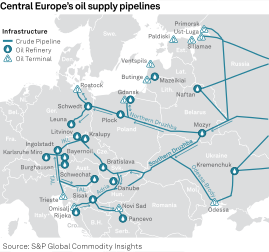
While the Czech Republic has completed the Trans-Alpine pipeline expansion in April, enabling it to replace Russian supplies with alternative sources, landlocked Slovakia and Hungary continue to rely on the Druzhba pipeline for most of their crude imports.
The EU has banned imports of seaborne Russian crude since December 2022 and petroleum products since February 2023, but provided a carveout for pipeline supplies for central European countries.
Through the southern branch of the Druzhba pipeline system, Russia is estimated to deliver 200,000-300,000 b/d of crude to Central Europe.
MOL, the sole refiner in Hungary and Slovakia still mostly relies on Russian oil supply to feed its major Danube and Bratislava refineries with a combined capacity of almost 300,000 b/d.
Based on the roadmap, the Commission intends to propose legislation requiring these countries to submit national plans by the end of 2025 outlining strategies to phase out Russian oil imports by 2027.
The countries will need to provide a timeline with milestones and corresponding measures, detail their diversification options and technical capabilities to replace Russian oil, and give information on the volume of their Russian oil imports under existing contracts and their expiry dates, according to the Commission.
"Sufficient infrastructure is available to replace such oil imports with non-Russian supply," the Commission stated, encouraging the affected countries to prioritize alternative supply infrastructure, particularly the Adria pipeline connected with the Croatian port of Omisalj.

Editor: