Maritime & Shipping, Crude Oil, Wet Freight
April 02, 2025
G7 tankers carry more Russian crude in March as Greek operators return amid weak Urals

By Max Lin
HIGHLIGHTS
Greek tanker firms capitalize on crude price-cap trading opportunities
Seychelles-based firms largest lifters of Russian crude amid sanctions evasion concerns
Operators' ability to remain within G7 price cap uncertain as Urals prices recover
Russia exported more crude on tankers supported by G7 maritime services in March, with Greece-based ship operators returning to the Russian market in droves to take advantage of price-capped trading opportunities.
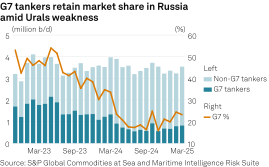
Nearly 820,100 b/d of Russia's seaborne exports in March were lifted by tankers flagged, owned or operated by companies based in the G7, the EU, Australia, Switzerland or Norway, or insured by Western protection and indemnity clubs, S&P Global Commodities at Sea and Maritime Intelligence Risk Suite data shows. Of the total, 553,500 b/d was carried by ships operated by Greek firms.
The March volume was the third highest in the last 12 months and was higher than the 787,200 b/d exported in February.
The increase in shipments on G7-linked tankers came as the monthly average price for free-on-board Primorsk Urals, Russia's flagship crude grade, fell 4.7% month on month to $57.421/b in March -- the lowest average since June 2023 -- according to data from Platts, part of S&P Global Energy.
G7 countries and their allies allow maritime services firms to transport Russian crude to other countries when the barrels are sold for no more than $60/b, and market participants have suggested tanker operators in Greece, Europe's top shipowning nation, would generally be willing to trade in Russia within the price cap regime.
With shipping capacity expanded due to the average Urals price falling below $60/b, sources said the lump sum Aframax rate for transporting Russian crude from the Baltic Sea to West Coast India -- the top buyer of Russian oil -- has fallen to around $6.5 million in recent deals and quotes from $7 million on March 19.
Whether tanker operators can continue operating within the G7 price cap in Russia in April remains to be seen, as Urals prices recovered to $62.295/b on April 1 from $54.47/b on March 5 amid recent crude strength, based on Platts assessments.
The discount of Urals to Dated Brent has been stood at $14.30/b-$14.50/b in recent weeks.
Seychelles-registered firms top Russian crude lifters in March
Overall Russian seaborne crude exports rose nearly 10% on the month to more than 3.5 million b/d in March. Non-G7 tankers loaded 2.7 million b/d, or 76.8% of total exports, marginally higher than the 75.6% share in February.
Those shipments were predominantly transported by the shadow fleet, established by Russian state interests and opaque operators to maintain the OPEC+ producer's overseas crude sales in circumvention of Western trade restrictions.
The US has suggested sanctions against Russia would evolve based on how the Ukraine-Russia peace talks progress, and market players said lifting sanctions could send most ships in the fleet to junkyards due to their old ages and lack of maintenance.
"Nobody wants to use an old, unmaintained ship for their supply chain," Larry Johnson, global head of freight at Mercuria, said at a Financial Times conference recently.
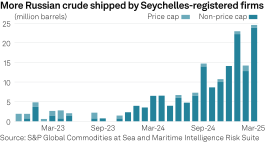
CAS and MIRS data shows Seychelles-registered firms lifted 24.5 million barrels of Russian crude in March, of which 97% was on ships without G7 links. This was the highest among all countries in March and was also the highest for the East African island nation since the price cap came into force in December 2022.
The Seychelles is a popular jurisdiction for shell companies that exist on paper only. Past media investigations have found some Russians operate opaque businesses via front companies in the jurisdiction.
Seychelles-registered firms have been among the top buyers of tankers from Western owners, with an aim of operating outside of the price cap, according to Follow the Money, a project by the nonprofit Platform for Investigative Journalism.