Crude Oil, Refined Products, LNG, Coal, Electric Power, Fuel Oil, Nuclear
March 11, 2026
15 years after Fukushima disaster, Japan confronts new energy crisis

HIGHLIGHTS
Hormuz disruption threatens bulk of Japan's crude supply
Qatar LNG played significant role post-Fukushima disaster
Energy resilience improved; scope to boost self-sufficiency
Fifteen years after the Great East Japan Earthquake struck offshore Fukushima on March 11, 2011, Japan is confronting a new energy crisis as the Middle East conflict disrupts shipping through the Strait of Hormuz, testing the resilience of its energy supply system.
The magnitude-9 earthquake that struck northeastern Japan and the subsequent tsunami shut more than 18 GW of nuclear and thermal power generation capacity -- including Tokyo Electric Power Co.'s Fukushima Daiichi and Fukushima Daini nuclear power plants -- and shut one-third of the country's refining capacity of 4.52 million barrels/day.
Fifteen years on, Japan could be facing its most severe energy crisis since the Great East Japan Earthquake if disruptions in the Strait of Hormuz continue, said Nobuo Tanaka, former executive director of the International Energy Agency.
"The big energy shock. So strategic stockpile releases should be utilized if necessary," said Tanaka, who triggered the release of 60 million barrels of oil from emergency stockpiles as IEA chief in June 2011 in response to supply disruptions from Libya.
If disruptions in the Strait of Hormuz last more than three to four weeks, "I think the shortage of supply will hit each consuming country," Tanaka said.
"I think the IEA's role is definitely limited compared with other crises," Tanaka added, referring to the volume of emergency oil stocks held by IEA members.
The IEA, whose 32 member countries hold more than 1.2 billion barrels of public emergency oil stocks, has previously authorized five collective stock releases, most recently in 2022 following Russia's invasion of Ukraine.
Japan, which took part in the IEA's last oil release until the end of April 2024, held about 468.28 million barrels of petroleum reserves -- equivalent to 254 days of domestic consumption -- at the end of December 2025, the latest Ministry of Economy, Trade and Industry data showed. These included national petroleum reserves, oil reserves held by the private sector and a joint crude oil storage program with oil-producing countries.
Japanese Prime Minister Sanae Takaichi said March 11 that Japan will release 15 days' worth of privately held oil reserves from March 16, along with one month's worth of national oil reserves, in response to an expected decline in the country's crude imports from late March, as tankers have effectively been unable to pass through the Strait of Hormuz.
However, it was unclear whether Japan has enough tankers to move a significant volume of oil nationwide if petroleum reserves were released to offset supply losses from the Strait of Hormuz disruption, given that the country has faced transportation restrictions for jet fuel in recent years.
It was also unclear whether heavy sour crude grades, such as Khafji, stored in the national oil reserves, would be compatible with Japanese refiners' residual cracking capacity, which has declined following a series of refinery closures.
The Middle East accounted for 93.5% of Japan's crude oil imports in 2025, according to METI data.
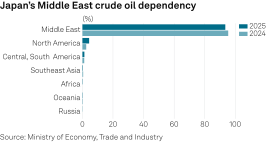
Meanwhile, Japan's LNG imports via the Strait of Hormuz reached about 4 million metric tons in 2025, accounting for 6.3% of the country's total imports, with Qatar supplying 5.3% and the UAE 1%, Ministry of Finance data showed. Including Oman's 4.5% share, the Middle East accounted for 10.8% of Japan's LNG imports last year.
On March 10, METI said Japanese power and gas companies are currently holding nearly 4 million mt of LNG in inventory -- equivalent to about one year of imports.
QatarEnergy said March 2 that it has suspended LNG production due to military attacks on its operating facilities in Ras Laffan Industrial City and Mesaieed Industrial City.
"If LNG cannot come out of the Strait of Hormuz, Japan will be affected to some extent, since not all of its LNG is secured through long-term or medium-term contracts," said Jun Nishizawa, currently a visiting fellow at the Institute of Energy Economics, Japan, after serving as group CEO of Mitsubishi's Natural Gas Group.
"However, the impact will be relatively limited, because Japan does have diversified supply sources," Nishizawa added.
Qatar LNG
In the wake of the 2011 Fukushima crisis, it was Qatar that significantly boosted LNG supplies to Japan, a move that paved the way for JERA's Feb. 3 signing of a 27-year, 3-million-mt/year sale and purchase agreement with QatarEnergy, said Kosuke Tanaka, head of the LNG division at Japan's largest power generation company.
JERA also signed a memorandum of understanding with METI and QatarEnergy to establish a trilateral framework for securing additional LNG supplies in emergency situations.
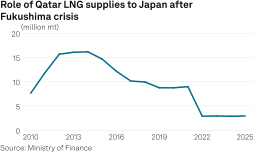
"There's no doubt that our past experience with them played a significant role in us deciding to sign a major contract with Qatar this time," said Tanaka, who was TEPCO's assistant manager of LNG Purchase Group 1 at the time of the earthquake.
In response to the increase in LNG demand after nuclear power plants were shut nationwide following the Fukushima nuclear accident, Hiroki Sato, who was head of the LNG business at Chubu Electric Power Co. in 2011, said, "Qatar played a very significant role" in supplying LNG to Japan.
"Qatar was a trustworthy supplier [...], when Japan had no choice but to buy LNG," said Sato, who is currently division CEO of global business at Chubu Electric, after serving in roles including chief fuel transactions officer at JERA, in which Chubu Electric holds a 50% stake.
QatarEnergy did not respond to a Feb. 26 request for comment on how it would respond to Japan's LNG needs under normal and emergency conditions following the SPA and MOU.
Increased resilience
The 2011 earthquake helped strengthen Japan's fuel security through both policy measures and industry initiatives.
"Including the Great East Japan Earthquake, various disasters and incidents have occurred, and through these experiences, we have become even more aware of the need to ensure a stable and appropriate domestic energy supply," said Hajime Wakuda, METI's director-general of natural resources and fuel.
"Therefore, we are constantly reviewing our systems to ensure the proper supply of fossil fuels, and since the Great East Japan Earthquake, we have been continuously working on this issue," Wakuda added.
The subsequent increase in LNG demand following the 2011 earthquake led Chubu Electric and TEPCO -- which later formed JERA in 2015 -- to develop practices now commonly used, such as ship-shore compatibility for LNG carriers and master agreements for LNG supplies, enabling quick responses to contingencies, according to Sato and Tanaka.
"To elaborate a bit more, we have been operating with a slightly larger number of FOB cargo vessels, and we are also utilizing some of them as floating storage," Tanaka said, adding that JERA currently operates a fleet of 22 LNG carriers. "Right now, the FOB ratio in JERA's portfolio is almost as high as 50%."
Energy mix
Meanwhile, TEPCO is set to resume commercial operations at the 1.356-GW No. 6 reactor of the Kashiwazaki-Kariwa nuclear power plant in Japan's northwest on March 18, marking the company's first reactor to return to commercial output since the Fukushima crisis.
Once it resumes commercial operations, TEPCO's No. 6 Kashiwazaki-Kariwa reactor will become the 15th reactor in Japan restarted under the new regulatory standards introduced in 2013. At the time of the 2011 earthquake, Japan had 54 operable reactors.
"In terms of energy self-sufficiency, after the nuclear power plants were shut down, things changed. Back at the time of March 11, [2011], nuclear power accounted for more than a quarter of Japan's energy, which helped keep the self-sufficiency rate high," said Takeo Kikkawa, president of the International University of Japan.
"Now, with nuclear reduced to about 8%, renewables, especially solar, have increased to make up some of the difference. But overall, the combined self-sufficiency rate is still only about 15%," said Kikkawa, who was previously involved for many years in the formulation of the Strategic Energy Plan -- Japan's principal energy policy -- as a member of METI's advisory committee.
However, Kikkawa said Japan's self-sufficiency rate could improve to about 30% by fiscal year 2040-41 (April-March), taking into account various scenarios outlined in the 7th Strategic Energy Plan formulated in 2025.
Japan, which once aimed to be "a nuclear-powered nation" before the 2011 earthquake, has shifted toward becoming a country powered by renewable energy, said Nishizawa, who was previously a member of METI's Natural Resources and Fuel Committee, referring to the 7th Strategic Energy Plan.
"Even now, nearly 15 years after the earthquake disaster, there remains a strong atmosphere that 'we must not even discuss' the [nuclear] issue. And precisely because the debate over nuclear power, which lies at the core of energy policy, has not been resolved, I feel that discussions on energy security are not progressing," Nishizawa added.
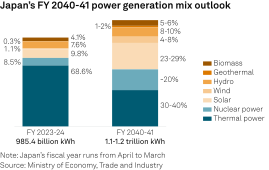
The FY 2040-41 power generation mix is projected to comprise roughly 40%-50% renewables, about 30%-40% thermal power and 20% nuclear power, compared with 22.9% renewables, 68.6% thermal power and 8.5% nuclear power in FY 2023-24.
"As long as we follow the mainstream path of energy security through an energy mix, we should not limit our fossil fuel options solely to LNG," Nishizawa said, pointing to sharply reduced investments across the entire coal value chain -- including upstream operations, rail transport, ports, shipping, terminals and power generation.
"It is essential to properly maintain the coal value chain as well," Nishizawa added.

Editor: