Crude Oil, Refined Products
January 05, 2026
Venezuela crisis seen having minimal impact on Indian oil flow, upstream developments eyed

HIGHLIGHTS
Venezuelan crude flows to India have largely dried up following sanctions
State upstream producers monitoring situation for investment implications
Refiners open to Venezuelan crude imports if conditions become favorable
India's downstream sector is unlikely to witness any major impact following the geopolitical developments in Venezuela, as oil flows from the South American supplier had largely dried up long before the recent crisis, regional industry sources and market analysts told Platts, part of S&P Global Energy, on Jan. 5.
State-run upstream producers are closely monitoring the situation to gauge the potential implications of their investments in Venezuela, sources said.
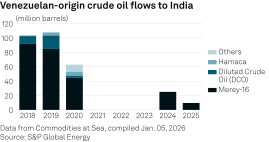
India is not new to Venezuelan crude. The country imported 108 million barrels -- or around 300,000 b/d -- of Venezuelan-origin crude oil in 2019, showed data from S&P Global Commodities at Sea. The flows have since declined to 25 million barrels in 2024, while only one VLCC discharged Venezuelan crude into the port of Sikka in 2025.
Venezuelan crudes imported by Indian refiners, such as Merey-16 and Hamaca, are typically heavy, with high sulfur and high asphaltene content, producing a higher percentage of residue.
"There could be some short‑term uncertainties with the continuation of the US embargo and knock-on effects of the blockade. But in a scenario where sanctions are removed, US oil companies resume investments in Venezuela's oil sector, and oil flows return to normal, it would be positive for India. Indian refiners are very familiar with Venezuelan crude and would be open to buying again once conditions are favorable," said Premasish Das, executive director for oil analytics at S&P Global Energy CERA.
"Recent developments in Venezuela are a matter of deep concern. We are closely monitoring the evolving situation," India's foreign ministry said in a statement over the weekend.
Upstream investments
Venezuela has some of the largest oil reserves in the world, at about 364 billion barrels of oil equivalent, according to S&P Global Energy CERA. Venezuela's largest oil fields include 14 supergiant fields, 11 of which still have more than 50% of their reserves. Venezuela's oil production has fallen from 3 million b/d in January 2008 to about 963,000 b/d in December.
"If things improve, Indian investments in Venezuelan oil fields and the locked-in revenue due to sanctions could open up and ONGC Videsh could greatly benefit from it. Indian refineries like Reliance Industries Ltd, Indian Oil Corp and Mangalore Refinery and Petrochemicals Ltd will benefit from heavy crude flows from Venezuela," DLN Sastri, former director of oil refining and marketing at the Federation of Indian Petroleum Industry, told Platts.
ONGC Videsh is involved in two upstream projects in Venezuela -- San Cristobal and Carabobo-1, according to its website. OVL acquired a 40% stake in the San Cristobal oilfield in 2008, with the remaining 60% owned by state-run PDVSA through its subsidiaries. The Carabobo area is located east of the Orinoco oil belt, with ONGC Videsh holding an 11% stake, IOC 3.5%, and Oil India 3.5%.
"For our upstream investments in Venezuela, it's a wait-and-watch situation at the moment," said a senior Indian upstream source.

Editor: