Chemicals, Natural Gas, Maritime & Shipping, Polymers
October 08, 2026
Egyptian K67 PVC shortage tightens supply in Brazil: sources

Editor:
HIGHLIGHTS
Spot prices climb $35/mt amid shortages
Traders flag production issues at a supplier
The absence of Egyptian polyvinyl chloride offers to Brazil for several weeks has pushed up import-market prices, with sources saying that buyers are increasingly turning to off-grade material amid limited alternatives.
Egypt is one of Brazil's main PVC suppliers that benefits from import tariff exemptions under a bilateral agreement.
In the first week of September, multiple Brazilian traders said that one of Egypt's producers had experienced a production problem, and that the availability of material for shipment in October would therefore be reduced. However, even after October, the same sources continued to report that production remained intermittent, leading to the disappearance of offers of Egyptian K67-grade PVC from the Brazilian market.
"Everyone is talking about the same thing," a trader said on Oct. 7, adding that one of the producers is "really having an intermittency problem, and the Egyptian material has disappeared."
A second trader said he had no Egyptian material available to offer his customers and that any price indication at this point would be only an estimate. "Everything is difficult," the source said.
Platts, part of S&P Global Energy, last assessed spot PVC at $940/metric ton CFR Brazil on Oct. 7, including duties, up $35/mt on the week.
A third trader reported receiving a request for a quotation for Egyptian K67 PVC from a customer that regularly buys more than 1,000 mt of resin per month, but said he could not fulfill the request. "This is the first time this customer has asked me for an offer; every other time, I was the one who approached him," the source said. "I believe he must be feeling a shortage at this point."
The same source, however, said offers of Egyptian K6701-grade PVC were available for October shipment, priced at $930-940/mt CFR Brazil. "The difference is the use of additives. For white pipes, the material cannot contain so many additives that compromise the product's color. K6701 has a more yellowish color; it is suitable for gray, blue and brown pipes," the source explained.
A PVC compound seller said he viewed the possibility of buying off-grade material with caution. "My customer who receives my compound is sensitive about the quality of the material. He has been complaining. So, we will choose to use a more reinforced resin."
Reports were also heard during the week of a shortage of Egyptian-origin polypropylene in Brazil in the week ending on Oct. 7, although no PP production problems were reported.
A fourth trader said that the main problem with the supply of Egyptian resins was not only production but also cost, driven by gas prices. "The problem is not production; it is cash flow," the source said, adding that he expects delays in Egyptian material shipments in the coming weeks.
A fifth trader said he had received a response from a PVC supplier in Egypt stating that the situation may take four to six weeks to normalize. "They are experiencing a lot of intermittencies. They produce for three days and then remain shut for four," the source said.
The same trader said he was negotiating K67 cargoes scheduled for shipment in December. "I am making a forward sale," the source said, adding that the high inventories built up in the market during the previous months were easing pressure on the market. "The people who are buying are not short on inventory; they push the freight further out, and whenever it arrives, it arrives."
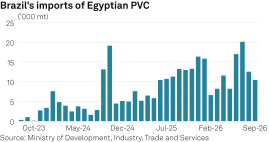
In September, Brazil's imports of PVC from Egypt fell 21% compared with the same month of 2025, according to the Ministry of Development, Industry, Foreign Trade and Services. The trade ministry data reflects cargoes that entered the country in September and may not correspond to sales finalized during that month.
Given the lack of offers in recent weeks, market participants expect the figures in upcoming releases to remain negative.
