Chemicals, Polymers
October 02, 2026
EU antidumping probe triggers reassessment of global PVC trade flows
Editor:
HIGHLIGHTS
Thailand, Brazil among alternative suppliers
Concerns over imports of downstream goods
US could face greater competition in export markets
The global polyvinyl chloride market has spent the past week reacting to the European Commission's initiation of an antidumping investigation into PVC imports from China, South Korea, Mexico and Taiwan.
Europe
In Europe, the immediate reaction from producers has been largely positive, with many welcoming the prospect of protection against more competitively priced imports with lower production costs. However, some producers also noted that the probe has come too late, with damage already inflicted on the European PVC industry. Some pointed to the most recent news on Sept. 29 that Westlake Vinnolit plans to close its Cologne plant in Germany by Q1 2027.
"We support this process," a European producer said, while a second European producer described the news as "positive."
"It was told many time that it will come, from that end it was a little bit unserious, but on the other hand, it was somehow expected to happen," a third European producer said.
Meanwhile, some market participants said any potential duties could have a negative downstream impact by encouraging imports of finished and semi-finished goods from similar regions. In the immediate future, consumers and traders have focused on reducing their exposure to any potential retrospective duties. Consumers increased their preference for buying on a free-delivered basis, while traders looked to sell on a CIF basis for consumers to take on duty risk. Traders were heard to hold mixed warehouse inventory levels.
"Antidumping duties are a waste of everyone's time and money. The problem is EU oversupply and bad economic policy. They can blame importers all they want. They will kill downstream industries with this nonsense," a European trader said.
"We are reducing CIF orders where customers won't take the risk," a second European trader said.
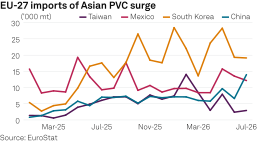
Asia
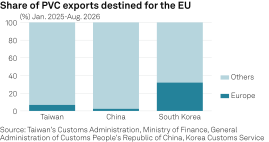
In Asia, market participants in China and Taiwan expect limited disruption even if the European Commission ultimately imposes antidumping duties on PVC imports, citing Europe's relatively small share of their overall export volumes.
Chinese traders largely downplayed the potential impact on regional PVC prices, noting that India remains the key outlet for Chinese exports and that volumes shipped to Europe are relatively small. They added that any impact would likely be concentrated among a limited number of ethylene-based PVC producers with established sales into Europe, with affected volumes insufficient to materially alter broader trade flows.
South Korean exporters, however, could face greater exposure, as Europe accounts for around a third of South Korea's PVC exports.
"The ADD is unlikely to put pressure on PVC prices," a Chinese trader said.
In the shorter term, market reaction has nevertheless been mixed since the launch of the investigation. A Taiwanese producer described buying interest as increasingly divided, with some customers accelerating purchases ahead of potential measures while others have paused procurement amid uncertainty.
"Some customers are rushing to secure larger volumes and build inventories, while others have stopped buying because they are concerned about potential duties," a Taiwanese producer said.
The Commission said it will register imports from all four origins early in the investigation, potentially allowing duties to be applied retroactively to registered volumes if measures are imposed.
"Thus, many buyers see securing cargoes now as the safest approach. Delaying purchases could leave shipments exposed to retrospective duties," a Chinese producer added.
US and Latin America
For US market participants, the primary focus has been the prospect of increased competition in export markets. Asian and Mexican suppliers shut out of the EU would likely seek alternative outlets, potentially placing additional volumes into Latin America, Africa, and Turkey and other markets where US PVC already competes. Although for Turkey, duties could result in less competition from Europe in Turkey, where there is likely to be higher domestic consumption.
"[There would] likely be more competition outside Europe as Asian and Mexican tons look for other homes," a US trader said, adding, "that [this] could squeeze US export prices more than volumes."
US exporters have recently benefited from higher freight costs, limiting Asian competition in Latin America. However, redirected Asian and Mexican supply could increase competition in these markets and put greater pressure on US export prices.
Although US market participants are considering the possibility of increased competition in Latin America, local sources say the likelihood of a significant shift in trade flows, including alternatives from China, South Korea, and Taiwan, is limited, especially on the West Coast of South America.
"The US will never lose its dominance in the Latin American market, thanks to cost and logistical advantages," a Colombian market participant said. "I don't believe any Asian producer will gain a dominant position in the region."
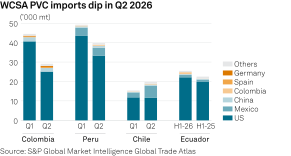
On the other hand, the potential redirection of material from Mexico to Europe is a source of uncertainty in the region, a second Colombian source said.
Vestolit, the Colombian subsidiary of Mexican producer Orbia, is a major PVC supplier to Brazil. One scenario envisioned by the market is that Orbia might redirect material from Colombia to Europe if the antidumping duty against Mexico comes into effect, the same source said.
However, while the impact on supply to Brazil remains unclear, market feedback suggests that the Colombian producer's priority will likely remain the local market and Brazil, where tariff exemptions benefit exports.
Another factor weighing in is the uncertainty regarding the determination of the ADD on US PVC in Mexico, and the impact this would have on export volumes. "At the end of the day, domestic markets will always be the priority," the first Colombian source said.
Alternative supply routes
Market participants said that, should antidumping duties be imposed at levels sufficient to close the arbitrage from the targeted origins, other import supply would likely persist but become more fragmented.
Rather than relying on regular, large-volume imports from a limited number of countries, buyers and traders may need to source material from a broader range of origins on a more opportunistic basis. Countries cited by market participants as potential alternative sources included Brazil, Thailand, Japan, South Africa and Qatar.
However, the volumes and competitiveness of material from some of these origins were unclear. In Brazil, PVC exports to Europe totaled 7,455 metric tons between January and August 2026, according to data from the Ministry of Development, Industry, Trade and Services. This represents a 203.5% increase compared to 2025, yet the volume remains negligible when compared to the 310,824 mt of PVC imported by Brazil during the same period, primarily from Colombia and Egypt.
Sources familiar with the Brazilian domestic market indicate that the strategy of local producers, Braskem and Unipar, is expected to remain mainly focused on the domestic market. It is understood that the recent exports were isolated moves driven by fleeting opportunities. Market feedback also suggests that Brazilian material would struggle to compete against cheaper material from other origins in Europe.
While some of these origins are currently uncompetitive into Europe, sources noted this could change if antidumping duties were implemented, potentially supporting European prices. Traders added that they had already begun testing small volumes from some of these regions.
"Yes, not a problem, it's endless, but we will need a variety to be consistent," the first European trader said in response to being asked about alternative suppliers.
"We are getting customers to approve as many materials as possible, they are on board to test, but it is still early," the second European trader said.
