Chemicals, Maritime & Shipping, Refined Products, Electric Power, Natural Gas, Olefins, Polymers, Naphtha, LPG, Aromatics, Solvents & Intermediates
September 24, 2026
European petrochemical markets brace for prolonged Rhine disruption

Editor:
HIGHLIGHTS
Low water levels disrupt European petrochemical logistics
Butadiene, propylene markets face greatest exposure
Participants fear Q4 supply strain if conditions persist
European petrochemical market participants are increasingly concerned that persistently low Rhine water levels could continue to disrupt logistics, raise delivered costs and tighten supply chains into the fourth quarter, with some warning that the full impact may only emerge if current conditions persist for several more weeks.
The Rhine, one of Europe's most important chemical transport arteries, has been under pressure since July as dry weather steadily reduced navigable water levels. Initial concerns emerged in mid-July when water levels at the Kaub chokepoint approached the critical 40 cm threshold, a level at which freight shipping is often suspended. Conditions subsequently deteriorated further, with the navigable water depth at Kaub falling below 10 cm on Aug. 14, marking a record low.
Platts assessed the Rhine water levels at the Kaub chokepoint at 11 cm on Sept. 23, down from around 105 cm three months earlier.
The river is a vital transportation route linking the Amsterdam-Rotterdam-Antwerp hub with major German chemical production centers, including Ludwigshafen, Cologne, Leverkusen and Wesseling. While cargoes continue to move, participants said barge loadings remain severely restricted, forcing companies to rely increasingly on rail and truck alternatives at significantly higher costs.
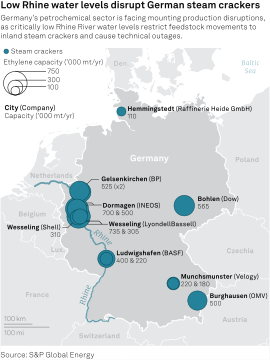
Market sources across multiple petrochemical value chains said operational difficulties have intensified as barges can only carry a fraction of their normal capacity. One C4 trader said barge loadings were recently limited to around 700 mt compared with a typical capacity of approximately 2,000 mt. Other participants reported maximum achievable loads of as little as 450 mt, increasing freight costs and reducing the efficiency of inland supply movements.
Barges on the Rhine can typically carry cargoes of between 2,000 metric tons and 5,000 mt. When the water depth falls below 75 cm, barge loads need be cut by up to 75%.
Concerns surrounding Rhine logistics have already translated into production disruptions. LyondellBasell declared force majeure at its 170,000 mt/year butadiene extraction unit in Wesseling on July 16 after low water levels restricted feedstock deliveries to upstream crackers. Covestro also declared force majeure on polyether polyols production at Dormagen in August, citing feedstock supply disruptions linked to Rhine conditions. BASF meanwhile declared force majeure on certain surfactant products as raw material availability was affected by logistics constraints.
Market participants noted that the disruption extends beyond transportation alone. Low river levels and elevated water temperatures have complicated cooling operations at some petrochemical facilities, creating a dual challenge for producers already struggling to secure sufficient feedstock supplies.
Olefins logistics pressure
In the butadiene market, participants said the disruption has reshaped regional trade flows. Producers historically reliant on Rhine shipping have increasingly turned to rail transportation, while Central European producers with established rail networks were heard benefiting from stronger demand as buyers sought alternative sources of material. One producer described rail substitution as creating substantial additional costs due to limited infrastructure availability.
"We have to use rail transfer carts to deliver into Central Europe. ... The market simply doesn't have enough technical infrastructure, adding huge costs to shipment," one producer said.
FOB Rotterdam Butadiene averaged $1,184.41/mt so far in September, up from an August average of $1,026.50/mt, a gain of nearly $158/mt.
The propylene market has also remained particularly sensitive to Rhine-related logistics disruptions due to its reliance on barge movements between the ARA region and inland German production sites. Market participants said restricted naphtha and LPG deliveries earlier in the summer reduced feedstock availability at steam crackers, limiting the production of propylene and related derivatives. Reduced vessel capacity has forced companies to increasingly rely on rail and truck alternatives, significantly increasing delivered costs and raising concerns about supply availability if low water levels persist into the fourth quarter.
Participants said reduced vessel capacity had increased the likelihood of dead freight costs, forcing companies to choose between accepting higher logistics expenses or utilizing more expensive rail and truck alternatives. Sources also warned that rail capacity alone would be insufficient should Rhine disruptions persist over an extended period.
In addition, rail options in Germany are limited because of the closure of the right-bank Middle Rhine Line, a key German freight route, between July 10 and Dec. 12 for refurbishment.
By contrast, the European ethylene market has been comparatively less exposed to Rhine disruptions, as a significant proportion of regional ethylene volumes are transported through the established pipeline network connecting major production and consumption centers.
Aromatics disruptions
Across the aromatics chain, participants said low Rhine water levels have weighed on both supply and demand fundamentals. In benzene, difficulties loading and transporting barges were heard weighing on demand, while disruptions to feedstock transportation along the Rhine and challenges related to cooling systems required for benzene extraction were also affecting supply.
Market participants said the styrene market appeared better positioned to manage the disruption, citing a customer base less concentrated in the Rhine region and greater access to rail and truck logistics.
Benzene CIF ARA averaged $1,264.29/mt so far in September, up from the August average of $1,103.39/mt.
Phenol and acetone markets have also faced challenges securing feedstock supplies. One distributor said exceptionally low Rhine levels were restricting access to raw materials and were "directly impacting the situation in Germany." Another producer described Germany as currently the "most attractive place to sell" as local production issues, exacerbated by a lack of feedstock travelling down the Rhine, left buyers short of material.
Methanol strain
Methanol market participants likewise identified Rhine logistics as their primary concern. Barge loading restrictions reduced throughput at terminals, driving storage utilization toward capacity and creating congestion across alternative transportation networks.
According to a source at a terminal in the ARA region, loading constraints pushed storage tanks into the mid-90% range by the end of August and prompted requests from suppliers for additional spot tank capacity as challenges discharging material persisted. Even those not reliant on the Rhine for feedstock deliveries were indirectly affected by congestion at terminals caused by a surge in rail and truck loadings.
A methanol buyer said it had become increasingly difficult to secure new loading slots if assigned rail slots were missed because of increased demand from those forced to find alternatives to barge loadings. Another buyer said the maximum barge load currently achievable was around 450 mt and that low production rates and high residual stock levels had sustained operations despite the logistical disruption.
Market participants estimated freight costs at about 2.5-3 times normal levels, while producers were already contending with elevated electricity and natural gas costs.
"The only reason we are not stopping is because of costs in idling the plant and German subsidies on natural gas," the buyer said.
Market watches duration
Looking ahead, market participants said the duration of the disruption will likely determine its eventual impact. Several sources noted that the industry has become more resilient following previous Rhine-related disruptions in 2018 and 2022, with many companies implementing contingency plans and diversifying transportation options. However, participants cautioned that rail capacity remains constrained and cannot fully replace river transport over extended periods.
Water levels at Kaub, stood at 11 cm as of Sept 23, after mostly hovering around 30 cm between Sept. 14 and Sept. 17.The levels are now forecast to approach zero by Sept. 28 and then remain at that level for at least three days, according to data from the German water authority WSV.
One European source warned that alternative transport options would not be sufficient over an extended period, cautioning of a potential "domino game" if inland supply chains come under mounting strain as low water levels persist.
With Rhine levels expected to remain seasonally weak through the coming weeks, participants across olefins, aromatics and derivatives markets said they would continue closely monitoring water-level developments. While widespread shortages have so far largely been avoided, concerns persist that prolonged logistical constraints could result in additional production disruptions, tighter regional availability and higher delivered costs heading into the fourth quarter.
Platts is part of S&P Global Energy.
