Chemicals, Polymers
September 16, 2026
US recycled polymer demand remains tepid amid legislative fragmentation
By Elleen Kim and Tareen Kazi
Editor:
HIGHLIGHTS
State PCR mandates remain lax, sources say
Legislation should target driving demand, not supply: sources
Economics of polymer recycling remain challenging
As the most recent wave of voluntary corporate sustainability commitments has largely passed without delivering concrete demand, recycled polymer market participants depend on a fragmented legislative landscape to bolster demand for recycled polymers, while cheap virgin resin continues to undercut adoption.
The US recycling system is governed by a patchwork of federal waste laws and increasingly ambitious state policies, with states taking the lead on recycling reform while Congress continues to debate broader national measures.
At the federal level, the Resource Conservation and Recovery Act, enacted in 1976, established the framework for solid and hazardous waste regulation, but it did not create a national recycling mandate, standardize municipal recycling programs or require producers to finance recycling systems.
The US generated 35.7 million tons of plastic waste in 2018. Of that, 75.6% went to landfills, 15.7% was sent to waste-to-energy facilities, and 8.7% (3.1 million tons) was recycled, according to the latest EPA data.
State recycling efforts
Some states, due to the lack of federal progress, have opted for more direct policies, with varying degrees of ambition.
One key state policy is the use of extended producer responsibility agreements, which shift the responsibility of managing the life cycle of a product and its packaging from municipalities and waste management companies to brand owners and packaging producers. Currently, seven states employ EPR schemes: Maine, Oregon, Colorado, California, Minnesota, Maryland and Washington.
Aside from EPR programs, 10 US states operate container deposit systems, or bottle bills, requiring consumers to pay deposits on certain beverages that are refunded when empty containers are returned for recycling: California, Connecticut, Hawaii, Iowa, Maine, Massachusetts, Michigan, New York, Oregon and Vermont. The financial incentive typically achieves higher beverage container recovery rates than conventional curbside recycling.
Also, recycled sources find the quality of material coming from deposit systems to be higher as opposed to plastics coming from the curbside recycling system, which contain higher amounts of contamination.
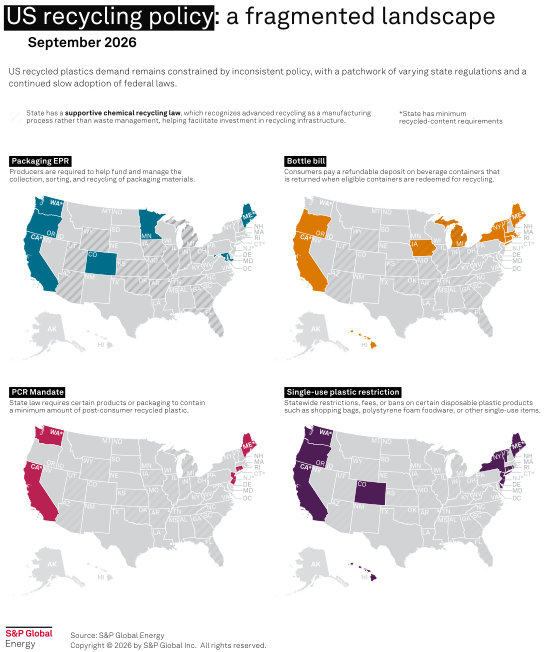
Some states have also opted to support advanced recycling, with 26 classifying it as a manufacturing process rather than solid waste management, thereby exempting advanced recycling plants from stricter environmental guidelines and increasing access to grants and tax benefits, and permitting manufacturers to use mass-balance attribution to allocate recycled content to products.
Despite these moves by states, sources said policies should focus on stimulating demand, not supply.
"We're increasing supply, but there is no mandate for brands to use recycled material," a source from a material recovery facility said. "Even if there's a mandate, people can import recycled content from overseas."
California, Washington, New Jersey, Connecticut and Maine have minimum recycled-content requirements, with California and Washington requiring at least 25% post-consumer recycled plastic, rising to 50% by 2030 and 2031, respectively, while New Jersey on Sept. 2 pushed back its food-contact packaging exemption to 2030 from 2027.
However, sources have found that brands often opt to pay the penalties rather than use the minimum required amount of PCR in packaging in these states, given the large premium of post-consumer resin over virgin resin.
"These states are not enforcing the legislation strictly," a source from a consumer goods brand said.
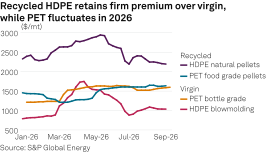
Platts assessed virgin PET at $1,598/mt DDP USWC Sept. 15, which is at a premium to Post-Consumer PET Premium Bottle Bales at $264.55/mt EXW Los Angeles, though the recycled PET requires additional costs associated with further sorting and processing.
Sources have underscored that virgin resin is cheaper to process, causes less machinery wear and arrives uncontaminated compared with recycled feedstocks.
Recycling in the US is "not built on an economic model," a recycler said. "Virgin plastic is inexpensive and better quality."
Federal progress behind states
Federal efforts have focused more on strategy and funding than on binding regulation. The Save Our Seas 2.0 Act, signed in 2020, directed the EPA to develop national recycling strategies, leading to a voluntary goal of raising the national recycling rate to 50% by 2030, though the agency's most recently published rate stands at 32%, based on 2018 data.
Several proposals remain under consideration in Congress. The Recycling Infrastructure and Accessibility Act of 2025 has made the most visible progress, proposing an EPA grant program to expand recycling access and curbside collection in underserved communities. The Recycling and Market Accountability Act would permit mass balance accounting for recycled-content verification, while the Tracking Plastic Waste Act would require physical traceability through the supply chain. Neither has advanced to a floor vote. The broadest proposal, the Break Free from Plastic Pollution Act, which would establish a national EPR framework, a nationwide deposit program and recycled-content requirements, has been reintroduced across multiple congressional sessions without advancing from committee.
The disconnect between US state and federal policies continues to slow the adoption of recycled content in plastic packaging. While voluntary brand commitments have driven progress, many fell short of their targets, pushed back timelines, lowered PCR goals or abandoned 2030 commitments. Record-low virgin resin prices have limited demand, leading to domestic mechanical and advanced recycler closures.
Sources say only binding legislation mandating the use of domestically produced post-consumer recycled plastic can create the sustainable long-term demand needed to revive the market.
Platts, part of S&P Global Energy, assessed post-consumer high density polyethylene natural bales at 35 cents/lb and recycled HDPE natural pellets at 99 cents/lb, both ex-works Chicago, on Sept. 15.
