Chemicals, Electric Power, Polymers
September 14, 2026
Brazil, Turkey assess impact of Egypt’s ADD on EU S-PVC
By Karina Trevizan and Joe Higginson
Editor:
HIGHLIGHTS
More price competition expected in Turkey
Europe reduces supply to Egypt, struggles to compete in Turkey
Limited impact on Brazil expected in the short term
The import markets for polyvinyl chloride in Brazil and Turkey are in a wait-and-see mode after Egypt, on Sept. 8, imposed definitive antidumping duties on EU-origin suspension-grade PVC, setting a 35% duty on the CIF value with a minimum charge of $274/mt for K65-K67 grades, with the main question being whether there will be changes in Egypt's supply to these countries.
European producers are expected to continue exporting more specialty grades to Egypt, such as K57 and K70, which will not be directly impacted by the antidumping duties, market participants said.
Inovyn and Ineos would still be able to supply Egypt from their plant in Porsgrunn, Norway, which falls outside the EU. The Porsgrunn plant has a nameplate capacity to produce 155,000 metric tons/year of S-PVC, according to Platts data.
Some European producers had already started reducing their exports of K65-67 into Egypt due to low netbacks compared to other markets. Now, with the antidumping duty, one of the main expectations is that Europe would seek to offset the loss of volume by directing more offers to Turkey, an important market for Egypt's exports.
"Less Egyptian material will come to Turkey, and more European PVC will look to move into Turkey," a European trader said.
However, other market sources also said this could prove challenging. Recently, European producers have struggled to compete for market share in Turkey amid comparatively high production costs, driven not only by elevated feedstock prices but increasingly by energy costs.
Additionally, alternative destinations in North Africa, such as Morocco, may struggle to absorb the volumes previously sold into Egypt. "Morocco will not be able to pick up the slack," a second European trader said.
In this scenario, a Brazil-based trader said he does not expect a significant impact on Egypt's PVC supply for export. "A change in the Turkish market could indeed be relevant, but, given current costs, I don't know how much room there is for a price war."
Other sources mentioned the possibility of Egyptian producers directing more material to the domestic market to compensate for the lack of supply from Europe. If this happens, the trend would be toward higher PVC prices in Brazil, a second local trader said.
"Something similar is happening in polyethylene. Asia is buying a lot from the US because local production has declined significantly. This is already gradually pushing prices higher. Latin America will have to accept increases or go without supply."
In turn, a third Brazilian market participant said there are doubts about whether the size of Egypt's domestic market would be sufficient to absorb the volumes. "I think it is advisable to wait a little to understand how this situation will unfold."
Limited short-term impact in Brazil
Despite the possibility of increased supply if Egypt loses market share in Turkey, Brazilian traders say there are limitations to the impact in the short term. The main one is the recent decline in domestic prices, which reduced interest in PVC imports through the end of 2026, according to market feedback.
"The point is that, to buy imported material, you have to buy now for it to arrive before November, and, at current prices, the domestic market wins," the first Brazil-based trader said.
The competitive prices in the domestic market are offsetting the pressure from the reduced availability of material from Egyptian producers to Brazil in the recent weeks. Multiple Brazilian sources said that PVC supply from Egypt has been reduced. "We are hearing fewer offers than usual," a fourth Brazilian market participant said.
One of the reasons mentioned by two sources was a 15-day maintenance shutdown at one of the producers, but this could not be officially confirmed. Another possible reason, mentioned by other sources, was the prioritization of the domestic market in Egypt.
All these short-term factors made it difficult to gain a clearer view of the impact of Europe's antidumping duty further ahead, according to market feedback. "The volume made available to Brazil is very limited at the moment; perhaps we could see the repercussions of this anti-dumping duty starting next month," a third Brazil-based trader said.
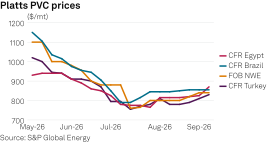
Platts, part of S&P Global Energy, last assessed spot PVC at $855/mt CFR Brazil including duties on Sept. 9, below the most competitive offer heard at $860/mt CFR Brazil for Egypt-origin material. In August, Egypt was Brazil's main supplier of PVC, according to data from the Ministry of Development, Industry and Foreign Trade.
