Chemicals, Polymers
July 21, 2026
Global PVC markets diverge with renewed Middle East tensions
Editor:
HIGHLIGHTS
Asia PVC prices rise on ethylene costs
European inventories push prices down
US export market stabilizes
Global PVC markets are moving in different directions as Middle East tensions and higher ethylene costs lift Asian sentiment and steady US exports, while weak demand and inventory pressure keep Europe under pressure.
Cost pressure drives Asia prices; demand keeps gains in check
Asian PVC prices have risen week over week in a supply-driven rally, supported by higher ethylene costs and renewed geopolitical risk. Producer cost pressure has largely driven the increase, rather than a broad demand recovery, which remains weak and is expected to limit further increases, market participants said.
Producers have been lifting offers as ethylene prices climb and PVC production economics come under pressure. A South Korea-based producer said the rally was initially triggered by tensions in the Middle East, while weaker producer margins and higher feedstock costs have added momentum for suppliers to push prices higher.
The sudden spike in ethylene costs has caused both sellers and buyers to adjust quickly. Sellers are frustrated by the feedstock surge, while buyers are concerned that earlier lower offers are no longer available, a second South Korea-based producer said.
Even so, PVC price increases are expected to lag feedstock increases, as buyers are unlikely to accept the full extent of cost pass-throughs, the producer added.
Export activity has increased amid concerns over possible ethylene-based PVC shortages linked to the effective closure of the Strait of Hormuz, market players in China said.
"Buyers are now purchasing in anticipation of possible ethylene-based PVC shortages, but after prices rose, concerns have grown, especially as domestic prices continue to fall," a China-based producer said.
In India, international producers largely held back offers during the week, with suppliers from South Korea, Taiwan and Indonesia adopting a wait-and-watch approach. Some producers indicated they may raise offers, citing higher production costs for ethylene-based PVC, while only a few China-origin offers were heard in the $735-$750/metric ton range.
Low inventories in India could amplify the impact of any price increase.
"The price increase effect will be harder this time compared with March, when India had excess inventories and easily available low-priced cargoes from China," an India-based trader said.
The trader added that incoming imports are only sufficient to cover about one month of demand, although the monsoon season could limit the impact of higher prices by weighing on downstream demand.
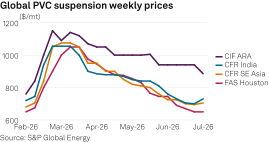
Platts, part of S&P Global Energy, assessed CFR India PVC suspension grade at $730/mt on July 15, up $30/mt week over week, whereas CFR Southeast Asia was assessed $10/mt higher over the same period at $705/mt.
Long supply softens European prices
European PVC prices have continued to fall despite recent escalations in the Middle East. Producers have moved to destock earlier than usual, as they hold elevated inventories ahead of the summer holiday period, when demand typically slows, market sources said.
Consumers also hold sufficient inventories after pre-buying in previous months. As a result, producers have increasingly competed on price to secure volumes.
From Asia, the arbitrage window has narrowed due to higher freight rates and rising FOB Asia prices, though some opportunities remain, sources said.
Platts assessed the FD Northwest Europe PVC spot price at Eur890/mt on July 15, down Eur110/mt week over week.
US export market steadies as sellers resist discounts
US PVC export prices have stabilized after a sharp decline, supported by renewed Middle East tensions, firmer energy sentiment and higher ethylene costs. These factors have slowed the pace of losses despite persistently weak demand.
Prices have fallen nearly 40% since early April and are now close to levels seen before the US-Iran conflict began. However, market participants said the latest geopolitical escalation has made sellers more cautious and encouraged some producers to raise or hold offers.
The market remains in a standoff ahead of August nominations, with producers seeking levels at about $665/mt FAS Houston, while buyers and traders have pointed to much lower workable values. Some traders have been heard short-selling US PVC into Latin America, Africa and other regions at netbacks equivalent to below $600/mt FAS Houston, reflecting expectations of further weakness.
Still, rising ethylene costs, potential hurricane-season inventory building, a planned Formosa Plastics turnaround in Texas and uncertainty linked to the Middle East conflict could limit additional price declines.
Platts last assessed US spot PVC for loading three to 30 days forward at $650/mt FAS Houston on July 15, stable week over week.
