Chemicals, Polymers, Olefins
July 20, 2026
PP prices across the Americas stop downward trend, despite worries for further drops
Editor:
HIGHLIGHTS
Not a single region falls for the first time in weeks, with most levels rising
Some participants in Latin America are seeing improved demand for PP
Still, weak demand concerns could outweigh freight, stocks, war support
Polypropylene prices in the Americas seem to be shaking off the downward trend they have been in since the end of April. Though weak demand concerns persist in some markets, particularly in the US, participants are increasingly optimistic about a more definite change of pace in the region. Those hopes are fueled by diminishing stocks, rising freight costs from Asia and uncertainty stemming from the flare-up in hostilities in the Middle East.
"Demand is starting to pick up," said a distributor in Paraguay. "We are trying to negotiate prices with a flexible policy, but demand is already above May levels."
According to Platts, all PP price assessments in the US, Brazil, Mercosur and the West Coast of South America either remained stable or rose on July 15. This is the first time none of the PP homopolymer levels have fallen in the region since the end of April.
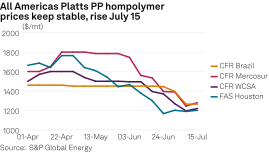
The change in trend is tightly tied to higher offer levels from Asia, a key supplier of PP across Latin America. The rise is itself tied to a re-ignition of hostilities between the US and Iran over the last two weeks in the Middle East, which has substantially increased freight costs and created worries among customers of a repeat of the upward trend seen during March and April, when the war started and pushed chemical markets into a sudden supply crunch.
Elevated freight rates and price instability in the Chinese market worried Brazilian market participants, while traders with business in WCSA all agreed that prices from China have been rising due to the disruption in the Middle East.
"Trump and Iran decided again that the world is too boring without a conflict," said a trader in Colombia. "All goods coming from China, including PP but polyethylene terephthalate and others as well, have shown offers at least $60-$100/mt more expensive than the week prior."
Suppliers are also seeing clients' stock levels diminish over the past two months, as they waited patiently for prices to reach a new bottom after building sufficient inventories on the March-April panic-buying.
"I had two months of stock then, I only have one left, and I'm back to wanting to build back my usual two-month inventory," said the Paraguayan distributor. "And that happens in a chain across the whole industry." A trader in the same country separately said customers have restarted negotiations recently, as "they are speculating that the bombings will make prices rise again. They need to replenish stocks, and fear prices might jump back again."
Lingering demand, upstream concerns
Though most participants in the Americas are hopeful about the change in pricing trends, all nonetheless agree that demand fundamentals remain weak.
"Overall demand is steady to soft, yes," said an Asian producer with business in the Americas. "But due to the current geopolitical situation, it has brought some pressure among buyers to make purchasing decisions quicker.
There is also a sense, one that is particularly strong in the US, that further downward pressure coming from upstream costs could weigh the PP market enough to restore the prior dropping trend.
"I don't think propylene is going to improve," said a PP distributor in the US. "Customers want to see cheaper prices."
A second US distributor and a consultant source separately shared similar perspectives of "very slow" Mexican and Latin American demand, with the consultant adding that "if propylene falls, it will also show on PP."
That pricing uncertainty, according to three supply-side sources in WCSA, is strong enough that they have all either heard about offers being held off or have held off offers themselves waiting for clearer pricing dynamics before venturing into negotiations with customers.
But for sell-side participants, even if further price decreases are coming for Americas PP, there is a silver lining. Contrary to the situation in other polyolefins, like polyethylene, polypropylene pricing levels across the Americas remain at substantially higher levels compared to before the start of the Middle East War back at the end of February. According to Platts, all prices in the region remain at least over $200/metric ton above from Feb. 25-July 15.
| PP prices remain above pre-war levels across all Americas markets | ||||
| Pricing change from Feb. 25-Jul. 15 | US FAS Houston | CFR Brazil | CFR Mercosur | CFR WCSA |
| PP Homopolymer | UP +$276/mt | UP +$305/mt | UP +$300/mt | UP +$270/mt |
| PP Copolymer | UP +$298/mt | UP +$335/mt | UP +$290/mt | UP +$295/mt |
| Source: S&P Global Energy | ||||
