Agriculture, Energy Transition, Biofuel, Renewables, Vegetable Oils, Oilseeds
December 30, 2025
COMMODITIES 2026: Hydrotreated vegetable oil to remain firm on strong demand; feedstock competition looms
By Kelvin Chow and Aditya Kondalamahanty
HIGHLIGHTS
EU, US mandates underpin competition for feedstocks
Singapore's data center policy may drive Asian demand
This is part of the COMMODITIES 2026 series, where our reporters bring you key themes that will drive commodities markets in 2026.
Hydrotreated vegetable oil prices are expected to remain firm in 2026 as tightening mandates in Europe and the US underpin demand, while competition for feedstocks intensifies as new biorefineries start operating, Singapore-based traders and producers said.
"We expect prices to remain around $2,500-$2,700/metric ton for FOB ARA (Antwerp-Rotterdam-Amsterdam) cargoes as demand for HVO will continue to be robust next year," an Asia-based renewable fuels producer told Platts, part of S&P Global Energy.
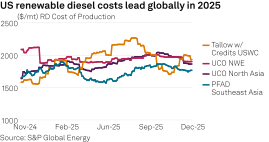
"How HVO prices are going to fare will also depend on the price of feedstocks, which we expect to stay above $1,000/mt as competition for feedstocks intensifies due to more biorefineries coming online," he added.
HVO, also known as renewable diesel, is produced from hydrotreating waste vegetable oils, animal fats and other residues, and is chemically similar to fossil diesel. Unlike traditional biodiesel (fatty acid methyl esters), HVO can be used directly in existing diesel engines without requiring modification.
Europe: Mandates tighten, demand surges
EU members are targeting a 14% reduction in transport greenhouse gas intensity by 2026, which is expected to drive up HVO blending. Traders said countries such as the Netherlands, Poland and Italy, abolishing double-counting rules, have effectively doubled HVO demand in motor diesel supplies, with Germany expected to follow.
A Europe-based biofuel trader said blenders and fuel suppliers are already positioning for the change. "They have essentially doubled the need for HVO to be included in their motor diesel supplies," he told Platts.
Prices rose sharply in 2025, driven by limited feedstock supply, sustainable aviation fuel mandates and maintenance at plants.
In October, Neste announced six weeks of maintenance at both its Singapore and Rotterdam facilities in the fourth quarter, resulting in reduced global availability. The Finland-based refiner accounts for a majority of HVO exports to the US.
The price of HVO produced from feedstocks listed in Annex IX-B of the EU Renewable Energy Directive, assessed by Platts, averaged at $2,136/mt in 2025. The price hit an all-time high of $2,761/mt on Oct. 27.
Outside the EU, reduced supply from the US and maintenance at plants also push HVO prices higher.
US: Policy shift guts imports
US imports of renewable diesel fell sharply in 2025 as the US tax credit policy favored domestic production over imports.
Average imports fell to 5,000 barrels/day in the first half of 2025 from 33,000 b/d in H1 2024 due to poor blending margins and policy disadvantages for imported biofuels, according to US EIA data.
The US budget in July extended 45Z incentives by two years on crop-based biofuels and restricted the eligibility of these credits to fuels only made from feedstocks grown in the US, Canada or Mexico.
Before 2025, both imported and domestically produced HVO received a $1/gallon blender's tax credit (BTC). The Inflation Reduction Act replaced the BTC with the Section 45Z Clean Fuel Production Credit in 2025, which only applies to domestic production, according to an EIA report in September.
Due to this, international biofuel producers found fewer profitable opportunities to send products to the US in 2025.
An Asia-based biofuels trader said that with the US "turning into a consumer rather than exporting its subsidized HVO into the EU or elsewhere, there is a decline in HVO supplies, which has pushed prices up since mid-2025."
Asia-Pacific: Policy lag, new demand drivers
Major Asian economies currently do not have HVO-specific targets or biofuel programs apart from Singapore's Green Data Centre Roadmap policy in 2025, which has incentivized the use of HVO for data center backup power.
"We believe that Singapore is well-positioned to lead the adoption of HVO with the right policy framework, infrastructure and support," said President Stationary Power Solutions Tobias Ostermaier at Rolls-Royce Power Systems in August.
Elsewhere, Australia is rolling out a A$1.1 billion ($730 million) cleaner fuels program to decarbonize mining and aviation. Market participants said emerging industries such as heavy mining, aviation and data centers could contribute to global demand growth in 2026.
A biofuels broker said that some cruise lines were experimenting with using 100% HVO instead of blends, though high costs compared to low-sulfur fuels required by the International Maritime Organization may limit uptake.
"There are enquiries by huge data centers in the possibility of using HVO in their electricity generation. In addition, they can trade their green credits to other users or incorporate into their sustainability plans," he said.
Biofuel analysts in the EU and Singapore also warned that as more biorefineries come online in 2026, feedstock competition will intensify, supporting prices.
The EU's SAF mandates and the US domestic incentives are expected to absorb most of the available supply, leaving Asia and emerging markets scrambling for volumes, they said.

Editor: