Maritime & Shipping, Agriculture, Grains
December 15, 2025
COMMODITIES 2026: Australia to reap larger wheat crop, export restrictions to counter supply pressure
By Vivien Tang and Ryan Wong
HIGHLIGHTS
Improved weather conditions boost Australian production
Shipment delays, MENA demand spike cuts Black Sea exports to SE Asia
Export capacity limitations to lend price support despite ample supply
This is part of the COMMODITIES 2026 series, where our reporters bring you key themes that will drive commodities markets in 2026.
Australian wheat prices are expected to exhibit more bearishness in early 2026, as they track significant global wheat supply, though export capacity limitations due to strong sales of other winter crops could support prices.
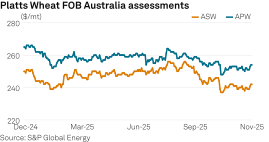
Australian wheat prices were largely rangebound for much of 2025, as thin imports from China, alongside economic and demand concerns, curbed buyer appetite for forward coverage, based on data from Platts, part of S&P Global Energy.
"Our expectations for [MY 2025-26] Australian wheat production are 35.6 million mt – aligned with ABARES following their December publication. As we have flagged in our recent reports, we believe USDA at 36 million mt is unlikely given it is difficult to realize such strong yield gains this late in the season," said Vladimir Zinkovski, senior principal analyst and head of APAC Crops at S&P Global Energy CERA.
Higher average crop protein is expected in the East Coast and South Australia compared to Western Australia, according to regional grains traders.
"We will be seeing lots of Australian Standard White with 9% protein grades (ASW9) and similar grades in WA, which is very much expected. The quality in northern New South Wales is very good, and Australia Hard 2 (AH2) is the dominant grade by far," said a Victoria-based trade source, who added that the Western Australian crop profile could mirror that of MY 2024-25.
Zinkovski noted that protein dilution could be less than expected in Western Australia, but expects a higher proportion of ASW and, to some extent, APW, at the expense of higher-protein grades in the state.
The profitability of other winter crops may discourage Australian wheat sales in the near term, as it consumes shipping capacity and results in less competitive prices for Australian wheat in Southeast Asia, according to Asian millers and grains traders.
Black Sea exports to Southeast Asia drop in 2025
Notably, 2025 saw a marked decline in bulk wheat shipments from major Black Sea exporters to Southeast Asia, based on S&P Global Commodities at Sea data.
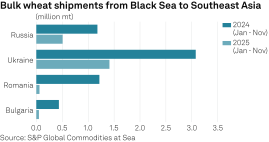
Between January and November 2025, Ukrainian and Russian bulk wheat shipments to Southeast Asian countries fell at least 50% year over year, while Bulgarian and Romanian shipments suffered even larger declines at 88% and 95%, respectively, CAS data showed.
Asian wheat buyers had shied away from Black Sea wheat after issues with shipment delays and high spot prices between July and August, driven by an unexpectedly higher protein crop harvest, which reduced the availability of feed wheat for exports, and a surge in spot demand from government tenders in the Middle East and Africa, according to multiple Asian wheat trade sources.
Nonetheless, Asian grain traders have noted that thin offers for Australian new-crop wheat are now benefiting Black Sea exports, which are drawing interest from Asian buyers for shipments up to the early first quarter of 2026.
Global grains production rises, demand concerns persist
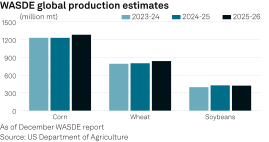
As 2025 comes to a close, the narrative of a heavy supply, stagnating demand, and rising corn production continues from 2024, with higher global grains production projected year over year by the US Department of Agriculture's World Agricultural Supply and Demand Estimates report released Dec. 9.
Meanwhile, Asian trade sources and millers continue to highlight concerns around domestic downstream demand and weak Chinese imports as a hurdle toward milling wheat consumption growth in the region, with mills exploring regional flour exports to diversify demand streams.
"We are expecting Southeast Asian flour millers to maximize imports in [MY 2025-26], given ample global supply and competitive prices, particularly from Argentina, which will set the price floor. As a result, we may expect more deferred business from [flour] millers," said Zinkovski.
In 2026, upside risks to wheat prices remain despite a global supply glut, due to non-wheat crops competing for export capacity, said several wheat exporters.
This has already been observed in US wheat prices, where corn and soybeans were prioritized at US Pacific Northwest ports, and may hit major canola and barley exporters, Canada and Australia, the sources added.

Editor: