Agriculture, Rice
December 12, 2025
COMMODITIES 2026: India’s surplus rice supply to weigh on global prices, reshape trade in Q1
By Arif Islam and Tanya Rana
HIGHLIGHTS
India's record rice output sets tone for global trade
India's competitive price to weigh on Thai, Vietnamese markets
Pakistan loses momentum as buyers shift to Indian origin
This is part of the COMMODITIES 2026 series, where our reporters bring to you key themes that will drive commodities markets in 2026.
India's record-breaking rice production and increasingly competitive pricing are poised to redefine global trade dynamics in early 2026, as buyers shift their focus toward the world's largest exporter, according to market sources who spoke to Platts, part of S&P Global Energy.
This shift could reconfigure major export routes, intensify price pressure on rival suppliers and set the pace for international rice prices through the first quarter of 2026.
Platts projects India's rice production for marketing year 2025-26 (October-September) at 151.8 million mt, up 800,000 mt year over year.
India's supply strength to drive Asian trade early 2026
India enters 2026 with strong bullish sentiment, backed by record Kharif output. First estimates for the Kharif crop were at a record 124.504 million metric tons for MY 2024-25 (October-September), up 1.7 million mt year over year, according to the Ministry of Agriculture & Farmers Welfare, released Nov. 27.
A Chhattisgarh exporter said "demand is likely to shift toward India," noting that government paddy procurement will keep supply tight until mid-January, when market pressure and price declines are expected.
Separately, traders cited a weakening rupee and renewed Nigerian demand as factors that enhance India's competitiveness. An Andhra Pradesh-based exporter said, "Demand might shift, as the rupee is depreciating against the dollar. Overall, it is looking good as India has a competitive advantage."
Industry sentiment aligns with this outlook. Umesh Gosai, rice trade head at ETG, said India may see softer prices, and with the expected price ease amid the open market sale scheme policy, buyers will start shifting to India rather than purchasing from Thailand or other origins. India is likely to be in demand, especially with a bumper crop anticipated this year, Gosai added.
As of Dec. 5, Platts assessed India 5% broken white rice at $338/mt, a decrease of $5/mt month over month. In contrast, prices for other Asian origins also saw increases month over month. Thailand's 5% broken white rice rose $50/mt to $379/mt, Vietnam's 5% broken white rice increased $9/mt to $358/mt, Pakistan's 5% broken white rice climbed $12/mt to $347/mt, and Myanmar's 5% broken white rice was assessed at $334/mt, up $14/mt, month over month, respectively, on Dec. 5.
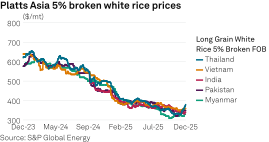
South African buying behavior highlights India's price leverage, with multiple buyers echoing this sentiment. A major South African buyer said that if Indian rice becomes $15/mt cheaper, buying would "immediately" shift from Thailand.
Elsewhere in Asia, exporters await clarity from New Delhi. A Delhi-based seller said India will only "have a chance" if OMSS rates are lowered, a decision expected after procurement ends mid-January.
Thai, Vietnamese prices to face pressure from India's supply
Thailand, Vietnam, Cambodia and Myanmar will enter Q1 2026 with mixed fundamentals but face rising competitive pressure from India's expected price softness.
In Thailand, tight supplies and elevated prices are likely to continue until February-March arrivals. A Bangkok supplier said, "When the new crop arrives, I expect the price for Thai 5% white rice to drop to around the $340/mt FOB level by February, from the current level above $380/mt," adding that India could dominate if oversupplied.
Vietnamese traders expect prices to rise unless India's supply outlook shifts. White rice will continue to face competition from India, Thailand, Pakistan and Myanmar.
Philippine buying is expected to resume once its extended import ban ends. Vivek Agarwal of Seri Food said, "Even if India has so much crop, the Philippines is unlikely to shift towards Indian rice ... However, if there is a huge difference in prices, there is a possibility some buyers might shift." The Philippines extended its import ban until the end of 2025 in late October.
Cambodia and Myanmar anticipate stronger Chinese demand in January and February as China seeks OM5451, Sen Kra Ob and other preferred varieties.
Pakistan loses momentum as buyers stay on sidelines
Pakistan's export activity remains subdued as major buyers remain inactive. Karan Prem Lohana, a rice trader at Jatlee Commodities DMCC, said he expects India to lead the market in early 2026 as West African demand continues to shift. "Pakistan is struggling to maintain market share because key buyers, such as China and Bulog, are not taking positions as they used to."
Pakistan-based sellers anticipate opportunities in the Philippines and a potential resurgence of Chinese private buyers following the Lunar New Year.
WAF policies, US consumer preferences shape regional trade risks
West Africa faces large stock inflows, with Senegal, Ghana and Mali imposing temporary import controls. Nigeria's political calendar is shaping policy direction. A local miller said, "2026 is the year preceding the election year ... so rice prices will be capped as much as possible."
In the US, India's bumper crop is viewed as a price risk for Thai exports. A US miller said, "If India is to have a bumper crop, then this may decrease the prices, and this will in turn cause Thai rice prices to decrease." However, consumer loyalty remains strong. An Arkansas miller said, "They will favor Thai rice over homegrown US rice."
South America is expected to experience a limited direct impact, although exporters remain sensitive to Thai pricing. A Brazilian exporter said, "If Thailand also drops its prices, Peru may import more rice from Thailand and not so much from Brazil."
Global pricing path hinges on India's early 2026 export policy
Across regions, market participants say global direction hinges on India's policy choices and its ability to absorb or release its record crop. Rajesh Khera, senior vice president of MOI International, said, "Buyers are sitting on the sidelines waiting for clarity in the Indian government's decision about the OMSS scheme. Market talks about a potential price reduction is keeping the buying decision on hold. The demand will immediately come once it's clear whether the government will offer any reduction in price or not."
India's management of its export policy and OMSS pricing in early 2026 will determine whether the current wait-and-watch mood turns into a surge in global buying. If New Delhi signals price easing, demand could rapidly swing toward Indian origin, setting the tone for rice markets well into mid-2026.

Editor: