Agriculture, Rice
November 18, 2025
Vietnam struggles to diversify rice exports amid the Philippines' import ban
By Chirag Aggarwal and Tanveen Kaur
HIGHLIGHTS
Exporters struggle to replace large Philippine demand in short term
Africa, China, Malaysia emerge as alternative markets for Vietnam rice
Exporters consider varietal changes due to market pressures
Vietnamese rice exporters are finding it difficult to diversify export destinations amid the Philippines' import ban, market sources told Platts, part of S&P Global Energy.
With one of their largest buyers sidelined, exporters are facing subdued demand, which is expected to keep prices under pressure in the near term. However, domestic demand and tight supply have lent stability to Vietnamese rice prices, preventing any significant declines.
The Philippines has been Vietnam's biggest rice buyer in 2025, importing 2.9 million mt over January-August, up slightly from 2.8 million mt during the same period of 2024, according to preliminary data from Vietnam Customs.
In early August, the Philippines suspended rice imports for 60 days from Sept. 1 to support domestic farmers hurt by falling prices during the harvest season.
Now, as per the Executive Order 102, signed on Oct. 30 by the Philippines president Ferdinand Marcos Jr., the ban has been officially extended until the end of the year.
The pause in imports has tightened buying interest, according to exporters, who say that no other market can absorb volumes at this scale in the near term.
"No other single destination can replace this. It has to be built over many, many years with many, many buyers. It's not an easy task," a Ho Chi Minh City-based trader said, adding that Vietnam ships around 3 million mt annually to the Philippines.
Exporters cautious, contracts thin at year-end
Amid the market pause, exporters said year-end seasonality is leading to very few fresh contracts, with most participants unwilling to commit to alternative markets.
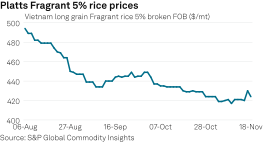
Amid thin demand, Vietnam rice prices have also fallen sharply.
Platts assessed Vietnam Fragrant 5% rice at $424/metric ton FOB and 5% WR at $353/mt FOB on Nov. 18, down $70/mt and $32/mt since Aug. 6, when the ban was first announced.
"It is the end of the year, so there are very few contracts. Almost everyone is waiting for the Philippines to import again," a HCMC-based industry source said.
The source added that exporters are reluctant to negotiate large volumes elsewhere because a sudden resumption of Philippine buying could lift domestic prices.
Africa, China, and Malaysia emerge as alternative markets
Some exporters said they have begun redirecting small volumes toward African and Asian destinations, although demand remains fragmented.
"Alternative is to various markets in Africa like Ghana, IVC, Mozambique and Senegal," a Ho Chi Minh City-based trader said.
"Exporters have been trying to shift to alternate markets in Africa such as Ghana, Ivory Coast, Senegal, and to Asian markets such as China and Malaysia," another HCMC-based exporter said.
Vietnam's shipments to these markets have risen sharply this year. Exports to Ghana reached 834,332 mt in January–October, up 59% year over year, while volumes to Ivory Coast climbed 133% to 916,539 mt. China also imported 629,509 mt, a 151% increase over the same period, Vietnam Customs data showed.
Even so, market participants said near-term demand from Africa remains subdued, with many destinations still carrying excess stocks after heavy buying earlier in the year.
Potential varietal shifts if Philippine demand stays weak
Some exporters expect farmers to shift their focus to different varieties if demand from the Philippines remains soft in the coming months.
"If the volume exported to the Philippines drops, farmers will shift to Glutinous, ST25, Japonica and OM 5451 varieties," an exporter said.
Another exporter said that market competitiveness is rising globally, with profitability tightening across the region.
"The rice business is becoming less profitable. Farmers in Thailand, Vietnam, the Philippines, and Myanmar are all losing money," the source said, adding that lower production might be the only way to support farm-gate prices.
Operational readiness and support
Additionally, market participants are focusing on strengthening internal operations to navigate ongoing uncertainty. "Build business model for long term: Bigger warehouse to stock during bans," a Ho Chi Minh City-based exporter said.
Echoing this sentiment, an industry source in Ho Chi Minh City noted that exporters are prioritizing the maintenance of machinery to ensure readiness for future market opportunities.
Alongside these internal measures, market sources note that support from trade bodies could further facilitate entry into smaller and more diversified markets.
"Trade bodies can assist in better financing, insurance, warehousing and ease of documentation," the HCMC-based trader said.
Despite current challenges, combined efforts from Vietnamese rice market participants are expected to enhance the sector's flexibility and resilience, enabling it to better manage future uncertainties, even as the Philippines is anticipated to return as a major buyer.

Editor: