Agriculture, Vegetable Oils, Oilseeds, Biofuels
November 20, 2026
Palm oil faces tighter supply in 2027 as Indonesian biodiesel absorbs more output
By Aditya Kondalamahanty and Ck Quick
Editor:
HIGHLIGHTS
Production to drop by 2 mil mt by 2027 in Asia
Indonesia's B50 program cuts exports 2.9 mil mt
Malaysian suppliers may gain market share in India in 2027
Palm oil supplies are set to tighten in 2027 as production falls in Indonesia, the top grower, while its B50 biodiesel program absorbs more domestic supply, potentially reducing exports even as demand from major buyers remains resilient, according to the Malaysian Palm Oil Council on Nov. 19.
Palm oil production across Indonesia, Malaysia and Thailand is forecast to fall by 2 million metric tons to 71.4 million mt in 2027 from an estimated 73.4 million mt in 2026, MPOC data presented at the East Malaysia Palm Oil Forum.
Indonesia is expected to account for most of the decline, with production falling 1.7 million mt to 48.1 million mt from 49.8 million mt. Malaysian production is forecast to decline by 300,000 tons to 19.77 million tons.
Indonesia and Malaysia are the world's largest producers and suppliers of vegetable oil.
The decline would reverse some of the production growth seen in Southeast Asia in recent years. Regional output increased by 4.9 million mt between 2022 and 2026, led by a 3 million-mt rise in Indonesia and a 1.7 million-mt increase in Malaysia.
MPOC attributed the expected Indonesian decline partly to low rainfall in southern Sumatra and Kalimantan during July to September, while Malaysia experienced largely normal rainfall, except for below-normal precipitation in Sarawak in August.
Malaysia's smaller production decline could also reflect a biological resting phase after two years of strong output, MPOC said.
The production slowdown comes as Indonesia is directing more palm oil to its domestic biodiesel program.
Palm oil consumption for Indonesian biodiesel reached a monthly record of 1.35 million mt in August 2026, equivalent to an annualized requirement of about 16 million mt, according to data presented by MPOC. The council said this indicated Indonesia was progressing toward full implementation of B50 blending.
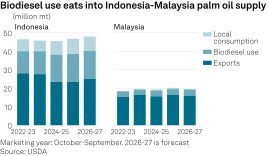
Higher domestic consumption and lower production are expected to reduce Indonesia's palm oil exports by 2.9 million mt in 2027, to 23.2 million mt from 26.1 million mt in 2026.
That would reduce combined exports from Indonesia, Malaysia, and Thailand to 40.9 million mt from 43 million mt, despite Malaysian exports increasing by about 600,000 mt to 16.75 million mt.
The shift could leave Malaysia filling part of the supply gap created by reduced availability in Indonesia, particularly in markets such as India, MPOC said.
Demand holds
The tightening supply outlook comes as demand in China and the EU shows signs of stabilizing this year after earlier declines. Meanwhile, palm oil's price advantage relative to soybean oil could support purchases from India, according to MPOC.
EU palm oil imports are forecast at about 3.8 million mt in 2027, down from an estimated 3.9 million mt in 2026. MPOC said 82% of EU crude and refined palm oil imports were used for food in 2025, suggesting demand may stagnate at a core level of around 3.7-4 million mt annually.
China's imports are forecast at 4.7 million mt in 2027, down from an estimated 5.15 million mt in 2026. Consumption is projected at about 5 million mt, though improving palm oil price competitiveness could push consumption above that level, MPOC said.
India could be a stronger source of import demand.
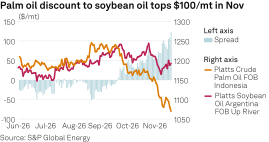
In India's domestic market, palm oil was trading at a discount of about $120/mt to soybean oil in mid-November, improving its competitiveness after prices fell in the fourth quarter of 2026, according to data from traders.
MPOC expects Indian buyers to restock aggressively after Diwali, as prices decline and Southeast Asian production weakens in 2027.
India predominantly imports crude palm oil, so a decline in Indonesian exports could create an opportunity for Malaysian suppliers, MPOC said.
The relative pricing of vegetable oils will remain important. Growth in competing oilseed supplies is expected to slow during the 2026-27 season, with combined soybean, sunflower seed and rapeseed production projected to increase by 17.3 million mt from a year earlier, below the four-year average annual increase of 22 million mt.
The combination of lower Southeast Asian palm oil production, Indonesia's increasing biodiesel requirements, and relatively steady import demand leaves the market vulnerable to sharper tightening if inventories fall quickly, MPOC said, adding that prices will be driven increasingly by those fundamentals, although geopolitical tensions, Indonesia's export policy, weather risks, and the extent of any biological resting phase in Malaysian palms remain key uncertainties for 2027.
A larger-than-expected production decline, coupled with rapid stock depletion, could put significant upward pressure on palm oil prices, MPOC said.
Platts, part of S&P Global Energy, assessed the price of crude palm oil FOB $1,070/mt Nov. 19, down 0.9% day over day.
