Agriculture, Livestock, Meat
November 17, 2026
US beef import prices hold steady amid high volumes, weak demand
Editor:
HIGHLIGHTS
Domestic lean beef production rises seasonally
Import volumes surge 22.4% on year
Traders anticipate a pre-Thanksgiving demand spike
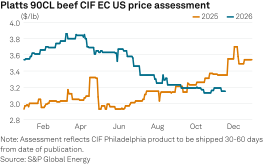
US import prices for 90% chemical-lean beef remained steady on the second half of November, although sentiment has been bearish as US seasonal demand slowed and seasonal lean beef production rose, while import volumes have been above usual levels during the fall.
Platts, part of S&P Global Energy, assessed 90CL frozen beef on a CIF East Coast basis for 30- to 60-day shipment at $3.15/pound on Nov. 16, unchanged day over day and week over week. The assessment was down 2 cents/lb from a month earlier and down 20 cents/lb from the year-ago level.
"I have a feeling we will see good demand this week before going quiet next week for Thanksgiving," a New Zealand-based beef trader said. "I think we could get higher on 85s and 90s, but no indication yet."
Domestic supply in the high season
According to analysts, fall is the season when ranchers send their cows and old bulls to slaughter, as grass is scarce during the winter, but cow movement for sale eases during the holidays.
Cow and bull slaughter was estimated at 109,000 head for the week ended Nov. 14, according to the US Department of Agriculture daily slaughter report. The total was up 1.9% from the previous week and 5.1% above the prior six-week average. But it was down 4.7% from the corresponding week in 2025 and 10.6% below the same week in 2024.
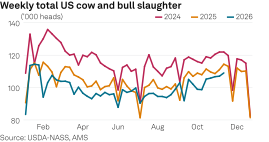
US cow and bull slaughter, the main source of lean beef, totaled an estimated 4.571 million head year-to-date through Nov. 14, down 4.7% from the same period in 2025 and 15.0% below the comparable period in 2024, according to USDA data.
Beef cattle inventory remains at historical lows, but dairy cows have represented the bulk of non-fed slaughter in 2026.
According to S&P Global Energy data based on USDA Weekly Actual Slaughter reports, dairy cows accounted for about 53% of non-fed production during 2026, compared with about 48% during the same period a year earlier.
"[US dairy cows] slaughter levels have been trending lower since the middle of September," S&P Global Energy CERA said in its Nov. 16 US Dairy Short-Term Outlook report. "And slaughter as a percentage of the dairy herd remains essentially unchanged from 2025 and below levels seen during the pre-expansion period."
High imports for the season
Meanwhile, imports of lean beef trimming remained high for the fourth-quarter season, although the trend was easing.
The USDA said in its latest Imported Meat Passed for Entry in the US report that total US imports of beef trimmings for the week ended Nov. 7 were 17,328 metric tons, down 10.9% week over week but up 40.8% from the same week in 2025.
Of the total US imports of beef trimmings during the week ended Nov. 7, 33.4% were from Australia, 31.1% from Brazil, 12.7% from Uruguay, 10.2% from Canada, and 5.1% from Nicaragua, USDA data showed. New Zealand was outside the top 5 that week.
US imports of Australian beef trimmings rose 6.4% to 5,781 mt during the week; imports from Brazil dropped 31.1% to 5,391 mt, and from Uruguay rose 48.8% to 2,207 mt.
According to the USDA data, 857,359 mt of beef trimmings have been imported through Nov. 7, up 22.4% from the same period in 2025 and up 38.0% from the same period in 2024.
Of the total lean beef trimmings imported during the year, 30.6% was from Australia, 23.1% from Brazil and 17.4% from New Zealand.
CERA analysts expect lower import volumes from South America.
"Import volume under the duty-free Tranche 3 quota is anticipated to fall below Tranche 1 and Tranche 2 volumes, as Brazil has redirected trade to China," CERA analysts said on its latest US Beef and Cattle Short-Term Outlook report. "SPG has updated trade volume expectations accordingly."
According to the report, "the pace of entry limits the near-term threat of a large influx of foreign lean beef into the domestic market."
