Agriculture, Meat
November 05, 2026
US September shrimp imports rise 12.6% as elevated inventories weigh on market

Editor:
HIGHLIGHTS
Ecuador, Indonesia boost US shrimp volumes
Holiday season tests oversupplied market
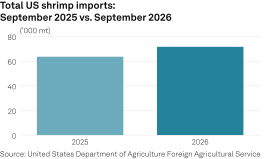
US shrimp imports rose 12.6% year over year in September, as increased shipments from Ecuador and Indonesia added to already elevated US inventories amid subdued demand.
US imports of shrimp and prawns totaled 71,605.6 metric tons in September, up from 63,565.4 mt in September 2025, according to data from the USDA Foreign Agricultural Service's Global Agricultural Trade System on Nov.4.
Despite the increase in arrivals, market participants described a US market struggling to absorb available supply.
"There is more inventory sitting in the local cold storage than I have witnessed in the past five years," one US shrimp importer said.
The importer attributed the buildup to the balance between supply and demand, with excess product continuing to weigh on the market.
A second US importer also described the market as oversupplied, saying the company had built inventories earlier in the year and had not purchased product for the past couple of months as sales remained sluggish.
The source cautioned against viewing September import volumes as an indication of current demand because of the time between purchasing, production and arrival in the US. September shipments largely reflected orders placed during July and August, the importer said.
Ecuadorean product can take roughly eight weeks from pack date to reach the US market, while Indian product can take around 12-14 weeks, according to the source. This means changes in current US buying could take several months to become visible in import data.
The cautious conditions align with S&P Global Energy research analyst Shreyash Sharma's outlook for the US shrimp market. Sharma said US shrimp imports have shown signs of recovery in 2026 following weaker imports in 2025, while demand remains cautious amid elevated inventories, tariff uncertainty and higher logistics costs.
Ecuador, Indonesia account for most additional supply
The September increase was concentrated among several major supplying origins.
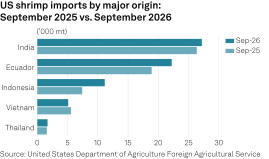
Ecuador shipped 22,219.7 mt to the US in September, up 17.5% from 18,904.1 mt in September 2025, USDA data showed. Indonesian shipments climbed 50.1% year over year to 11,151.9 mt, compared with 7,430.5 mt a year earlier.
Combined shipments from Ecuador and Indonesia increased by about 7,037 mt year over year, accounting for most of the 8,040.2 mt increase in total September US shrimp imports.
India remained the largest supplier to the US, with shipments increasing 3.2% to 27,205.7 mt from 26,366.6 mt in September 2025. Vietnamese shipments fell to 5,109.2 mt from 5,561.3 mt, while Thailand shipments were relatively steady at 1,695.1 mt, compared with 1,581 mt a year earlier.
Sharma expects abundant global production to continue influencing supply conditions. Ecuadorean shrimp production is forecast by S&P Global Energy to increase 8.4% year over year to 1.52 million mt in 2026, while Ecuador's total shrimp exports are forecast to rise 24% to 1.74 million mt.
Ecuadorean shipments to the US have increased 36.6% year to date, according to S&P Global Energy research.
Production is also forecast to expand in India and Vietnam, rising 7.2% and 6.5%, respectively, in 2026, according to Sharma.
Ecuador weather poses risk to expanding production
The outlook for Ecuador remains subject to weather and operational risks following a period of strong production growth.
Sharma identified heavy rainfall, flooding, electricity rationing and power outages as challenges facing Ecuadorean producers, with disruptions contributing to earlier harvesting and operational difficulties.
One importer said particularly favorable growing conditions earlier in the year had led to unusually strong shrimp growth from existing ponds, helping boost production.
The source said conditions have since deteriorated following persistent heavy rainfall and flooding, with freshwater entering shrimp ponds posing a particular risk to salinity and future shrimp growth.
The importer expects the effects of weaker growing conditions to become more apparent in supply between December and February, although shipment lead times could delay any corresponding effect on US import statistics.
Holiday demand tested against heavy inventories
The US market's ability to absorb existing supplies is now expected to come into greater focus as seasonal shrimp consumption increases.
One importer said demand typically strengthens between November and February around New Year's Eve, Lunar New Year and Valentine's Day, providing an opportunity for the market to work through inventories.
However, the source expected excess supply to remain the dominant market factor in the near term.
Sharma similarly characterized the US market as well supplied and cautious, with ample inventories contributing to steady but fragmented shrimp pricing and limiting the potential for significant upward price movement in the near term.
The September increase in imports therefore does not necessarily indicate a corresponding improvement in current US consumption. Instead, earlier purchasing decisions and shipment lead times have continued to bring product into the market even as buyers contend with elevated inventories.
With global shrimp supply expected to remain ample, the pace of inventory drawdowns during the holiday demand period could determine whether the US market begins to rebalance or carries substantial stocks into early 2027.
