Agriculture, Grains, Oilseeds
November 05, 2026
Democratic sweep may lead to change in US tariff stances, reducing farm costs

By Sampad Nandy
Editor:
HIGHLIGHTS
Tariff cuts on farm machinery may be on agenda
Democrats may push for domestic relief under farm bill
Focus on resolving Middle East war, reducing fuel costs
Democratic victories in the 2026 midterm elections could push the US Congress to negotiate on various issues related to agriculture, including a change in the stance on tariffs and the five-year farm bill, US-based policy experts said Nov. 5.
Democrats surpassed midterm expectations by winning at least 54 Senate seats, flipping at least seven seats previously held by Republicans, including in Iowa, Ohio, Texas and Kansas. The party is also on track for its largest House majority in decades, flipping several districts with farming communities.
The Democrats have opposed the tariffs imposed by US President Donald Trump and have sought to repeal them.
"Repeal the Trump tariffs that are making everything — from groceries to cars to clothing — more expensive," said James Talarico, senator-elect from Texas, on his campaign website.
Democrats may also push for a reduction in tariffs on farm machinery and other products, which are pushing up farming costs, US-based market participants said.
"Iowa's farmers have been hit hard by the chaotic tariffs and trade policies coming out of Washington. End the chaotic tariffs that are sending farms toward a 1980s-style farm crisis," Iowa's Senator-elect Josh Turek said on his campaign website.
Since assuming office in January 2025, Trump has imposed tariffs on several products imported from different countries.
Initially, the tariffs were imposed under the International Emergency Economic Powers Act, but the Supreme Court later struck them down in February 2026. Following that, Trump imposed temporary tariffs under Section 122 of the Trade Act of 1974 for 150 days, before imposing country-specific tariffs under Section 301 of the same act.
However, several farmer groups have said the tariffs led to higher costs of fertilizers and ended up weighing on agricultural profits.
A Democratic majority may also push Congress to rein in the Middle East war, which has raised energy and fuel costs in the US and is affecting farmers, participants said.
Increase in exports
Market participants are also hopeful of a rise in exports of US farm and food products if there is a potential change in tariff policies.
"If the US softens its stand on tariffs, that may push China to reduce its tariffs on US farm products and spur demand," a corn farmer based in Iowa said.
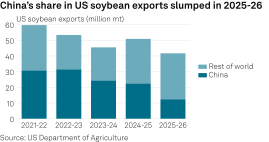
China paused purchasing US-origin soybeans between June and October 2025 amid a tariff dispute. While it resumed purchases in October 2025 from the US, it has maintained a reciprocal import duty on the product. As a result, US soybean sales to China declined 44.9% year over year to 12.4 million metric tons in the marketing year 2025-26 (September-August), according to the US Department of Agriculture.
Some US-based market participants said China may also look at cutting tariffs on US-origin soybeans.
China has outlined plans for tariff reductions on a range of US agricultural goods, including grains, soybean products and animal proteins, while excluding commercial soybeans, according to details released by the Ministry of Commerce Sept. 28.
However, Beijing had yet to finalize its tariff reduction plan, announced after President Xi Jinping met Trump in Washington Sept. 23-25, during the third bilateral summit since October 2025.
Platts, part of S&P Global Energy, assessed New Orleans SOYBEX FOB at $484.01/mt Nov. 4, down $4.31/mt day over day.
Domestic reliefs
Apart from tariffs and rising costs, the midterm results may push Congress members to negotiate over the five-year farm bill in the lame-duck session during November-December, before the new Congress assumes office in January 2027.
"A key area to watch in the lame-duck session is whether Democrats, emboldened by Tuesday's sweeping victory, push harder for changes to the Senate Farm Bill," Roger Bernard, senior policy analyst at S&P Global CERA, said in a brief.
The 2018 farm bill officially expired in October 2026 after a series of extensions.
According to CERA, Democrats may push harder to secure a two-year delay for changes in the cost-sharing formula between the federal administration and the state governments.
So far, Republicans have insisted on a one-year delay included in the measure that advanced through the Senate Agriculture Committee.
The farm bill covers several key aspects related to agriculture, including price loss coverage, agriculture risk coverage, crop insurance and disaster assistance.
