Agriculture, Refined Products, Oilseeds, Biofuels, Diesel-Gasoil, Vegetable Oils
November 03, 2026
Brazil biodiesel fees fall for Nov-Dec as backlogs offset seasonal support

Editor:
HIGHLIGHTS
Distributors hold excess inventory volumes
Producers fail to meet margin recovery goals
Brazil's biodiesel market concluded negotiations for the final two months of 2026 with producers' expectations again unmet, margins increasingly squeezed and demand constrained by limited diesel availability, which outweighed the seasonal support typically seen during the period.
Logistics differentials negotiated between producers and fuel distributors for November-December 2026 fell by more than 30 reais/cubic meter from September-October, bringing all regional indexes into negative territory. Industry sources attributed the decline to distributors' outstanding biodiesel volumes and constraints on diesel access, citing Petrobras S.A. quotas and imports.
Platts, part of S&P Global Energy, surveyed 54 companies between Oct. 23-30 to calculate the volume-weighted average differential, commonly known as the "fee" for biodiesel term contracts across the key regions shown on the map. The fee reflects the producer's margin and is part of a pricing formula that also incorporates Chicago Board of Trade soybean oil futures, the vegetable oil price basis at Paranaguá port and the Brazilian real/US dollar exchange rate.
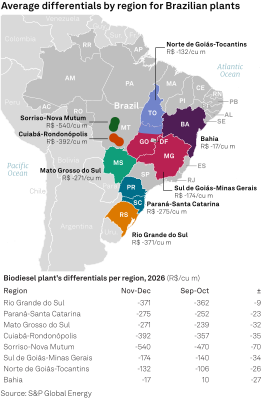
The Sorriso-Nova Mutum microregion in Mato Grosso recorded the largest decline in September-October, with the fee falling by 70 reais/cubic meter. Cuiabá-Rondonópolis, also in Mato Grosso, posted the second-largest decrease, at 35 reais/cubic meter.
Rio Grande do Sul recorded a smaller decline of 9 reais/cubic meter, leaving fees broadly in line with the previous period. Even so, producers in the state, one of Brazil's main biodiesel supply hubs, said the reduction dealt a significant blow to efforts to restore margins already squeezed by feedstock costs.
Recovery hopes dashed again
The November-December outcome fell well short of producers' expectations at the start of negotiations, when they sought increases of 300 reais/cubic meter from the previous period to restore margins. Producers pointed to reduced soybean oil availability during the inter-harvest period as a traditional source of support for fees at this time of year. Several distributors told Platts they had also expected an increase based on historical patterns.
"I expected this to be a period of recovery for sellers, as negotiations in previous periods had favored buyers," a regional distributor said. "Producers in several states started with aggressive offers but later gave ground."
Ample biodiesel inventories, combined with weaker and uncertain demand for imported diesel, gave distributors leverage to push prices lower during negotiations. Some producers sacrificed sales volumes to hold their initial offers, contracting only quantities covered by feedstocks already purchased and allocated to biodiesel production, rather than committing to additional soybean oil purchases.
Even producers that initially held firm eventually lowered prices toward the end of negotiations to remain competitive and meet the volume target set by oil regulator ANP. "This shows how fragmented our sector is, with no common pricing fundamentals underpinning producers' offers. Everyone follows their own strategy," a local producer said.
Challenging outlook
With fees falling during a period that would normally bring increases, several market participants expect conditions to remain challenging for biodiesel producers in the months ahead. Seasonally weaker demand early in the year could add further downward pressure.
Some market sources said the sector had also expected a different outcome in Brazil's late-October presidential election and a stronger real against the US dollar, which would have lowered soybean origination costs. Instead, the market reported a sharp rise in the dollar against the real following President Luiz Inácio Lula da Silva's reelection, shortly after contract negotiations, undermining those expectations.
Domestic feedstock prices rose as the currency moved against the assumptions, and producers sharply increased biodiesel spot offers, but many of those offers did not result in trades. Biodiesel spot trading has since remained subdued, with sporadic deals failing to reflect the change in the exchange rate. Producers expect liquidity to remain limited until the currency stabilizes.
