Agriculture, Meat
October 29, 2026
Thai chicken prices drop as Japan turns to more processed imports from China
By Rubashiny Veeramohan and Sheryl Leao
Editor:
HIGHLIGHTS
Japanese buyers switch to processed chicken amid high prices
Thai BLK domestic spot prices dropped 25% since April
Processed chicken imports from China up 22% on year
High prices for frozen boneless chicken legs from Brazil and Thailand earlier in 2026 prompted Japanese buyers to gradually switch to processed or pre-cooked products from China and Thailand, multiple Japanese trade sources told Platts in October. China's price competitiveness has attracted many Japanese buyers, although quality concerns persist.
In Japan, domestic spot prices for Thai-origin frozen boneless leg kakugiri (diced boneless legs) slumped by at least 25%, falling from Yen 800-900/kg (over $4.50/kg) in April to about Yen 600/kg ($3.80/kg) in October amid weaker demand, according to Japanese trading sources.
Additionally, as Brazilian unsized boneless legs weighing at least 200 g (BL200UP) stocks remain ample and are priced lower than Thai BLK, many businesses in Japan have started dicing them in-house, Japanese importers said.
Thai BLK is at least $1,100/mt CFR above Brazilian product, according to data from Platts, part of S&P Global Energy.
"They have installed machines to cut BL200UP and are now doing the cutting themselves," a Tokyo-based importer added.
Thailand remains a key supplier of BLK cuts to Japan due to its superior quality in terms of weight and size, according to importers.
In 2025, Thailand supplied 180,532 mt of unprocessed frozen chicken meat (up 0.2% year over year) and 320,723 mt of processed chicken meat (up 3% year over year) to Japan, remaining the second-largest supplier after Brazil.
Persistent production constraints and adverse weather affected flock health and broiler weights in Thailand since early 2026, resulting in low supplies and shipment delays that kept Thai BLK prices high earlier this year, according to Asia-based trade sources.
Many Japanese food manufacturers and retailers, especially supermarkets and convenience stores, have shifted from expensive Brazilian and Thai unprocessed chicken meat to processed or pre-cooked products, such as Chinese karaage, Japanese importers said.
"Some of my customers have shifted to the Chinese market, though there have been complaints about the quality of the Chinese products," said a Bangkok-based exporter.
Currently, Thai karaage is priced at about $4,500/mt CFR Japan, while Chinese karaage is about $2,500-$2,700/mt CFR Japan, the exporter added.
"China's products are cheaper due to overproduction," the exporter said, noting that Chinese products are generally more price competitive, though quality remains a concern among buyers.
According to Iman Nur Salsabila Mohamad Zamri, an APAC Proteins analyst at S&P Global Energy CERA, import volumes for January to August 2026, compared with the same period in 2025, may provide some evidence of the shift.
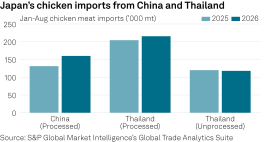
"Thailand's unprocessed chicken imports declined slightly (-2%), while processed imports grew only modestly (+5%). At the same time, processed chicken imports from China increased significantly (+22%), which could indicate some substitution toward lower-cost prepared products," Iman said.
"However, the shift does not appear to be large enough to materially change supplier dynamics," Iman said, adding that Thailand remains by far the largest supplier of processed chicken to Japan, though a more significant growth is indeed seen from China's processed chicken import.
Thailand's 2026 chicken meat exports were projected to fall 3.8% year over year, according to CERA analysts in the latest Thailand Poultry Short-Term Outlook.
Export volumes dropped by 6.6% year to date through August, with limited prospects for recovery, analysts said.
Eased EU restrictions on Brazil and strong Chinese competition add further pressure on Thailand's processed chicken exports, analysts added.
China is expected to remain a net chicken-meat exporter in 2026, with poultry-meat production forecast to rise 8.0% year over year, according to analysts.
Japan allows poultry imports from China only in the form of heat-treated, processed products—such as cooked or frozen prepared meals—while raw poultry remains strictly prohibited. This restriction is enforced by the Ministry of Agriculture, Forestry and Fisheries (MAFF) due to stringent animal health, biosecurity, and avian influenza regulations.
Platts assessed CFR North Asia chicken leg at $2,350/mt on Oct. 28 for November-December loading to Tokyo, down 31% from an all-time high of $3,400/mt in April, as persistently full cold storage facilities in Japan limited buying interest.
