Agriculture, Metals & Mining, Grains, Ferrous, Oilseeds
October 07, 2026
Black Sea disruption enters third month, pushes wheat buyers to alternative origins

Editor:
HIGHLIGHTS
Attacks hamper Black Sea infrastructure
CIF wheat prices surge on high freight
Egypt's wheat stocks running low
Buyers of Black Sea wheat from Egypt to Bangladesh are grappling with supply and trade-flow disruptions as intensified attacks on regional infrastructure persist for a third month.
With exporters staying on the sidelines, Egypt is facing supply shortages, while Turkey and Bangladesh have been forced to seek alternative sources.
Tensions escalated on Oct. 6 following an attack on two commercial vessels, including a wheat coaster, in Bulgaria's economic zone, the first such attack on shipping in a NATO member's Black Sea waters, according to local reports.
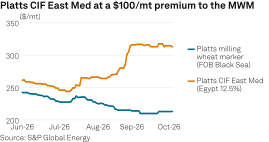
The Platts wheat benchmark, the Milling Wheat Marker, averaged $211.73/metric ton in September, down from August's $219.30/mt for Black Sea ports, as rising freight costs and continued port disruptions squeezed the market. The Marker fell to a new low of $204/mt on Oct. 6 on a lack of FOB demand and with shipowners wary of attempting Black Sea crossings.Platts is part of S&P Global Energy.
Russian sellers largely stayed out of the market due to limited shipping routes, redirecting cargo to Baltic ports. Demand for Baltic-bound shipments lifted Volga and Central prices to 10,000–10,500 rubles/mt and 9,000–10,400 rubles/mt, respectively, according to rail operator Rusagrotrans.
S&P Global Energy CERA cut its Russian wheat export forecast to 32.5 million mt, down from 42.5 million mt on Sept. 25, assuming Black Sea exports normalize by January 2027.
"Unfortunately, we aren't on the market. There is a great risk. I guess we will come back in October," one Russia-based seller said.
"I am not in the market. There is no cargo," a second seller said.
Baltic ports remained congested, with limited rail, storage, surveying, and laboratory capacity constraining offers and causing delays. Exporters turned to multipurpose non-grain terminals as a workaround, although these facilities often require temporary grain-handling and inspection arrangements.
"Russian terminals are overcrowded, inland logistics and fobbing are complicated," a third Russian seller said.
Baltic-to-Egypt freight rose week over week by $10/mt to $54/mt Oct. 7 amid competing steel and fertilizer demand like urea. FOB Riga and Liepaja traded at $272-273/mt Oct. 6.
Ukraine export volumes lag
Since July, Ukraine has relied heavily on the Danube route to export wheat. However, intensifying strikes on ports such as Izmail and key links, including the Zatoka Bridge, have increasingly disrupted shipments, multiple market participants said.
Grain has been diverted through congested routes and costly rail connections via Moldova, while multi-week queues at the Sulina Canal have raised freight and demurrage costs.
Meanwhile, exporters are prioritizing newly harvested, higher-margin autumn crops such as oilseeds. Marine routes' share of Ukrainian wheat exports fell to 78% in July–September 2026 from 98% a year earlier, while rail and ferry shares rose to 17% and 4%, respectively, data from the Ukrainian Grain Association showed.
Buyers sought 11.5% wheat at $278-$283/mt from the Port of Constanța, and coasters traded in the low $300s/mt to Egypt.
Scramble for supply
Disruptions to traditional Black Sea routes have tightened regional availability and raised delivered costs, prompting buyers such as Egypt to seek alternative supplies.
Egypt's private importers faced low stocks and higher costs, pushing ex-warehouse wheat prices to 17,200 Egyptian pounds/mt, up 200 Egyptian pounds/mt week over week. Government reserves remain covered up to six months of consumption, according to local news reports citing Egypt's agriculture ministry.
"The Egyptian market is running out of stock," one local buyer said, after booking four 12.5% Russian wheat vessels for October shipment.
Platts CIF East Med basis Egypt 12.5% was assessed at $313/mt on Oct. 6, holding in the low-to-mid $310s since August, a $109/mt premium to the Milling Wheat Marker.
Egypt's September wheat imports fell 50% month over month and 74% year over year to 358,925 mt. Ukraine replaced Russia as the top supplier, shipping 136,921 mt, mainly by several coasters, according to LATT Trading & Shipping data.
"There are stocks for Ukrainian wheat, but not Russian 12.5% and 11.5% protein," another buyer said.
A third buyer last purchased in August, while a pasta maker had only one month's supply remaining.
In Turkey, buyers turned to government stocks and a record harvest. Turkey's state grain board announced the release of 5.5 million mt from warehouses starting Oct. 5, priced at 18,500 lira for bread wheat.
Seasonal imports are expected at just 2 million mt, down sharply from 7 million mt last year, four market participants in Turkey said.
Despite a strong harvest, Turkish buyers sought Russian high-protein wheat, while new Tilletia rules led to several vessel rejections.
"If Russia opens fully, we will buy mainly 13.5-14.5% protein. If it does not open in November, we have to bring it from Lithuania or Germany," a buyer said.
Bangladesh sought Indian wheat, which fell to $310–315/mt at the border, discouraging Black Sea imports as fuel costs and a strong dollar raised expenses, a local buyer said. India supplied up to 200,000 mt by rail and truck after lifting an export ban Aug. 24.
Since the disruption began in July, state buyers broadly have paid noticeably more for wheat than at their final pre-disruption tenders: Jordan by $57/mt, Saudi Arabia by $63/mt, Algeria by $56/mt, and Tunisia by $45/mt, with most volumes expected from Romania and Bulgaria.
The CVB market was assessed at $294.25/mt on Oct. 6, down from its early-September peak of $305.5/mt but still carrying a $90/mt premium to the Milling Wheat Marker.
