Agriculture, Natural Gas, LNG, Metals & Mining, Vegetable Oils, Oilseeds, Food, Pesticides, Beverages, Non-Ferrous
October 01, 2026 · Updated October 02, 2026
Argentina eyes bigger share of India's edible oil market, seeks broader trade ties

Editor:
HIGHLIGHTS
India's top edible oil supplier in MY 2025-26
Bilateral trade surpasses $6.5-billion mark
Sunflower acreage expands 14% in Argentina
Argentina, India's largest supplier of edible oils in the current marketing year 2025-26 (November-October), expects agricultural trade with the world's biggest vegetable oil importer to continue expanding as rising Indian demand aligns with growing Argentine production, Argentina's ambassador to India said Sept. 30.
Bilateral trade between the two countries has already surpassed $6 billion and now stands at around $6.5 billion, Ambassador Mariano Caucino said in an interview with Platts, part of S&P Global Energy, at the Teflas Globoil vegetable oil conference in Mumbai.
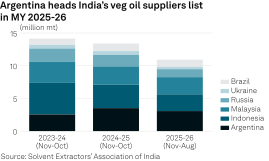
"Today, India is one of our five largest trading partners," Caucino said, adding, "Argentina is India's number one provider in edible oils. We are the number one provider of soybean oil and number two in sunflower oil."
India imports more than half of its vegetable oil requirements and relies heavily on overseas purchases of palm, soybean and sunflower oils to meet domestic demand.
In the first ten months of MY 2025-26 (November-October), India's vegetable oil imports from Argentina totaled 3.059 million metric tons, with Malaysia second at 2.62 million mt, data from the Solvent Extractors' Association of India showed in a Sept. 15 report.
The trade outlook is supported by a strong harvest in Argentina, one of the world's leading agricultural exporters. The US Department of Agriculture projects Argentina's MY 2025-26 soybean crop at 50 million mt and sunflower seed production at a record 7 million mt, boosting supplies available for processing and export.
Argentina is also expected to remain a major global supplier of vegetable oils. USDA forecasts show soybean oil exports reaching about 6.15 million metric tons in MY 2025-26, while expanding sunflower production is supporting high volumes of sunflower oil shipments.
The US Foreign Agricultural Service in an April report forecast Argentina's sunflower area to expand by approximately 14% in MY 2026-27 to 3.3 million hectares, continuing a multiyear upward trend following already strong gains in the previous two seasons.
Caucino said the growth in the edible oil trade reflects the natural complementarity between the two economies.
"India is growing so much. India has an almost unlimited demand for food," he said, adding, "Argentina is expanding its production, and there is a convergence of the national interests of Argentina and India."
The ambassador welcomed India's recent reduction in import duties on edible oils, saying lower tariffs help consumers gain access to more competitively priced imports and could create room for Argentina to further increase shipments. "Argentina could become an even more important provider," he said.
Beyond edible oils, Argentina is seeking to deepen cooperation with India in agriculture and food technology, leveraging what Caucino described as one of the world's most efficient farming sectors.
Agricultural production in Argentina is almost entirely private and highly export-oriented, he said, allowing the country to supply food to fast-growing markets while also sharing expertise across the value chain.
The two countries are exploring opportunities in a broader range of farm products, including pulses, walnuts and wine, although the ambassador said high import tariffs remain a barrier for several categories.
"There are always conversations and negotiations," he said, referring to efforts to improve market access for agricultural products.
In December 2025, the Indian Council of Agricultural Research and the National Institute of Agricultural Technology, Argentina, signed the Work Plan 2025-2027 to strengthen bilateral cooperation across natural resource management, mechanization, micro-irrigation and fertigation, digital agriculture, biosafety and phytosanitary measures, and value chain development.
Widening trade interests
The agriculture relationship is increasingly being complemented by cooperation in strategic sectors such as energy and mining.
Caucino pointed to Argentina's vast Vaca Muerta shale formation as a potential source of liquefied natural gas supplies and said Indian companies are already active in lithium projects in northern Argentina, home to some of the world's largest reserves of the battery metal.
He also noted growing interest in critical minerals, including rare earth-related opportunities, as countries seek to diversify supply chains for energy transition technologies.
Still, he said, agriculture remains the foundation of the relationship.
"The two countries enjoy a high degree of economic complementarity," Caucino said, adding, "We are in a very good stage, but we can do even more."
Platts assessed the Argentine soybean oil FOB Up River price for November loading at $1,205.49/mt Sept. 30, down 1.6% from the start of the week.
