Agriculture, Maritime & Shipping, Meat
September 30, 2026
Inventory emerges as key force in Ecuador's shrimp market

Editor:
HIGHLIGHTS
Exports remain robust
Spot demand fades
Ecuador's shrimp market remains near historically depressed prices despite increasing exports as limited spot demand and persistent margin pressure suggest that the inventory throughout the supply chain may be exerting as much influence on market behavior as underlying consumption trends.
The Platts Ecuador Shrimp Marker head-on shell-on 30-40 count was assessed at $4,190/mt on Sept. 28, recovering modestly from lows recorded in August, but still $710/mt under recent highs of $4,900/mt in March 2026.
Spot liquidity has slowed, according to traders, but exports have risen by 12.6% in the first half of 2026 year-over-year, according to the National Aquaculture Chamber in Ecuador (CNA) data.
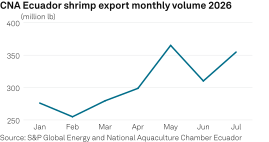
The trend of increased exports with less spot activity for small to medium-sized companies means the market may be keeping more inventory in destination markets.
One producer-exporter said large Ecuadorean groups maintain substantial frozen inventories in destination markets and that some European customers are already being supplied directly from those stocks.
Another producer said shipments into key markets continue largely uninterrupted despite widespread perceptions of weak demand.
An exporter also cited reports from a US customer still holding significant inventories available for sale, even as major Ecuadorean suppliers continue marketing products aggressively in the market.
In addition, over the years, major Ecuadorean exporters have expanded commercial operations in overseas markets through partnerships with distribution platforms, cold storage facilities, logistics and an integrated supply chain. If an increasing portion of sales is being fulfilled from inventories held in Europe or the United States, demand may remain active even while purchases in Guayaquil become less visible.
Under such a model, shrimp can continue leaving Ecuador, be positioned in destination-market warehouses, and then be sold locally before replenishment demand returns to Ecuador.
European importers described a similar situation. While some participants viewed summer consumption as reasonably healthy, buyers generally reported little urgency to replenish because product availability remained comfortable.
The divergence between strong export flows and subdued spot activity suggests that inventory positioning is becoming a more important driver of market behavior than end-demand alone.
As major Ecuadorean exporters expand integrated commercial networks and maintain stocks closer to end markets, a growing share of consumption may be supplied from inventories already held in destination countries rather than through immediate replenishment purchases from countries of origin.
In this environment, shrimp can continue moving through the supply chain and export volumes can remain robust even while spot liquidity in Ecuador appears limited.
As a result, inventory levels, replenishment cycles and the commercialization strategies of vertically integrated suppliers may be exerting as much influence on price formation as underlying consumption trends, helping explain why prices remain near historically low levels despite rising exports.
