Agriculture, Chemicals, Refined Products, Biofuels, Fuel Oil, Diesel-Gasoil
September 30, 2026
Existing methanol-capable shipping fleet could consume 2 bil gal/year of ethanol

Editor:
HIGHLIGHTS
Fleet could consume 6 mil mt/year
Maersk completes first US ethanol bunkering
Ethanol costs 43% more than conventional fuel
The existing fleet of methanol-capable ships could consume nearly 2 billion gallons/year of ethanol if operated primarily on the fuel, offering ethanol producers a potentially significant new outlet for demand as the shipping industry seeks lower-carbon alternatives, according to a US laboratory study released on Sept. 28.
The 112 to 120 methanol dual-fuel vessels currently operating could consume about 6 million mt/year of ethanol, assuming an average fuel use of 100 mt/day of conventional marine fuel and operation for 330 days/year, the National Laboratory of the Rockies said in Evaluation of Ethanol Use in Marine Shipping. The study was produced under the direction of the ethanol industry group Growth Energy.
The calculation represents a high-substitution scenario rather than a demand forecast, according to the study. Most methanol-capable vessels currently operate primarily on conventional fuel, while ethanol adoption remains constrained by fuel standards, bunkering infrastructure and the need for recognized lifecycle greenhouse-gas accounting, the study said.
However, commercial developments during 2026 indicate that ethanol has progressed beyond engine testing, the study said.
A.P. Moller - Maersk said Sept. 28 that it completed the first ship-to-ship commercial ethanol bunkering of a deep-sea container vessel in the US, fueling the Tangier Maersk with 100% domestically produced corn ethanol in an operation that could open new trade flow pathways for US agricultural commodities into the marine fuel supply chain.
Methanol fleet offers entry route
Ethanol could use much of the engine technology, handling infrastructure and operating experience already developed for methanol because the two alcohol fuels have similar characteristics, the study said.
Testing by engine manufacturers, including Everllence, WinGD and Wärtsilä, has shown that engines designed for methanol could operate on ethanol with few or no hardware changes, according to the study. Trials aboard the Laura Maersk progressed from a 10% ethanol-methanol blend in late 2025 to 50% ethanol, and subsequently to 100% denatured ethanol in early 2026, the study said.
Ethanol also has an energy-content advantage. Its lower heating value of 26.9 MJ/kg is about 35% higher than methanol's 19.9 MJ/kg, meaning less fuel and storage space are required to provide an equivalent sailing range, the study said.
A vessel requires about 1.8 times the storage volume when using ethanol instead of marine gas oil, compared with 2.4 times for methanol, the study said.
Ethanol is also less toxic and corrosive than methanol and biodegrades more rapidly if spilled into water. However, its 14 C flash point requires nitrogen blanketing, ventilation, fire detection and specialized handling, similar to that of methanol, according to the study.
Price gap narrows
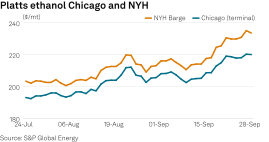
On an energy-equivalent basis, ethanol remained more expensive than very low sulfur fuel oil but cheaper than green methanol.
Ethanol was priced at $666/mt, or $1,064/mt on a VLSFO-equivalent basis, compared with VLSFO at $744/mt, in the study's June comparison. This left ethanol at a roughly 43% premium, the study said.
Green methanol was quoted at $988/mt in mid-May, equivalent to $2,033/mt after adjusting for energy content, almost twice the energy-equivalent ethanol price, according to the study. The ethanol and VLSFO figures were based on US and Houston market data, while green methanol reflected a single Rotterdam biomethanol price; thus, the comparison was a snapshot rather than a continuous benchmark, the study said.
Global marine fuel consumption was estimated at 259 million mt in 2023, after adjusting for incomplete reporting to the International Maritime Organization, illustrating the scale of the potential market, according to the study. Alternative fuels represented less than 0.5% of reported marine consumption during 2021-23, the study said.
Standards remain a barrier
The IMO's interim safety guidelines already cover ethanol use aboard appropriately designed vessels, while three ethanol pathways are under consideration within its lifecycle framework.
However, broad commercial adoption will require a marine ethanol fuel specification, the study said. ISO is developing the ISO 6583-2 standard for ethanol, with publication targeted for 2027, according to the study.
Bunkering infrastructure remains another constraint. Ports handling ethanol imports and exports already have storage capacity, but dedicated barges, ship-transfer procedures and reliable port-level supply chains will be required, the study said.
Ethanol's near-term opportunity lies in using the existing methanol fleet and infrastructure while the shipping industry evaluates a wider "two-alcohol" fuel strategy, the study said.
"Ethanol is technically viable as a marine fuel," the study said, adding that scale would depend on fuel standards, infrastructure investment and recognized lifecycle emissions values.
Platts, part of S&P Global Energy, assessed Asian fuel ethanol up $8/cubic meter week over week at $681.67/cubic meter CIF Philippines on Sept. 28, amid stronger US ethanol futures.
Ethanol futures remained volatile throughout the week, but remained above $2/gal over the September-November period. Ethanol futures for October hit $2.2/gal on Sept. 25.
