Agriculture, Energy Transition, Refined Products, Biofuels, Carbon, Vegetable Oils, Jet Fuel
September 28, 2026
India SAF policy expected within two weeks as industry eyes 2027 target

Editor:
HIGHLIGHTS
Policy announcement slated for early October
Panipat refinery to begin co-processing output
UCO collection reaches only 6% of potential
India could announce its sustainable aviation fuel policy in the first or second week of October, establishing a framework to move the country's SAF industry beyond indicative blending targets and toward commercial implementation, the head of an industry association said Sept. 28.
"We have been informed that the SAF policy could come in the first or second week of October," Rohit Kumar, secretary general of the SAF Association and the Carbon Markets Association of India, said at the India SAF Conclave in New Delhi.
The announcement would arrive as India prepares to enter the mandatory phase of the International Civil Aviation Organization's Carbon Offsetting and Reduction Scheme for International Aviation, or CORSIA, from Jan. 1, 2027.
India has established indicative SAF blending targets for international flights of 1% in 2027, 2% in 2028 and 5% by 2030. The government said in July that the draft policy was in its final stages, with inter-ministerial consultations and stakeholder engagement underway.
Panipat could support the initial target
Alok Sharma, vice president of the SAF Association and former director of research and development at Indian Oil Corporation, said India was moving from policy design toward practical deployment but must avoid treating SAF as a single fuel or technology.
"SAF should not be viewed as a single technology," Alok Sharma said. Instead, India should develop a portfolio of pathways with different feedstock requirements, technology maturity, production economics, lifecycle performance and scalability.
India's earlier experience with compressed biogas and second-generation ethanol demonstrated that new biofuel industries can encounter initial problems before technology, supply chains and commercial models stabilize, he said.
Alok Sharma identified sustainable feedstock, scalable technology and predictable airline demand as three fundamental requirements for the emerging industry. In a broader framework, he said infrastructure and strong investment signals were also essential.
Near-term supply is expected to be supported by refinery co-processing. Alok Sharma said Indian Oil Corporation was preparing to begin co-processing SAF at its Panipat refinery and that the planned output could support India's initial 1% requirement.
The Panipat refinery became India's first facility certified to produce SAF through UCO co-processing.
India amended its Aviation Turbine Fuel Control Order to include SAF-blended aviation fuel and recognize approved refinery co-processing and blending routes. The change was intended to help operationalize the country's blending targets.
Feedstock availability versus accessibility
India possesses significant theoretical feedstock potential, but only a fraction is currently available through organized and traceable supply chains.
Annual edible-oil consumption of around 29 million-30 million mt could generate an estimated 1.8 million-2.6 million mt of UCO, according to the SAF Association. However, only around 110,000-156,000 mt, or about 6%, enters formal collection channels.
Alok Sharma said UCO could support early HEFA and co-processing volumes, but would become increasingly constrained once blending rises beyond the initial stages. India would therefore need to develop alcohol-to-jet and other pathways alongside waste-oil processing.
Certification, demand certainty remain unresolved
Certification compliance, chain-of-custody documentation, mass-balance systems and lifecycle emissions accounting must be established before Indian SAF can qualify under CORSIA or access premium international markets, Alok Sharma said.
Long-term airline offtake would also be needed to give producers sufficient revenue certainty to finance projects.
He identified viability-gap funding, production-linked incentives, corporate social responsibility funding, concessional and green finance, and carbon-market revenue as potential means of supporting early projects.
These concerns align with the government's earlier identification of high capital and operating costs, expensive feedstock, fragmented collection systems, limited long-term offtake and inadequate fiscal support as obstacles to domestic production.
Early SAF markets in the EU and US have relied on combinations of mandates, penalties and production incentives. India would similarly require demand-side obligations and supply-side support if it wants to progress from the 1% requirement to the more demanding 5% target, Alok Sharma said.
The SAF Association estimates that India could eventually develop around 40 million mt/year of SAF production potential by 2050, equivalent to roughly 10% of projected global capacity. However, realizing that potential would depend on converting available resources into feedstock that is collectible, certified and commercially deliverable.
The immediate challenge, Alok Sharma said, is to ensure that the forthcoming policy connects feedstock, technology and airline demand rather than establishing blending percentages without the commercial mechanisms required to support them.
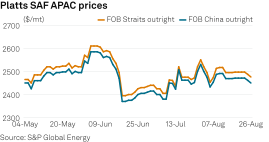
Platts, part of S&P Global Energy, assessed Sustainable Aviation Fuel HEFA-SPK FOB Straits, reflecting CORSIA-certified cargoes, at $2,440/mt on Sept. 28, unchanged from Sept. 25,
