Agriculture, Refined Products, Biofuels, Jet Fuel, Vegetable Oils
September 16, 2026
Hong Kong plan sets 1%-3% SAF target for departing flights by 2030
By Samyak Pandey and Daniel Workman
Editor:
HIGHLIGHTS
EcoCeres plans 450,000 mt/year Dongguan hub
Feedstock prices hit three-year highs in 2025
Hong Kong has set a target to source between 1% and 3% of the fuel used by flights departing from Hong Kong International Airport from sustainable aviation fuel by 2030, anchoring a broader push to build a regionally competitive supply chain across the Guangdong-Hong Kong-Macao Greater Bay Area. The policy is gaining commercial weight as Hong Kong-based EcoCeres advances plans for a 450,000 metric ton/year production hub in Dongguan that could affect jet fuel trade flows across southern China.
The SAF targets are contained in Hong Kong's First Five-Year Plan for Economic and Social Development of the Hong Kong Special Administrative Region (2026-30), released by the Hong Kong SAR government on Sept. 16. The plan commits Hong Kong to constructing an SAF blending facility and leveraging a production base in Dongguan to develop an integrated Greater Bay Area value chain. The Dongguan facility is expected to begin operating by 2030, according to the government document.
EcoCeres anchor
Hong Kong-based SAF producer EcoCeres signed an investment letter of intent with the Dongguan Municipal People's Government in May to establish what it described as the first complete SAF supply chain in the Greater Bay Area, with the proposed facility expected to produce about 450,000 metric ton/year of SAF and hydrotreated vegetable oil.
The integrated model spans waste-based feedstock collection across the Greater Bay Area, refining and production in Dongguan, and blending, refueling, and trading operations in Hong Kong — directly mirroring the infrastructure framework outlined in the government's five-year plan.
The Dongguan hub would add to EcoCeres' existing combined capacity of 770,000 mt/year across facilities in Jiangsu, China, and Johor, Malaysia, where the company's 420,000 mt/year SAF plant was recently commissioned and is running at about 95% of nameplate capacity.
EcoCeres has framed the project as a matter of energy security, highlighting that geopolitical disruptions, like restrictions in the Strait of Hormuz, have quickly depleted European jet fuel reserves and exposed vulnerabilities in aviation fuel supply chains.
EcoCeres co-Chairman James Tam said scaling SAF would reduce supply-chain vulnerabilities only if systems were designed for resilience from the outset, with production, refining, blending and fuel delivery located close to demand.
EcoCeres is currently focused on Europe, which produces over 50% of its SAF. CEO Matti Lievonen said that US imports to Asia are restricted under current policies. In the near term, sales in Asia are aimed at early 1% mandates in Singapore and South Korea, as discussed during the Johor facility inauguration.
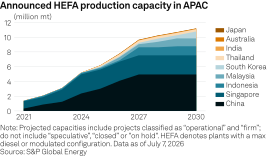
Hong Kong's 1%-3% SAF consumption ratio target for 2030 is modest relative to mandates being implemented in Europe, where the EU's ReFuelEU Aviation regulation requires 2% SAF blending at EU airports from 2025, rising to 6% by 2030 with a 1.2% e-SAF sub-mandate.
However, the plan signals an intent to build supply-side infrastructure ahead of any future regulatory tightening, which could position Hong Kong as a SAF trading and blending hub for the broader Asia-Pacific region.
A Hong Kong-based asset manager plans to launch a dedicated SAF fund using a government-administered structure that combines a private fund with an exchange-traded fund. This aims to broaden financing options for SAF projects beyond traditional bank lending. In 2025, the firm handled about $4 billion in transactions across 48 international markets.
Feedstock constraints
Feedstock availability remains a critical constraint on the Greater Bay Area SAF ambitions.
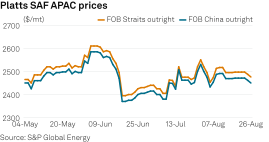
Major Asian feedstocks, including used cooking oil and processed fatty acid distillate, reached three-year price highs in 2025, driven by regional export restrictions in Indonesia and China and competing demand from European buyers under the ReFuelEU Aviation mandate.
EcoCeres' proposed Dongguan facility is expected to draw on Greater Bay Area waste oil networks to help stabilize supply. The company has already launched a closed-loop urban waste oil system with the Suzhou Municipal Government as a potential model for feedstock collection.
Uzbekistan has also emerged as a potential feedstock frontier, with Hong Kong-based Henderson Land Group in discussions with Tashkent to develop SAF production using drought-resistant oilseed crops on up to 1.5 million hectares of underutilized land in the Republic of Karakalpakstan and the Bukhara and Navoi regions. EcoCeres presented its technology at those talks, with the Johor facility's European offtake model cited as a template for securing stable demand channels.
Zhuhai Hongcai Fine Chemical separately received approval in May for a 400,000 mt/year SAF plant with a total investment of Yuan 1.9 billion. Construction is scheduled to run from October 2026 to October 2028, adding further supply-side momentum to the Greater Bay Area's SAF industry.
Platts, part of S&P Global Energy, assessed Sustainable Aviation Fuel HEFA-SPK FOB China, reflecting ISCC-EU certified cargoes, at $2,489/mt on Sept. 15, unchanged from Sept. 14, considering adjacent market information and maintaining the spread between SAF FOB Straits and FOB China cargoes at $60/mt.
