Maritime & Shipping, Agriculture, Grains
September 16, 2026
Egypt wheat imports slow as Black Sea disruptions drive up costs

Editor:
HIGHLIGHTS
Freight costs surge amid Black Sea risks
Buyers halt purchases, await price drops
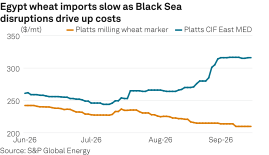
Egypt 12.5% wheat price jumps $70 since July
Egypt, the world's largest wheat importer, is grappling with rising freight costs and supply disruptions in the Black Sea region, a critical source of its wheat. Market participants say Egypt remains highly dependent on Black Sea wheat, with little appetite for alternatives, even as freight rates surge and sourcing routes shift.
Most importers have withdrawn from the market amid ongoing Black Sea disruptions, halting purchases for several months. Only a handful of companies are buying spot Russian wheat, mainly on a CIF basis from sellers with vessels ready to load and sail, a trend that intensified after escalations in the Black Sea in July.
Since July, Egypt has imported just 1 million metric tons of wheat, half the volume of the same period last year, according to LATT Shipping & Trading Co. Despite this slow start, market participants expect annual imports to reach 12 million mt, with domestic consumption steady at 20.5 million mt. All recent imports have been made by private firms, as the state has relied on local purchases and comfortable stock levels. By contrast, the state imported at least 550,000 mt during the same period last year.
Over the past several weeks, Egypt bought five or six handy cargoes in the $315-$320/mt range, according to multiple market participants. "The market is slower," one trader said, noting that buyers who purchased earlier at $275-$290/mt are now holding back, and some are offering part cargoes at $300-305/mt.
Russia has been routing most of its wheat via the Baltic due to strikes at its deep-sea ports. However, for most Egyptian buyers, Baltic wheat is not a viable replacement because of the prohibitive distance and cost. "I see the spot Baltic price, but overall it will take a month to arrive in Egypt," one buyer said. Freight rates for shipments from the Baltics to Egypt have climbed to $50/mt, up from $40 previously. Insurance costs have also soared, rising by 40% per day as shipowners avoid deep-sea ports.
Platts' wheat benchmark, the Milling Wheat Marker, fell to a six-year low as of Sept. 15, as wary FOB buyers and shipowners steered clear of deep-sea ports. Meanwhile, the CIF East Med basis Egypt 12.5% wheat was assessed at $316/mt Sept. 15, up from $246/mt in July.
Some buyers have preferred smaller coaster shipments from Ukraine or Handysize vessels partially loaded from Danube-area ports such as Galati. Ukrainian handy cargoes via Constanța were at $310/mt for 11.5% protein, while the coasters market saw bids at $301/mt against offers at $307/mt.
"Coasters' flow is very small; at some point, they will have to buy a lot more," a Ukrainian seller said of Egypt's weak demand.
Romanian and Bulgarian wheat is not favored by the buyers, with prices at Constanța considered too high.
"October will be the same [price level] or will also increase, I believe," said a local buyer, pointing to continued high prices ahead.
Despite weak demand, buyers expect activity to pick up as schools reopen in early September. Locally, ex-warehouse prices are 16,500 Egyptian pounds for Russian 12.5% wheat and 16,000 pounds for Ukrainian 11.5% wheat, with discharge and storage expenses adding 500-600 pounds. Flour prices have risen by $49/mt since July, partly due to competition from Turkey, which is enjoying a record local crop.
Most Egyptian buyers are not exploring origins beyond the Black Sea, anticipating a sharp drop in prices if peace negotiations materialize, and are instead buying locally to meet industrial needs. At the Platts Cairo Grains & Freight Forum on Sept. 9, sentiment was pessimistic: 57% of 30 respondents expect Black Sea export disruptions to continue into Q1 2027, 33% expect an end between October and December, and the remainder anticipate resolution by the end of September.
When Russia banned wheat exports in 2010, buyers sought alternatives. "Egypt can adapt and will likely do the same," said another local buyer, suggesting Egypt could again shift its sourcing strategy if necessary.
